
Discounts on Russia’s Urals blend oil fall to zero
Russia is poised to reap a major financial windfall from rising global oil prices due to the war in the Gulf, after the discounts on the Urals blend of oil fell to zero in the last week
Robin Brooks, senior fellow at the Brookings Institution warned in a blog that the shift in energy markets could undermine Western efforts to constrain Moscow’s war economy and give the federal budget, which was facing a very large deficit this year, a major fillip.
Brooks said the discount on Russia’s Urals crude relative to the global Brent benchmark had effectively “disappeared,” reversing the steep price gap of up to $20 that appeared after the Trump administration imposed new oil sanctions on Russia last year, targeting its two biggest companies. Pressure was increased after the US and Europe also began targeting Russia’s shadow fleet tanker more aggressively.
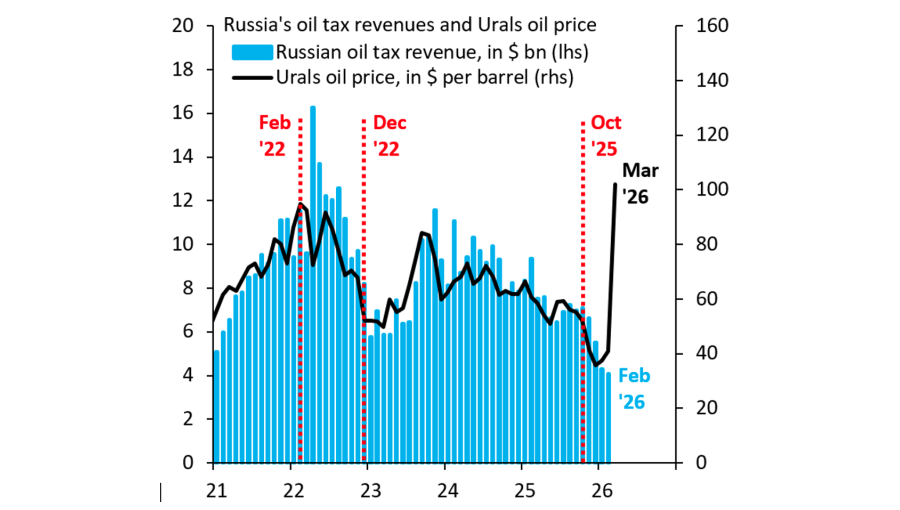
“The discount on Urals crude versus Brent has shrunk to zero,” Brooks said. “Russia's windfall now exceeds anything we saw in 2022 after the Ukraine invasion. Recent US sanctions waivers have destigmatized Russian oil and give Putin a huge windfall. Terrible for Ukraine.”
The shift has been driven largely by disruption in global oil flows linked to hostilities in the Gulf that resulted in “Wild Monday" last week. Markets were suffering from whiplash after oil prices rose to $120 per barrel on March 9 as the global energy crisis gathered momentum, only to fall back to $85 again by the end of the day after Trump said the war was “pretty much over.” Prices were also helped by the International Energy Agency (IEA) decision to make the largest release of reserves in history a few days later.
However, prices quickly returned to over $100 per barrel after Iran hit three tankers in the Gulf a few days later, underscoring the fact that Iran remains in control of the Straits. Moreover, since then the pattern of Iranian strikes against tankers and infrastructure has expanded, as Iran signals it could easily escalate and bring production in the entire region to halt.
Brooks argued that the threat of a closure of the strategic waterway had rapidly altered market dynamics. Whereas, in the early stage of the war, analysts assumed that it would end quickly. Those hopes are rapidly fading and the assumption of a longer conflict and oil prices reaching $150 or more is becoming mainstream.
“Russia is by far the biggest winner from fighting in the Gulf,” Brooks said. “That’s because the closure of the Strait of Hormuz is flipping the global oil market from surplus to deficit in a very short period.”
As supply tightens, buyers are increasingly turning back to Russian crude despite sanctions and political pressure. “Russian oil has gone from global pariah to now being extremely sought after,” Brooks said.
He warned that if the situation persists, Moscow could secure a windfall similar to the surge in revenues recorded in 2022, when high prices helped offset the impact of Western sanctions. In that year, Russia earned an all-time record current account surplus of $225bn – twice as large as the previous record set in 2021.
“If this is allowed to persist, Russia will reap another 2022-style windfall,” Brooks said. “That windfall was so big that it — in one year — made up for all of Russia’s official FX reserves frozen by the West.”
Data on Russian oil tax revenues suggests the fiscal impact may already be building. “You don’t need much imagination to see that tax revenues will rise very sharply in March and likely rival the windfall of 2022,” Brooks said.
He also criticised divisions within the European Union over further sanctions measures. “The rise in oil prices means the maritime services ban won’t be included in the twentieth sanctions package the EU plans to finally roll out next week,” Brooks said, adding: “Greece’s shipping oligarchs are the winners in the stand-off over the services ban, even as they now make even more money in a high global oil price environment. That’s a scandal and indicative of a governance crisis in the EU.”
As bne IntelliNews reported, about a fifth of Russia’s shadow fleet are actually EU-flagged and registered Greek tankers. Moreover, more than half of the tankers bought by Russia to expand its fleet were sold to them by Greek shipping companies.
Brooks said political pressure in Washington could further weaken sanctions enforcement, pointing to a recent 30-day waiver allowing India to continue purchasing Russian oil. “If oil prices spike again, perhaps because Iran steps up its attacks on oil tankers in the Strait of Hormuz, pressure to lift Russia sanctions will build further,” he said. “Putin is winning across many fronts at the moment.”
Follow us online