
France pays more than Germany for power despite its nuclear fleet as Europe's gas crisis bites

IntelliNews summary:
- Switzerland, northern Italy, Serbia and Portugal paid more than France on November 29; prices rose again across Europe for November 30.
- French nuclear output fell to 25.9 TWh in September and 27.5 TWh in October, from 29.0 TWh and 30.3 TWh a year earlier, while gas-fired generation is up 21% this year.
- EU gas stores were 67.2% full on November 25, a record low for the date; Germany's were 54.5% full.
- Norway's reservoirs were 66.0% full against a median of 78.6%, and Poland imported about 8% of its power in January-October.
____________________
France is paying more for power than Germany despite Europe's largest nuclear fleet, as idle reactors and a gas crisis push prices above €200 per megawatt hour (MWh) across much of Europe.
French power for delivery on November 29 averaged €203.79 per MWh in the EPEX Spot day-ahead auction, against €190.01 in Germany and €113.38 in Poland, according to Energy-Charts data compiled by Germany's Fraunhofer ISE. Switzerland, at €222.18, northern Italy, at €214.04, Serbia and Portugal were dearer still. Prices for November 30 climbed again, to €241.39 in France, €252.27 in Germany and €264.80 in Poland. German day-ahead power averaged about €102 per MWh in November 2025.
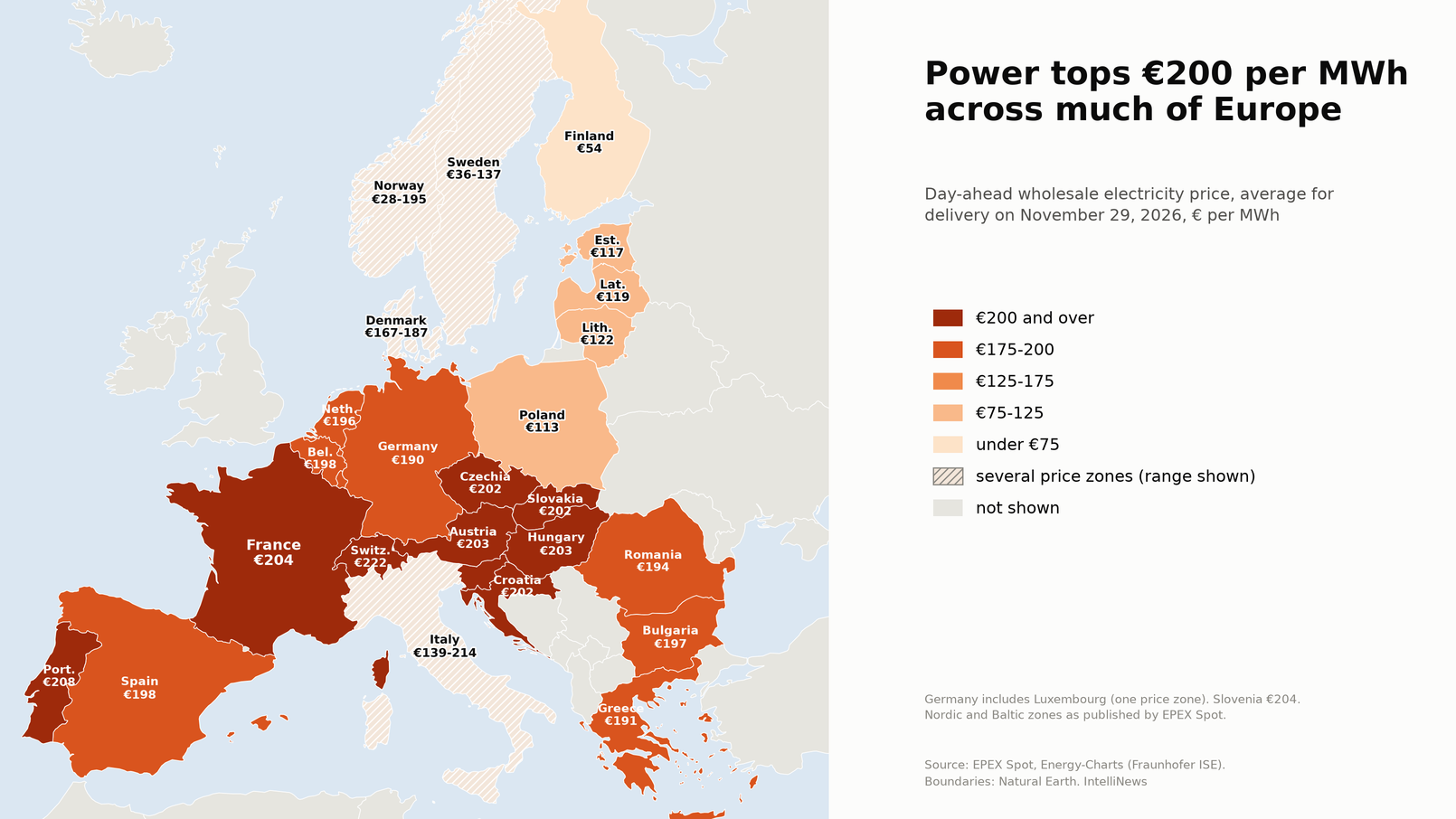
Day-ahead wholesale electricity prices by bidding zone for delivery on November 29, 2026, € per MWh. Source: EPEX Spot, Energy-Charts (Fraunhofer ISE). Boundaries: Natural Earth. IntelliNews
"France currently has the highest electricity prices in Europe - despite its nuclear power plants," the German renewable energy news service IWR said in a post on X, adding that reactors with around 20,000 MW of the fleet's 63 GW were offline "not even in winter" generating. Grid data on its France generation page show French reactors producing between 45.4 GW and 46.6 GW in the early hours of November 29, against installed nuclear capacity of 61.37 GW, leaving roughly a quarter of the fleet idle.
France is normally Europe's cheap-power exporter, its reactors pinning prices below its neighbours' through the winter. This year the coupled European market is setting prices off gas, and France has less of its own low-cost output to lean on. French nuclear generation from January 1 to November 28 came to 325.24 terawatt hours (TWh), down from 329.37 TWh a year earlier, with the shortfall concentrated in the autumn: 25.9 TWh in September against 29.0 TWh in 2025, and 27.5 TWh in October against 30.3 TWh. Hydropower, excluding pumped storage, fell 8.9% to 41.71 TWh after a dry year, and gas-fired generation rose 21% to 16.72 TWh, according to the same ENTSO-E data.
Gas sets the price
Gas plants usually set the marginal price of electricity in winter, and Europe is short of gas. The Dutch TTF benchmark broke €100 per MWh on October 28 for the first time since December 2022, after the closure of the Strait of Hormuz cut LNG shipments from the Gulf, one of the chokepoints that have reshaped energy flows this year. Moody's said in November that gas for 2027 delivery had doubled on the TTF hub since March, and that the jump in power prices had been sharpest where gas sets the price most often.
EU gas storage fell to a record low for mid-November on November 15, with withdrawals running five times faster than a year earlier, and stood at 67.2% full on November 25, the lowest for the date since records began in 2011 and down from 77.5% a year earlier, according to Gas Infrastructure Europe. Net withdrawals reached 7.11 TWh that day, the largest of the season, as temperatures fell below freezing in central Europe. Held at that pace, stores would be down to 30% full in the second half of January. Germany's sites, the EU's largest, were 54.5% full, a record low for the date, as the country slips deeper into a gas crisis that began when its stores failed to refill over the summer.
How quickly that feeds through to electricity was clear on November 9, when wind output collapsed across northwest Europe and German and French prices spiked above €600 per MWh in the early evening. The French daily average of €334.12 per MWh was the highest since December 2022.
"These kind of high prices can not only be explained by elevated gas prices but show there is a certain scarcity in the system," Alessandro Armenia, an energy analyst at Kpler, told Bloomberg at the time, adding that similar episodes were likely to recur at least until mid-January.
The forecasts get worse as the weather turns colder. A study by the energy analysis firm Montel for the Greens in the Bundestag, reported by Reuters on November 19, modelled an average German wholesale price of just over €166 per MWh between October and February, adding about €16bn to the country's power bill. German storage operators' association INES has warned that in an extremely cold winter like that of 2010, German gas demand could go unmet in January, February and March 2027, with shortfalls of up to 6.6 TWh in a month.
Germany turns to its neighbours
Germany shut its last three reactors on April 15, 2023, and has since leaned on imports. It had been a net exporter of electricity for years before the nuclear exit, but bought more power from abroad than it sold in 2023 and 2024. Windier weather has narrowed the gap this year: imports fell 8.7% y/y to 34.5 TWh in the first half of 2026 while exports rose 14.9% to 33.9 TWh, cutting the net import surplus to 0.6 TWh from 8.3 TWh a year earlier, the federal statistics office Destatis said in September. That balance swings back to imports whenever the wind drops, as it did on November 9.
Norway's batteries run low
Norway's hydropower reservoirs act as a battery for northern Europe, sending power south through interconnectors to Germany, the Netherlands, Denmark and Britain. They are unusually empty. Norwegian reservoirs were 66.0% full in the week to November 22, against a median of 78.6% for the time of year, according to the energy regulator NVE. In the south-western price zone, which hosts most of the export cables, they were 50.8% full, below the previous lowest level for that week of 57.3%. Southern Norway is now pricing power like the continent: €195.41 per MWh in the south-west and €186.04 around Oslo on November 29, against €27.58 in the north of the country, where reservoirs are 90% full but grid links south are limited.
Norway is also Germany's largest gas supplier, and its exports have dipped. Equinor's Visund platform will stay shut until January 1 after an electrical fire, and output has been cut at the Troll and Asgard fields, taking Norwegian pipeline exports to 285.7mn cubic metres per day on November 20 from 335mn a day earlier.
Poland leans on coal
Poland, at the other end of the price map on November 29, still generates about half of its electricity from coal, a share that has edged up this year as wind output fell. Solar capacity reached 28,231 MW on September 1 and wind 11,794 MW on October 1, but battery storage stood at just 1.3 GW. In October, hard coal supplied 44.3% of output and lignite 20.9%, with coal-fired generation up 8.5% y/y and lignite 17.7%, while gas-fired output fell 30.5%, grid operator PSE said.
Poland generated 130.26 TWh in January-October, up 6.4% y/y, against domestic consumption of 141.7 TWh, leaving it to import the difference of about 11.4 TWh, or 8% of demand, according to PSE figures. October was the exception, with output of 14.9 TWh running ahead of consumption of 14.5 TWh, as coal plants ran harder. That cushion gave Poland the cheapest power in central Europe on November 29, but its day-ahead price more than doubled the next day to the highest of the big markets, as the cold spread east.
Follow us online