

How effective are Ukraine’s drone strikes at destroying Russian refinery production?
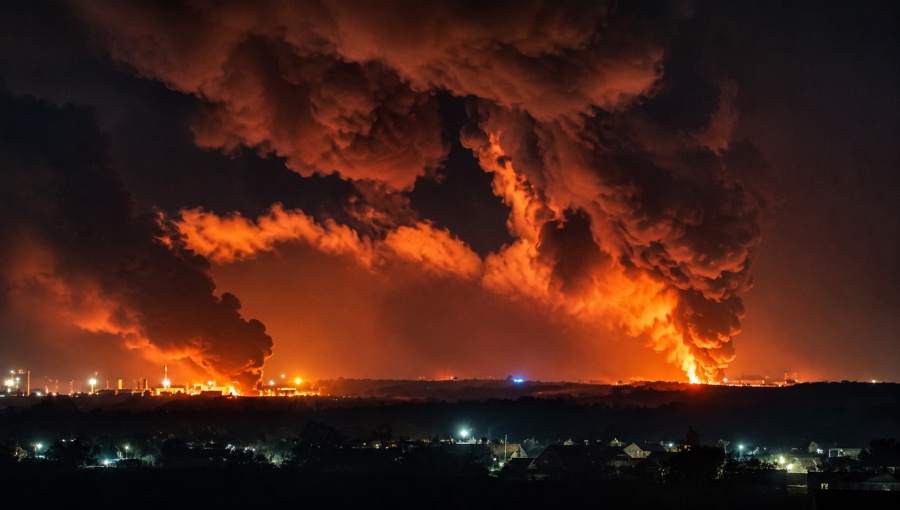
Wrangling over how effective Ukraine’s drone strikes of Russian refineries has broken out amidst conflicting reports of just how much damage is being done to Russia’s key oil infrastructure.
Since last summer, Ukraine has stepped up its campaign against Russia’s cash cow industry in an effort to cut the Kremlin off from one of its main sources of income. This year Ukraine is firing more drones at Russia than Russia fires at Ukraine for the first time ever.
As the campaign reached a crescendo last month with sustained attacks on Russia’s Baltic Sea oil terminals at Primorsk and Ust-Luga that handle a fifth of Russia’s oil traffic, Reuters reported that Russia’s oil exports were down by 40%.
However, later reports based on government figures said that while production at refineries was down by some 10-15%, exports had been largely unaffected and the damage at the two ports was largely superficial and had been repaired.
Ukraine has ramped up its drone production and is on course to make some 7mn drones this year, according to Ukrainian President Volodymyr Zelenskiy. At the same time it has introduced a new class of long-range drones that can reach deep into Russia’s interior to hit the far flung oil refineries scattered across the country. At issue is to fly the thousands of kilometres needed to reach their targets, the payload of the drones is restricted by fuel consumption concerns. Consequently, while the drones can do a lot of damage, typically causing major fires, the explosive package is not enough to destroy a refinery. As one analyst put it: “There is a big difference between hitting a refinery six times with 50kg of explosive and hitting it once with 300kg.”
Conflicting reports
On May 20 Reuters reported “Exclusive: Oil refining at a standstill in central Russia after Ukrainian drone strikes, sources say,” that key refineries at Kirishi, Moscow, Nizhny Novgorod, Ryazan, Yaroslavl, that produce some 30% of Russian petrol and a quarter of its diesel, had all gone offline.
“Virtually all major oil refineries in central Russia have been forced to halt or scale back fuel output following Ukrainian drone attacks in recent days, according to official data and sources,” Reuters reported. “Moscow has already introduced a gasoline exports ban starting from April until the end of July.”
The combined capacity of refineries that have fully or partially halted operations exceeds 83mn metric tonnes per year, or around 238,000 tonnes per day. That accounts for around one quarter of Russia's total refining capacity, according to Reuters.
However, a follow up report by Russian Forbes reported that the impact of the attacks was a lot less damaging.
“Such losses during the peak fuel season could have been a serious blow to the country's economy, but experts interviewed by Forbes do not believe the damage is that significant. Forbes investigated why gasoline shortages occur on the exchange but not at gas stations, how long it typically takes to restore damaged refineries, and how Belarus can help,” Forbes reported.
There is no doubt that the attacks have reduced the throughput at Russian refineries and as IntelliNews reported, Russia has been forced to turn to Belarus to top up supplies to meet domestic demand. But the imports from Belarus are limited.
Russia's domestic consumption of gasoline runs at over 100,000 tonnes per day, which makes the 17,000 tonnes bought from Belarus in early May a significant share, but not a crisis. "Volumes remain small compared with Russia's daily consumption of over 100,000 tonnes," noted energy expert Sergei Vakulenko. “This is not yet a crisis of supply, but it is a signal of the strain on the system.”
On May 21, the Ministry of Energy said that the domestic motor fuel market in Russia remains stable, and the industry is prepared for seasonal demand growth.
"Currently, the domestic market is sufficiently supplied with light petroleum product reserves, the logistics infrastructure is functioning reliably, and there have been no disruptions in regional supply," the Ministry of Energy stated, without specifying reserve volumes, Forbes reports.
Following a meeting on the fuel market on May 26, Deputy Prime Minister Alexander Novak said that the government's priority remains "the reliable and uninterrupted supply of fuel to domestic consumers in the required quantities" and the need to develop additional response measures in the event of disruptions.
Domestic fuel costs have risen, but only modestly, suggesting the impact of the drone strikes is limited. From May 20 to 26, prices for AI-92 gasoline on the St. Petersburg Exchange rose by 2%, from RUB66,136 to RUB67,443 per tonne, and for AI-95, by 3%, from RUB72,833 to RUB74,954 per ton.
Rather than losing a quarter of its production, expert calculations suggest the volume of unsatisfied orders on May 26 was 41,000 tonnes for AI-92 and 34,000 tonnes for AI-95. And even those shortages could be merely market demand triggered not by physical shortages, but from traders anticipating a surge in demand.
Another factor affecting demand calculation is the possibility that the main suppliers such as Lukoil, Rosneft, and Gazpromneft have stopped selling fuel on the exchange and are instead supplying it to their own gas stations.
Another point of contention is that Reuters’ calculation uses the refineries entire production capacity as a basis for its projection, but experts interviewed by Forbes say that is an exaggeration as even if a refinery is hit, most are still continuing to work albeit at reduced levels. Some facilities can be repaired in a matter of days, while others will require more time, experts say.
"Experience shows that in previous years, there were no attacks on Russian refineries that would have caused damage requiring lengthy repairs," Stanislav Mitrakhovich, an expert at the Financial University and the National Energy Security Fund told Forbes. "I believe that even now, there's no way to disable large refining facilities for long periods, although attacks can reduce production for a short period."
The bottom line is that Russia is not yet suffering from a fuel crisis and any shortfall caused by Ukraine’s attacks can be covered by imports from Belarus for now. Russia consumes over 3mn tonnes of gasoline monthly, according to Maxim Shevyrenkov, head of the Commodity Market Analysis Center at the Institute of Energy and Finance. Belarus is capable of shipping over 200,000 tonnes of gasoline per month, and Belarusian petroleum products are imported into Russia duty-free, Shevyrenkov points out.
A similar investigation by independent Russian outlet Meduza came to similar conclusions: Ukrainian drones are being fired more frequently and penetrating deeper into Russian territory, but Russia’s refineries’ production bounces back quickly.
The main conclusions of Meduza’s investigation included:
- The frequency and depth of UAF strikes on Russian territory have risen substantially since mid-2025 and have held at a stable level — more than 30 verified attacks per month.
- There has been no surge in strike intensity in 2026, despite a number of high-profile attacks on Moscow, Tuapse, Perm, and other major cities.
- Strikes on oil infrastructure represent approximately one-third of Ukraine’s long-range campaign in 2026, consistent with the second half of 2025. Ukraine’s military has likely learned in recent months to target the refinery equipment that is particularly difficult to repair.
- The average range of UAF strikes against targets deep inside Russia has increased recently: in May, the figure doubled y/y, from 400 kilometers (249 miles) to 800 kilometers (497 miles).
- This may indicate that Russia’s air defences are being depleted, but we don’t yet have enough data to verify.
- The UAF’s long-range campaign was most effective in its first phase, in late summer and early fall of 2025, when Russian refineries suffered their greatest capacity losses.
- By mid-fall of that same year, oil industry operators had adapted — judging by available data — to the more intensive strikes on their facilities, and had learned to repair damaged equipment quickly or draw on spare capacity.
Follow us online