
Japan's oil hub promises much but delivers little for Southeast Asia

Japan and the IEA agreed in Manila on November 17 to build an Asian oil security hub in Tokyo, but nothing in the deal obliges anyone to share a barrel.
On the same day, leaders of the Asia Zero Emission Community (AZEC), which groups Japan, Australia and nine Southeast Asian states, welcomed an Asia Oil Security Task Force that their joint statement calls "a voluntary body". The hub itself will be run from Tokyo by the state-owned Japan Organization for Metals and Energy Security (JOGMEC) and will offer advice on building stockholding systems, shared market analysis and work on emergency co-operation. What it will not do is impose the duty that gives the International Energy Agency its weight: members that import oil must hold at least 90 days of net imports and release them together when called.
That missing duty matters because Asia's buffers are wildly uneven. Japan's reserves covered 204 days of domestic consumption on August 21, on industry ministry figures. Indonesia, Southeast Asia's biggest economy and fuel consumer, holds operational fuel reserves of about 23 days, Deputy Energy Minister Yuliot Tanjung said on November 9, according to Kontan. The new bodies sit on top of that gap; they do not close it.
Months against weeks
Even after this year's record emergency release, the IEA's own monthly data put Japan at 176 days of net imports in August, down from 201 days in February, the last month before the Iran war. South Korea's cover rose to 221 days from 202 over the same months. Australia remains the region's IEA laggard at 52 days, well short of the 90-day rule.
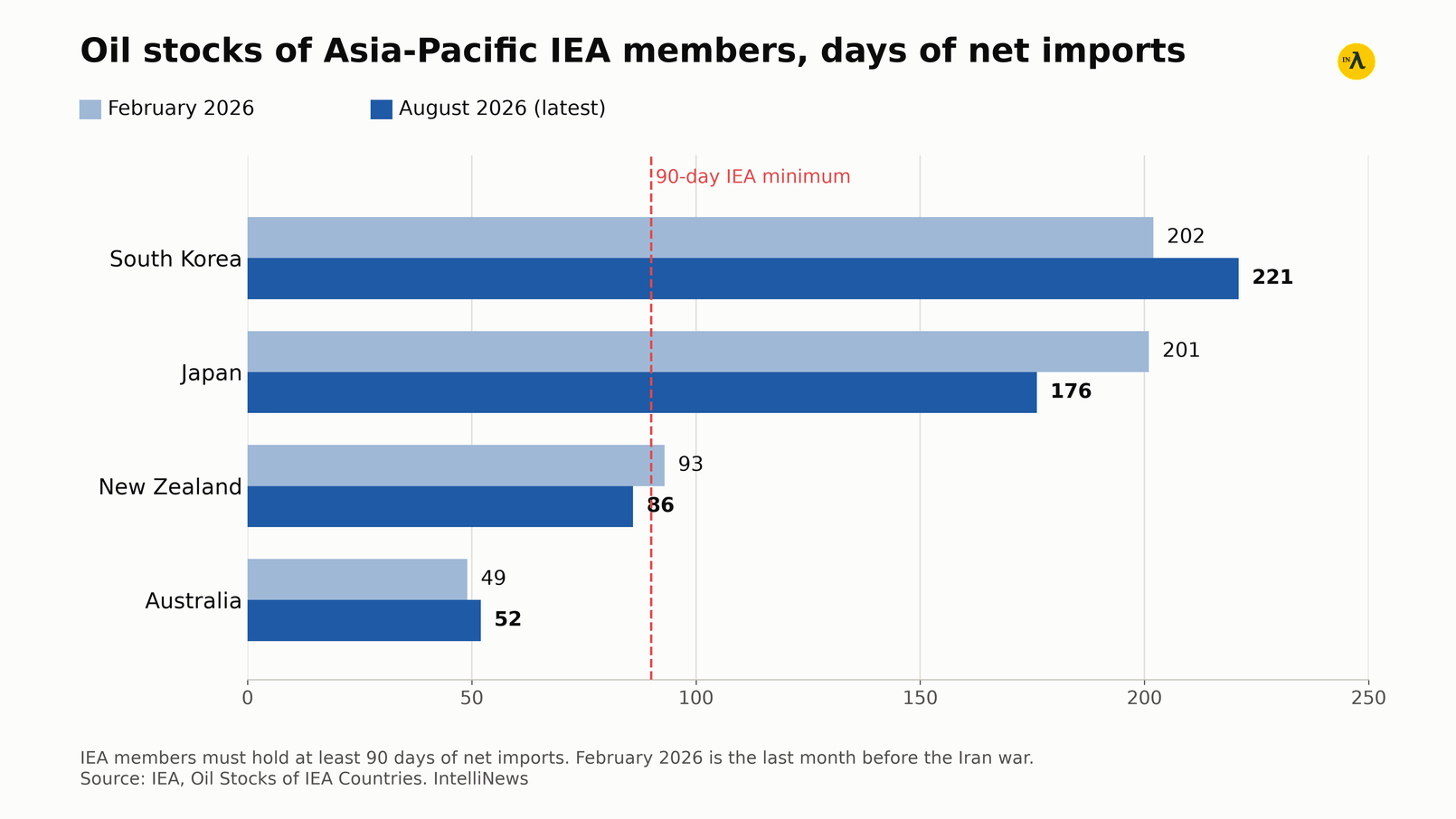
Oil stocks of the four Asia-Pacific IEA members, days of net imports, February and August 2026. Source: IEA, Oil Stocks of IEA Countries. IntelliNews
Outside the IEA club the numbers are thinner and counted differently. The Philippines had 50.33 days of total petroleum supply on November 6, according to its Department of Energy. Vietnam's crude and product stocks amount to 33-36 days of net imports, the Ministry of Industry and Trade said in October, against a goal of roughly three months by 2030. China, the world's largest crude importer, publishes no inventory figures at all, and it is not an AZEC partner.
Southeast Asia's exposure is structural. Around 98% of the crude the Philippines imports comes from the Middle East, and Japan's Agency for Natural Resources and Energy estimates that some 90% of the crude moving through the Strait of Hormuz heads to Asia.
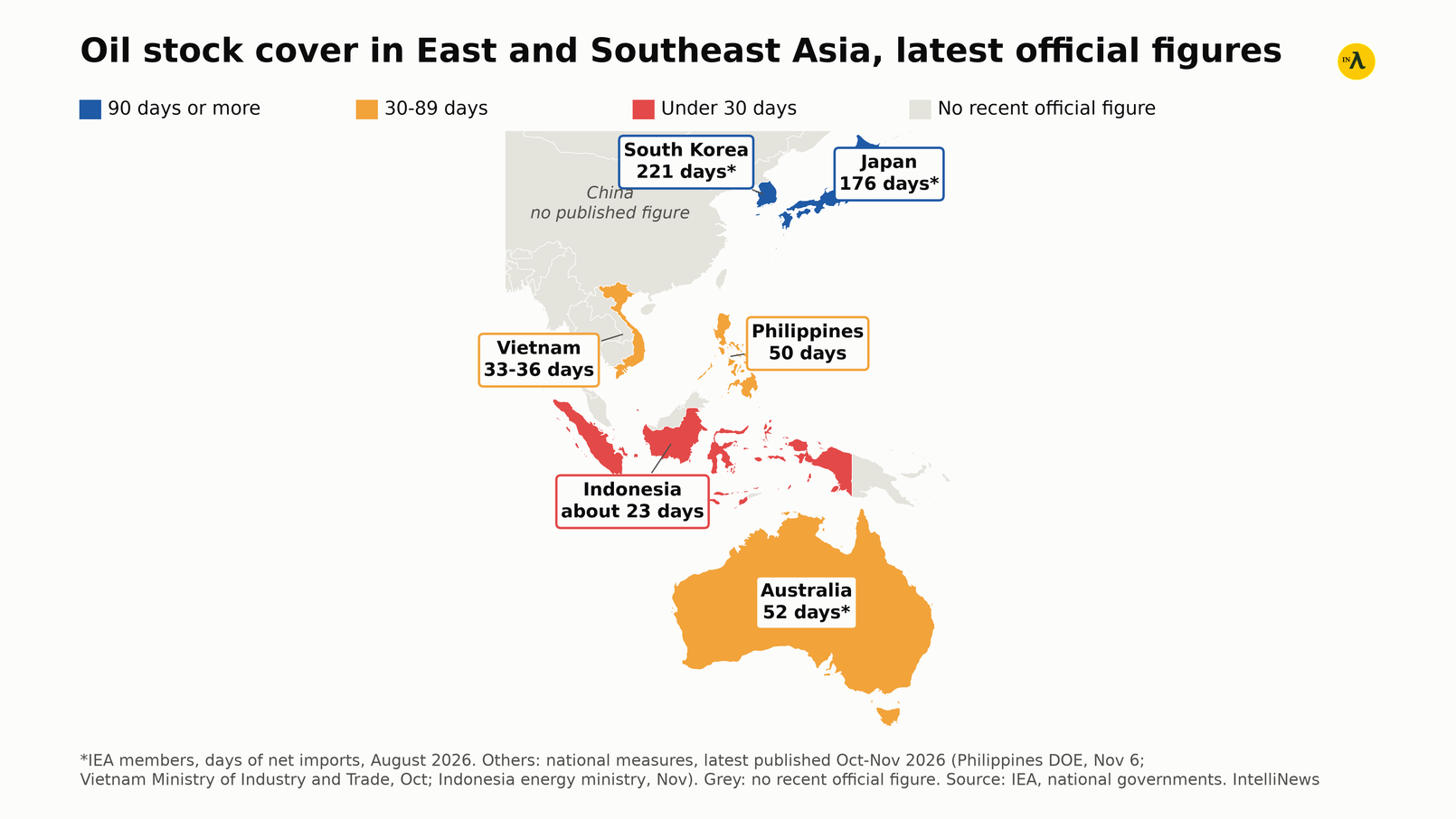
Latest official oil stock cover, days. IEA members on the IEA measure (days of net imports, August 2026); the Philippines, Vietnam and Indonesia on their governments' own measures, published October-November 2026. Grey: no recent official figure. Source: IEA, national governments. IntelliNews
Tanks, tickets and Gulf crude
Tokyo is filling the gap one partner at a time. It signed a memorandum on November 17 to help Manila build its first state oil reserve, with Japanese agencies providing capacity building and policy support. "Once we complete the first phase of the project, it will mark the first time in history that the government itself will have a storage facility to reserve or stockpile oil, whether diesel, crude oil, or gas," Energy Secretary Sharon Garin said, BusinessWorld reported. She has put the cost of a reserve at about PHP30bn ($471mn), and state oil explorer PNOC-EC is also testing paid access to oil held in Indonesian and Thai tanks.
Gulf producers see an opening. The UAE wants to store crude in Southeast Asia under a regional reserve backed by Singapore, Indonesia, Malaysia and the Philippines, and Saudi Aramco will put crude into Singapore's Jurong Rock Caverns from the second half of 2027. Producer-owned oil on the buyers' doorstep helps, but it remains the producer's oil, and no release terms have been published.
"We intend to promote it as an equivalent of an Asian version of the International Energy Agency," Prime Minister Sanae Takaichi said of the task force at the AZEC leaders' meeting. A voluntary forum is some way from that. ASEAN's revised petroleum security agreement, adopted in October 2025, had been ratified by only six of the bloc's 11 members by October 30.
The big buyers keep their own counsel
The region's two largest importers are making their own arrangements. China went back to building crude stocks in October, with imports and domestic output exceeding refinery runs by about 490,000 barrels per day (bpd), the first build since July, while diesel exports fell to about 313,000 bpd from 500,000 bpd in September, Reuters reported. Those barrels serve Beijing's needs first.
India, a guest in Manila, is buying on price. Its Russian crude imports are on course to drop by nearly 400,000 bpd in November to about 1.7mn bpd as Saudi and Iraqi cargoes take a larger share, preliminary Kpler data show. India and Pakistan are also building reserves with Gulf money.
The real test of the Tokyo hub is whether anyone fills Japan's idle tanks for its neighbours, and who pays for the oil. The Iran war has drained nearly 1bn barrels from world stocks, according to ADNOC chief executive Sultan Al Jaber, so refilling will be costly just as governments are asked to fund it. Until the hub carries an obligation, Southeast Asia's security will rest on weeks of stocks and promises made one bilateral deal at a time.
Follow us online