
Russia's Urals discount widens to deepest since April 2023 as Gulf crude returns

Discounts on Russia's Urals crude at its ports have widened to the deepest since April 2023 as Gulf oil returns through Hormuz, Kommersant reported on November 13, citing price agency Argus.
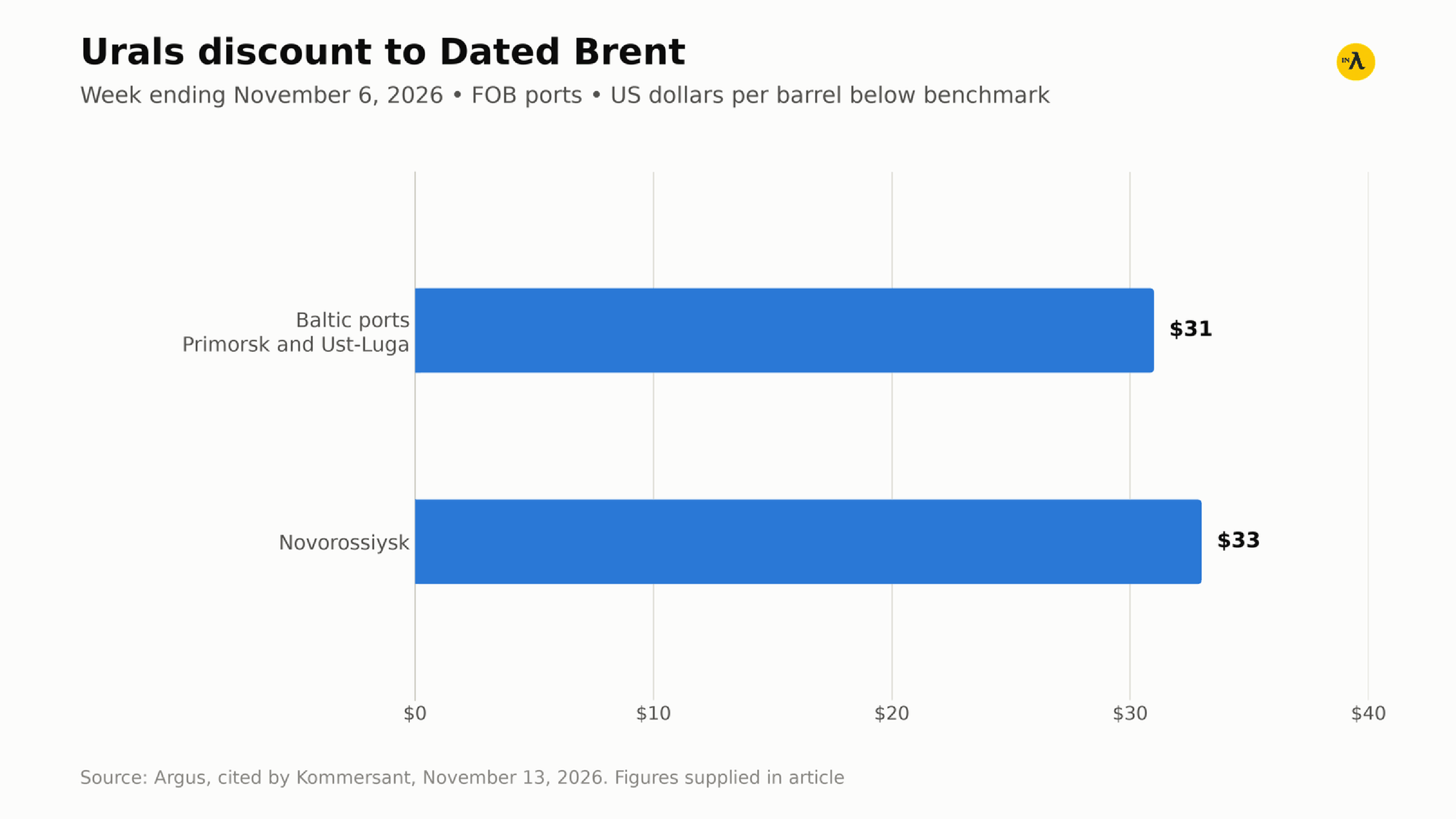
Urals traded $31 a barrel below Dated Brent at the Baltic ports and $33/b below it at Novorossiysk in the week to November 6, a widening of $2.15-2.95/b in a week. With world prices also falling, Urals lost $24.73/b to $65.63/b FOB at Primorsk and Ust-Luga and $23.93/b to $63.63/b at Novorossiysk, according to Argus.
The discounts on Russian Urals to the price of Brent hasa fluctuated dramatically during the course of the war, ranging from some $35 below the cost of a barrel of Brent to $5 premium at times, depending a wide variet of factors including new sanctions and the shortage of supply after the Strait of Hormuz was closed earlier this year.
The windfall Russia drew from the disruption to shipping through Hormuz is now running in reverse. Urals averaged $101.7/b in October and its discount to Brent narrowed to $23/b, the Centre for Research on Energy and Clean Air (CREA) estimated, lifting Russia's fossil fuel export earnings to their highest since 2022. The 2027 budget the Duma passed in first reading on October 29 already assumes a Urals price of $50/b, down from $59/b, Finance Minister Anton Siluanov told deputies.
Weak demand from importers and high freight costs are both weighing on Urals, Argus said, although tanker rates have started to ease. Chartering a tanker to carry 100,000 tonnes from Primorsk to India's west coast or northern China fell by $0.70/b to $28.6-32.7/b. Freight for 80,000-tonne cargoes from Novorossiysk to India and China fell by $0.87/b to $39.9-46.9/b.
India is the market where Urals has lost most ground. Urals delivered to India's west coast in December fell $2.30/b to $94.38/b, and its premium to Dated Brent turned into a $2.25/b discount, the first since August. Shipments of crude to India through Hormuz rose to 2.1mn barrels per day (b/d) in November, more than its imports from Russia of 1.8mn b/d, Bloomberg reported, citing Kpler. Indian refiners began switching to Gulf crude in October as freight costs priced out Russian barrels.
China has taken up some of the slack. The premium on Urals delivered to Shandong province in December held at $18/b over ICE Brent February futures, a price of $114.69/b, according to Argus. China's imports of Russian crude rose by 20% m/m and by almost 43% y/y to 1.57mn b/d in October, while India's fell by 67% m/m and 62% y/y to 692,000 b/d, according to S&P Global Commodities at Sea.
The recovery in Gulf supply has allowed India to import more Iraqi crude, while Russian oil stays less competitive because of shipping costs driven by war risk and a shortage of tankers, Sergei Frolov, managing partner at NEFT Research, told the paper. Chinese demand for Russian grades is being supported by the approach of the new year, when refiners' current import quotas expire, he said. The discount was already widening in October, when Frolov blamed rising freight rates and shipping risk in the Black Sea.
Export volumes have held up so far. Urals loadings from the Baltic ports stayed at about 1.5mn b/d on November 1-6, roughly level with the same period of October, and exports of Urals, Kebco and Siberian Light from Novorossiysk were almost unchanged at 762,000 b/d, Argus said, citing Vortexa and Kpler. Kazakhstan's Kebco grade has not been shipped from the Baltic since August.
"We are seeing growing competition on the world oil market, and the competitor for Urals is the rising supply from the Persian Gulf countries," said Kirill Bakhtin, head of Russian equity analysis at BCS World of Investments. Sergei Tereshkin, chief executive of Open Oil Market, said the rise in transit through Hormuz, one of the world's chokepoints, may only be a precursor to a full recovery in shipping. In that case not only Urals but all the main grades would get cheaper, and competition for buyers would intensify in every market, he warned.
Follow us online