

Second attack on Iran’s Bushehr nuclear power station raises Chernobyl radiation cloud spectre
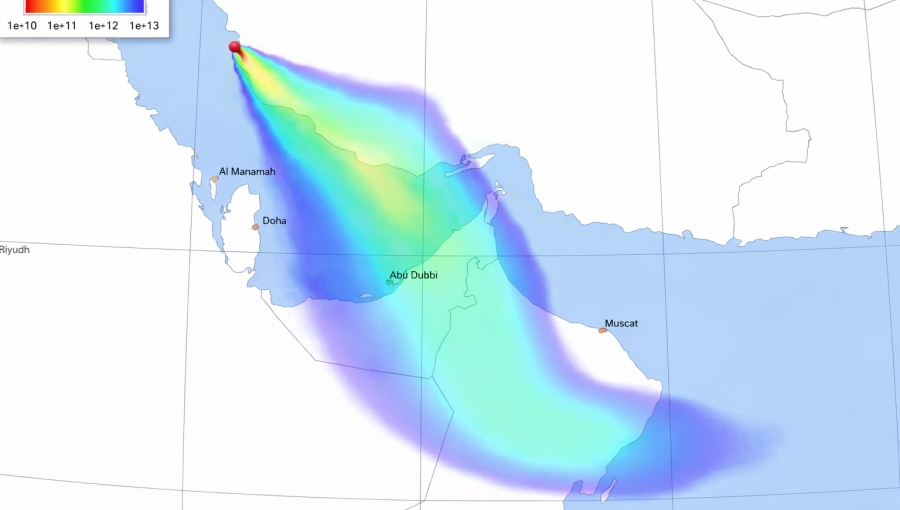
A second missile attack in the proximity to Iran’s Bushehr nuclear power plant (NPP) has raised the spectre of a Chernobyl-like cloud of radiation drifting over the Gulf region, making some countries uninhabitable for decades and poisoning the water in the Persian Gulf that would shut down many of the desalination plants that produce most of the region’s drinking water.
Israel struck at the nuclear power plant on March 18 with missiles landing 350m away from the main buildings, in what was seen as a warning shot at the time.
The situation at Iran's Bushehr nuclear power plant continues to deteriorate and attacks pose a direct threat to nuclear safety, the head of Russia's state nuclear corporation Rosatom said on March 28 after the second Israeli strike near the facility.
The Russian Foreign Ministry on Saturday called for "unequivocal and firm condemnation" of the attack near Bushehr.
"We hope that, by receiving timely and objective information directly from the Iranian authorities about what is happening on the ground, the Director General of the IAEA will be able to convey a simple message to the aggressors immediately and unequivocally: ‘It is time for you to stop!'," its spokesperson Maria Zakharova said in a statement Reuters reports.
The International Atomic Energy Agency (IAEA) reported there was a second strike at the NPP on March 27, according to Iranian authorities, which said there was no damage to the operating reactor and no radiation release.
IAEA chief Rafael Grossi warned that any strike damaging a reactor could trigger a major radiological incident, urging “maximum military restraint.”
Experts warn that if Bushehr takes a direct hit, radioactive clouds could disperse beyond Iran’s borders. According to an internal emergency planning exercise prepared by Russian engineers that operate the plant, “the radiation would reach the UAE within 24 hours” and due to prevailing winds continue to cover most of Oman as well before heading out to sea.
A secondary danger is the radioactive fuel and cooling water could spill into the shallow Persian Gulf poisoning the sea water that the hundred-odd desalination plants along the shore use to provide most of the region with drinking water.
The Russian exercise modelled the trajectory and speed of a radioactive plume following a hypothetical major accident. The Persian Gulf’s prevailing wind patterns are a key factor in determining the direction and concentration of such a plume. “It is not the only possible trajectory, and other exercises show different trajectories, although they usually head across the Persian Gulf,” the Russian assessment says.
Bushehr, Iran’s only operational nuclear power plant, is located on the country’s southern coast, directly across the Gulf from several densely populated urban centres, especially in the UAE. In the event of a direct hit on Bushehr, Dubai, the UAE’s commercial capital, would probably empty out as it lies directly in the path of a possible radioactive plume. Doha, the capital of Qatar, would also probably see an exodus, as although it is not in the expected direct path, it is one of the closest capitals to Bushehr.
Bushehr puts sanctions Rosatom sanctions off limits
So far, the West has refrained from putting sanctions on Russia's nuclear business, which could force Rosatom from withdrawing from Bushehr.
Russia’s nuclear exports have been booming after it upgraded its technology from the failed RBK reactors of Chernobyl and uranium is the new gas, used by the Kremlin to create an energy dependence on Moscow amongst its power-hungry new friends in the Global South.
A US congressional briefing on March 12 warned that sanctions on Russia’s state nuclear corporation Rosatom could heighten safety risks at Iran’s Bushehr nuclear power plant by disrupting technical support and fuel supply arrangements critical to its operation.
In testimony submitted to the House Foreign Affairs Committee, Institute for Science and International Security President David Albright stated that Rosatom plays an ongoing role in ensuring the reactor’s safe functioning, including the provision and removal of nuclear fuel and specialised engineering services.
The document noted that any interruption could increase the likelihood of a meltdown at the reactor. Bushehr, a Russian-designed VVER reactor – its state-of-the-art design - located on Iran’s southern coast, depends on Russian expertise for maintenance and safety oversight as part of a 60-year supply and maintenance deal signed with Moscow.
Albright cautioned that sanctions targeting Rosatom without carve-outs for civilian nuclear cooperation could have “unintended consequences.” In the case of Bushehr, he indicated that a breakdown in cooperation could “increase the risk of an accident,” given the plant’s reliance on Russian technical assistance and fuel cycle management.
In particular, Russia is in charge of spent fuel removal and is a key non-proliferation and safety measure. Disruptions could lead to on-site accumulation of spent fuel, compounding both safety and security risks.
Follow us online