
Taiwan's lawmakers demand energy price freeze into 2028 as state firms sink

IntelliNews summary:
• CPC is to receive about $3.1bn in compensation and $7.1bn of new capital; Taipower gets about $2.2bn.
• The cabinet warned that CPC's losses would almost wipe out its share capital by the end of 2026.
• Gas for power generation is more than 70% dearer than before the Iran war began in February.
• Taipower's request for a 12.83% tariff rise was refused in September; rates are reviewed again in December.
____________________
Taiwan's legislature wants fuel and electricity prices held until the end of January 2028, leaving two loss-making state energy companies to keep soaking up the cost.
No lawmaker objected when the opposition Kuomintang (KMT) caucus put the motion to the chamber on November 20, the day legislators approved the government's TWD607.63bn ($18.5bn) supplementary budget for 2026 without a cut, Focus Taiwan reported. Pump prices must stay at or below this year's levels, and power tariffs remain frozen for households using less than 500 kWh a month and for small businesses using under 1,500 kWh, according to the Taipei Times.
The burden falls on refiner CPC Corp, Taiwan and Taiwan Power Co (Taipower), which are projected to post pre-tax losses this year of TWD56.3bn and TWD73.28bn respectively, according to figures cited by the Taipei Times in October. CPC's liabilities already exceeded 94% of its assets at the end of September. The October projections predate the November 20 support package, and it is unclear whether they factor in the compensation and capital injection approved that day.
The January 2028 cut-off carries the freeze through the local elections on November 28 and the presidential and legislative campaign that follows. Taiwan has chosen its president in January since 2012, though no date has yet been set for 2028, and with voters this close to the polls neither the KMT nor the governing Democratic Progressive Party (DPP) has shown any appetite for dearer petrol or power.
Who picks up the bill
The supplementary budget sets aside TWD101.43bn to compensate CPC for freezing or slowing rises in petrol, diesel and gas prices and TWD71.1bn to cover Taipower's tariff freeze. CPC also gets a TWD233.83bn capital injection. Lawmakers approved in full TWD208.55bn of extra borrowing to finance the package.
CPC has lost money every year since 2020, holding down prices through the pandemic, the war in Ukraine and now the conflict in the Middle East. Its accumulated losses were on course to reach TWD127.6bn by the end of 2026, nearly wiping out its TWD130.1bn share capital, according to the cabinet's budget proposal, which warned that the company would be on the edge of insolvency early in 2027 without new capital.
The Taiwan People's Party (TPP) tried to strip out the entire injection, saying CPC had not explained how much would fund new infrastructure rather than repay old debt. Its caucus secretary-general, Hung Yu-shiang, also argued that a one-off injection could not fix an energy mix in which gas generates more than half the island's electricity. The motion failed by eight votes to 39, with KMT legislators in the chamber but sitting out the vote.
The DPP's Fan Yun said the money would shore up CPC's credit standing and could save it about TWD4.2bn a year in interest.
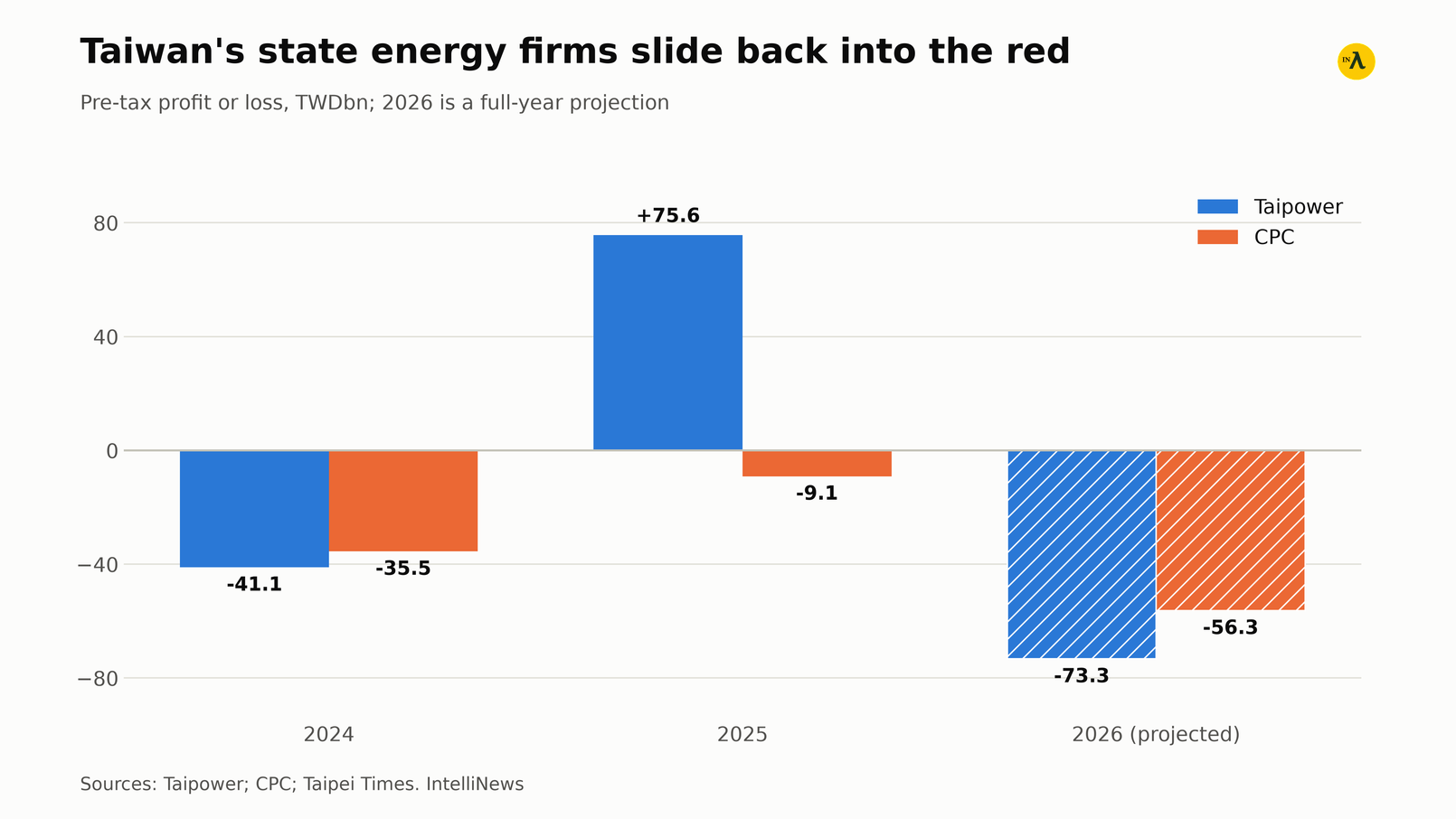
Pre-tax results of Taipower and CPC, 2024-2026; 2026 figures are full-year projections. Sources: Taipower; CPC; Taipei Times. IntelliNews
A war-time price shock
The losses date from late February, when US and Israeli strikes on Iran sent oil and gas prices soaring. Gas for power generation has since become more than 70% dearer, and Taipower expects this year's fuel bill to run more than TWD160bn above pre-war levels, the utility said in October. Gas supplied half of Taiwan's power in 2025, up from 30.6% a decade earlier, according to Energy Administration figures, a shift opponents of the nuclear phase-out blame for the utilities' exposure.
CPC has held pump prices flat 21 times this year and slowed six other increases, the cabinet said, often absorbing a loss on every litre it sells, while bottled gas has been frozen since the fighting began. Passing on the full cost would push 95-octane petrol above TWD45 a litre, cabinet spokesperson Lee Huei-chih said, Liberty Times reported on October 2.
Taipower returned to profit in 2025, posting record earnings of TWD75.6bn efore tax after three years of losses, but its accumulated losses had climbed back to TWD371.1bn by the end of August. The utility asked for a 12.83% tariff rise in September; the government declined, and the Electricity Price Review Committee chose to wait for the legislature's budget decision before revisiting rates. The next review is due in December.
Beyond the budget
The money approved on November 20 compensates the two companies for prices held down in 2026. Holding them through January 2028 means the cost of the next 13 months will have to be met from next year's budget or from fresh capital calls, and its size will be set by oil and gas markets that Taipei does not control. Business lobbies backed state support at an October hearing, while academics argued that taxpayers should not pay for past policy mistakes.
The freeze rounds off a year in which Taipower's fuel costs ballooned on Middle East gas prices, the cabinet bundled energy relief into a supplementary budget that also pays for drones and missile defence, and the opposition pressed for a TWD20,000 cash handout for every resident. Each call on the public purse has been easier to make in an election season than the one decision both parties have avoided: letting energy prices rise.
Follow us online