
Ukraine's strikes hit Russian refineries representing 30% of capacity as Abu Dhabi talks open

Ukrainian drone strikes since late October have hit Russian refineries representing about 30% of the country's oil refining capacity, Reuters reported on November 10, as US, Russian and Ukrainian negotiators met in Abu Dhabi.
At the end of October, Russian refineries were processing about 700,000 tonnes of crude a day. Two industry sources told Reuters that strikes could reduce processing by about 200,000 tonnes a day. Over the past week, attacks disrupted work or caused emergencies at nine of Russia's 35 major refineries, which together can process about 300,000 tonnes a day, or 2.2mn barrels a day (b/d), against total primary capacity of about 930,000 tonnes a day. Plants in Ryazan, Yaroslavl and the Volga region were among those hit, and on November 9 drones set fire to the Kirishi refinery near St Petersburg, the second-largest in the country.
Kyiv has stepped up the campaign while its delegation sits across the table from Moscow's. Ukraine largely held off in October after US President Donald Trump announced an energy ceasefire on October 11 and Washington pressed it to leave Russian refineries alone. The strikes resumed on October 30, and Kyrylo Budanov, the head of the presidential office, said the pause had ended because Russia went on killing civilians. Fuel is the one part of Russia's economy Ukraine can reach in force, and every refinery offline adds to the pressure on the Kremlin while the talks run.
The strikes have kept going overnight. Drones hit the port zone of Ust-Luga, Russia's main Baltic export hub for oil products, coal and fertiliser, in the early hours of November 11, starting a fire and injuring three workers, Leningrad region governor Alexander Drozdenko said. He did not say which terminal was hit.
Shortages are spreading again in what is the third wave of fuel rationing this year. Rosneft has reimposed limits of 30 litres of petrol per vehicle at urban filling stations and 50 litres at roadside ones in Karelia, Buryatia, Novosibirsk Oblast and Krasnoyarsk Krai, and the Leningrad region has set caps of its own. Kazakhstan, which Moscow had counted on to plug the gap, has shipped just 8,000 tonnes of petrol to Russia since the summer.
The cut is smaller than at the height of the second crisis in September, when the Ukrainian military claimed more than 45% of Russia's refining capacity had been knocked out, a figure it raised to 51% on October 4. Neither claim was independently verified, and they measure damage rather than lost throughput. Plants reported halted or cut in September accounted for 37% of Russia's nameplate capacity, according to the refinery damage ledger.
The damage is showing in the budget even with the Middle East war holding oil prices high. Oil and gas revenues fell 14.1% year on year to RUB6.442 trillion ($78.0bn) in January-October, the finance ministry said in a preliminary estimate on November 10, while non-oil and gas revenues rose 19.1%. Oil and gas now bring in 19.4% of federal revenue, and the ministry expects the full-year deficit to reach 3.2% of GDP.
The squeeze reaches back to the wellhead, because crude that cannot be refined or shipped has to stay in the ground. Unplanned supply outages worldwide eased to 7.36mn b/d in October from 8.66mn b/d in September, according to the US Energy Information Administration (EIA), most of them in the Gulf, and the agency's estimate includes about 1mn b/d of Russian crude.
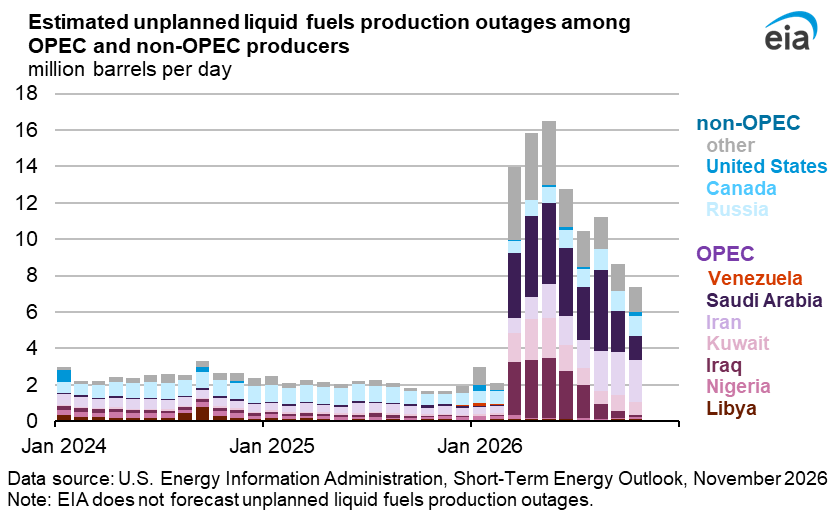
Estimated unplanned liquid fuels production outages, mn b/d. Source: US Energy Information Administration, Short-Term Energy Outlook, November 2026
Russian military bloggers are worried about how the strikes are being run. The Russian Telegram channel Dnevnik Razvedchika (Intelligence Officer's Diary) claimed that Ukrainian operators now watch strikes in real time and redirect drones in flight from a damaged distillation unit to storage tanks, cracking units or substations, using Israeli-made HiSKY satellite terminals in place of Starlink. The claim has not been confirmed.
President Volodymyr Zelenskiy has said Ukraine will stop hitting Russian refineries only if Moscow stops striking Ukraine's energy system, and Russia has kept up its attacks on Ukraine's grid through the talks. President Vladimir Putin warned in August that Kyiv had opened a Pandora's box by striking Russia's economy.
Follow us online