
Why the Baku-Supsa pipeline is back at the center of the energy game
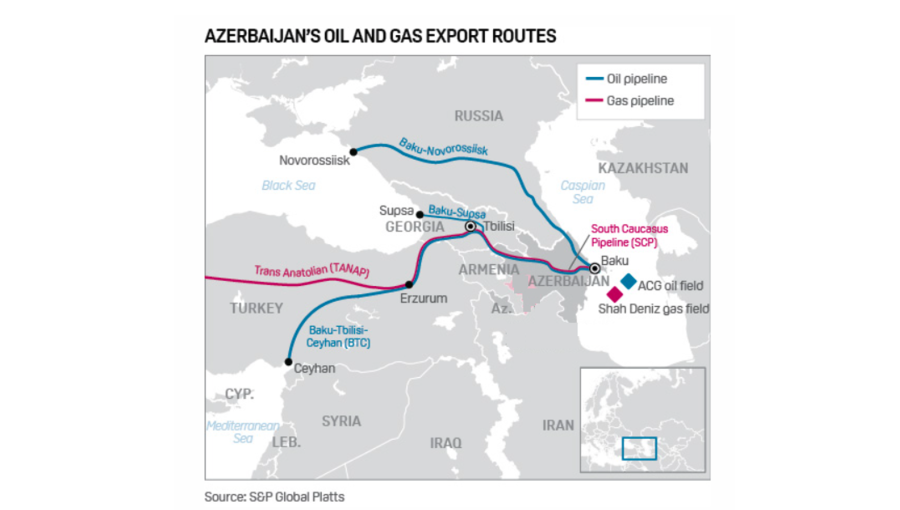
The transfer of operational functions of the Western Route Export Pipeline, better known as the Baku-Supsa pipeline, to the state authorities of Azerbaijan and Georgia may at first glance look like a purely technical development. In reality, it is much more than that. The return of this strategic energy route to its owners comes at a time when Europe is looking for more reliable access to non-Russian energy resources, Central Asian producers are searching for additional export corridors, and the South Caucasus is once again becoming a key transit space between East and West.
On June 8, BP Azerbaijan confirmed that operational functions of the Baku-Supsa pipeline had been transferred to the relevant state structures of Azerbaijan and Georgia. Under previously agreed arrangements, Baku and Tbilisi have regained control over all facilities along the route, except those located within the Sangachal terminal.
This should not be interpreted as a sudden withdrawal by BP or as a sale of assets. Earlier, on June 2, on the sidelines of Baku Energy Week, BP’s Regional President for Azerbaijan, Georgia and Türkiye Giovanni Cristofoli made it clear that the company was fulfilling its contractual obligations. According to him, operational control over the pipeline was being returned to its owners in line with previously agreed legal commitments.
That clarification is important because the Baku-Supsa pipeline has always been more than just infrastructure. Since its launch in 1999, it has symbolized Azerbaijan’s ability to export Caspian oil to global markets without relying on routes through Russia. It also strengthened Georgia’s role as a transit country and helped shape the modern energy map of the South Caucasus.
The latest developments show that both Azerbaijan and Georgia understand the value of bringing this route back into active use. In May, during Georgian Prime Minister Irakli Kobakhidze’s visit to Baku, the two countries signed a new agreement aimed at restoring the operation of the Baku-Supsa oil pipeline. The document provides for an operational contract covering the Georgian section of the pipeline and is expected to support the resumption of oil transit from Central Asia to Europe through Georgian territory.
For Georgia, this is not merely an energy issue. It is also about budget revenues, transit relevance and geopolitical positioning. Georgian Economy Minister Mariam Kvrivishvili has described the Baku-Supsa pipeline as strategically important not only for Georgia and the wider region, but also for Europe and international partners. Her message is clear: by restoring this route, Georgia strengthens its position as a reliable partner for neighboring states and Europe.
For Azerbaijan, the logic is just as clear. Baku has spent decades building an energy export architecture that gives producers and consumers alternatives. The Baku-Tbilisi-Ceyhan pipeline remains the main strategic route for Azerbaijani oil, but BTC alone cannot answer every logistical and commercial challenge. The Baku-Supsa route offers additional flexibility, especially at a time when Central Asian oil is increasingly looking westward.
The pipeline itself has serious capacity. Built as part of the contract for the development of the Azeri-Chirag-Gunashli fields, Baku-Supsa is 837 kilometers long and has an annual capacity of 7.5 million tons of oil. It starts at the Sangachal terminal near Baku and runs across Azerbaijan and Georgia to the Supsa terminal on Georgia’s Black Sea coast. According to SOCAR, from the start of commercial operations to April 1, 2026, a total of 738 million barrels of oil had been transported through the pipeline.
However, in recent years, Baku-Supsa has not been operating at full capacity. Since the spring of 2022, oil transportation through the route was halted, and exports were redirected to the Baku-Tbilisi-Ceyhan pipeline. BP representatives previously noted that the resumption of operations would depend on shippers’ requests for tanker loading at Supsa.
This is where Kazakhstan enters the picture. In July 2025, Kazakhstan’s Minister of Energy Yerlan Akkenzhenov signaled interest in Baku-Supsa as a possible export corridor. Speaking to Trend on the sidelines of the 17th summit of the Economic Cooperation Organization in Khankendi, he said Astana remained in constant contact with SOCAR and was considering all possible transport corridors, including Baku-Supsa.
That statement was not accidental. Kazakhstan has long needed additional export routes to reduce dependence on traditional corridors. Transit of Kazakh oil through Azerbaijan began in March 2024, when SOCAR announced the start of shipments through the Baku-Tbilisi-Ceyhan pipeline. The first batch of Kazakh oil from the Tengiz field was delivered to the Sangachal terminal from the port of Aktau.
But there are limits to how much Kazakh oil can be moved through BTC. The pipeline is already heavily loaded, and there are quality differences between Azerbaijani and Kazakh crude. These factors naturally make Baku-Supsa more attractive as an additional route.
This is why the return of Baku-Supsa to active consideration should be viewed within a broader energy context. Europe’s interest in Central Asian hydrocarbons has grown sharply since the start of Russia’s full-scale war against Ukraine.
The search for alternative energy routes is no longer a theoretical policy debate; it is a practical necessity. In this environment, every corridor that can move Caspian or Central Asian energy resources westward without passing through Russian territory becomes strategically valuable.
There is also a security dimension. The Baku-Supsa pipeline runs near, and in some areas close to, Georgia’s occupied Tskhinvali region. This has always created risks. During the August 2008 war, Georgian media reported alleged attempts by Russia to strike energy infrastructure, including the Baku-Tbilisi-Ceyhan pipeline. At that time, oil operations through the ports of Batumi and Kulevi were temporarily disrupted due to security concerns.
The risk did not disappear after 2008. In July 2015, Georgia’s Foreign Ministry accused Russian forces of illegally moving so-called border banners along the occupation line, resulting in a section of the Baku-Supsa pipeline falling inside occupied territory. In July 2017, another section of the Baku-Tbilisi-Supsa route near the village of Karapila in Georgia’s Kaspi district came under the control of Ossetian separatists.
These developments were not just local border incidents. They demonstrated how energy infrastructure can become an instrument of pressure. Some experts have argued that the seizure of sections of the pipeline was linked not only to Georgia, but also to attempts to pressure Azerbaijan into increasing oil transportation through the Baku-Novorossiysk route.
That context matters. In May 2013, Russia terminated the agreement with Azerbaijan on the transit of Azerbaijani oil through Russian territory, which had been in force since 1996. From 2014, Azerbaijani oil began to be transported via Russia under a commercial contract, while volumes through Baku-Novorossiysk gradually declined. Against this background, any pressure on alternative westward routes served Moscow’s broader interest in preserving leverage over regional energy flows.
The numbers from that period are revealing. In January-May 2015, according to data cited by Neftegaz.ru, 11.024 million tons of oil were exported through Baku-Tbilisi-Ceyhan, 1.833 million tons through Baku-Supsa, and only 594,710 tons through Baku-Novorossiysk. The imbalance clearly showed which routes had become more important for Azerbaijan and its partners.
Today, the geopolitical environment is even more sensitive. Russia’s war against Ukraine has made energy diversification a central issue for Europe. The South Caucasus has become not just a regional transit hub, but part of a much larger strategic architecture linking the Caspian basin, Central Asia, the Black Sea and European markets.
In this sense, Baku-Supsa’s return is not simply about restoring an old pipeline. It is about reopening a corridor that may soon become more necessary than ever. For Azerbaijan, it strengthens the country’s role as an energy and transit hub. For Georgia, it reinforces its importance as a bridge between the Caspian and the Black Sea. For Kazakhstan and other Central Asian producers, it may offer another route to diversify exports. For Europe, it provides one more non-Russian channel at a time when such routes are increasingly valuable.
The key question now is not whether BP is leaving the project. It is not. BP remains a strategic partner, while the return of operational control reflects long-standing contractual obligations. The real question is whether Azerbaijan, Georgia and their partners can turn Baku-Supsa from an underused route into an active part of the region’s new energy map.
If they succeed, the pipeline’s renewed role could go far beyond oil transportation. It could become another pillar of the Middle Corridor, another instrument of regional resilience, and another sign that the South Caucasus is no longer a peripheral space, but a strategic energy bridge between Central Asia and Europe.
That is why the return of Baku-Supsa to its owners should not be underestimated. In today’s geopolitical environment, infrastructure is power. And Baku-Supsa is once again becoming part of that power.
Seymur Mammadov is a special commentator for News.Az and the director of the international expert club EurAsiaAz. The article reflects the author’s personal opinion and does not necessarily represent the views of News.Az.
News.Az is a bne IntelliNews media partner. This article first appeared here.
Follow us online