
Zelenskiy says Ukraine's drones have knocked out 55% of Russia's refining capacity

Ukrainian drones have put more than 55% of Russia's oil refining capacity out of action, President Volodymyr Zelenskiy said in his evening address on November 15.
Zelenskiy said he had received a report from Commander-in-Chief Mykhailo Drapatyi on what Kyiv calls its "long-range sanctions". "We are now achieving results practically every day, and as of today, we have disabled more than 55% of Russia's oil refining capacity," he said, according to Ukrainska Pravda. "This is our justified response to Russia's refusal to de-escalate and its strikes on our energy infrastructure."
The figure is the highest Kyiv has claimed, up from the 51% the defence ministry gave on October 4 and 45% in September, and it lands as Russia's third fuel crisis of the year takes hold. The first wave of shortages started in May and was already hitting the real economy by July before easing as damaged plants restarted. A second round arrived with the harvest in August, and regions reimposed rationing in September. This time the drones are reaching deeper into Siberia and returning to plants as soon as they are repaired, and Rosneft reimposed fuel rationing in several regions on November 9.
Almost every Russian refinery of any size has now been hit. The Missile War Monitor's refinery damage ledger tracks 33 crude oil refineries, counting Bashneft's three Ufa plants separately, and records drone strikes on 29 of them since June 2022, 218 strikes in all. The four that have never been hit are the plants furthest from Ukraine, in Siberia and the Far East: Achinsk, Angarsk, Komsomolsk and Khabarovsk. The plants that have been hit have nameplate capacity of about 277mn tonnes a year, or 85% of Russia's 327mn tonnes. Ryazan is the most-attacked, with 17 strikes, followed by Yaroslavl, Afipsky and the Ufa complex with 16 each.
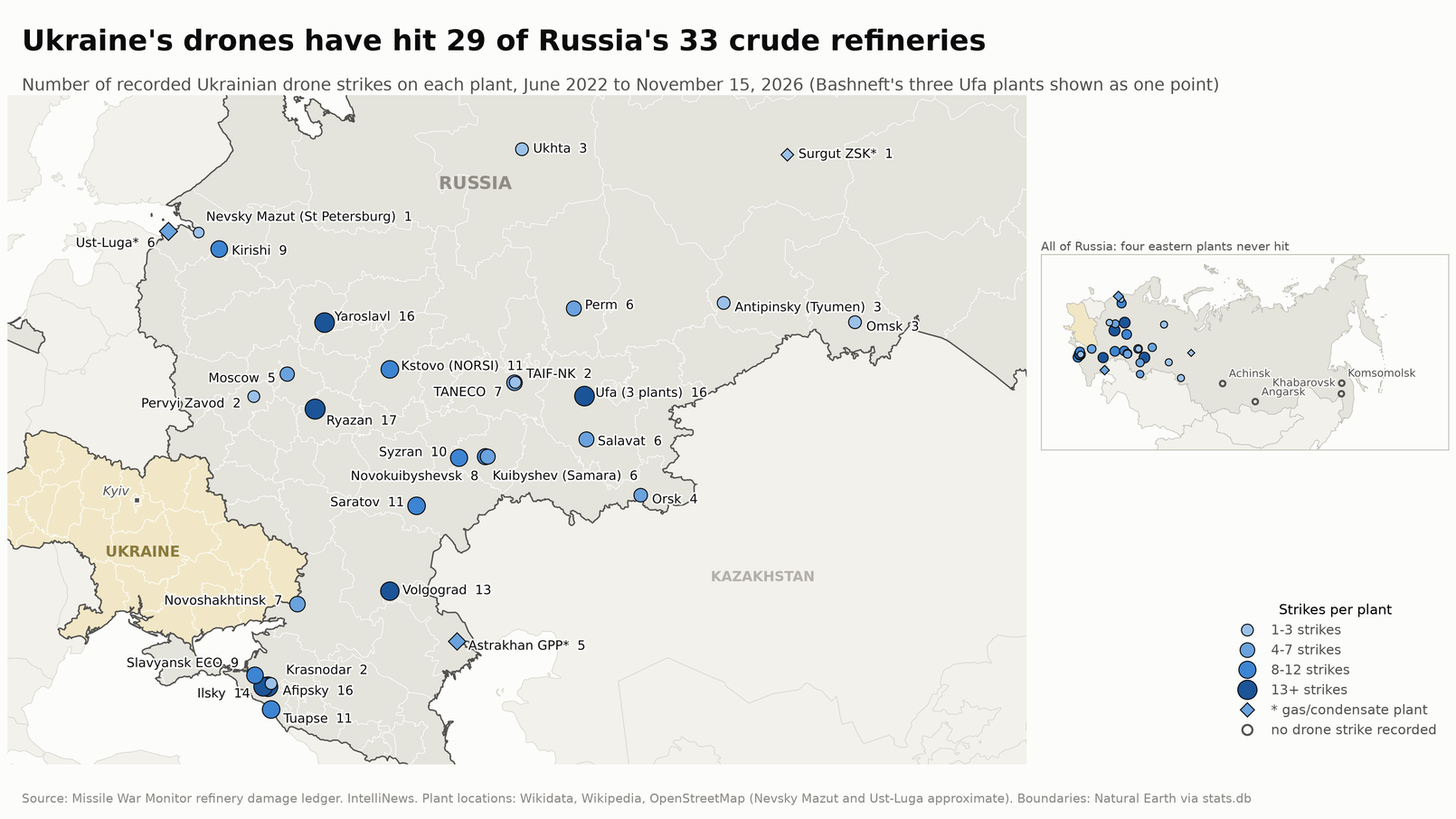
Recorded Ukrainian drone strikes on each Russian oil refinery, June 2022 to November 15, 2026. Diamonds mark gas and condensate plants; hollow circles mark refineries with no strike recorded. Source: Missile War Monitor refinery damage ledger. IntelliNews
Counts of the total vary with what is included. Ukraine's military intelligence agency HUR said in early November that strikes had put 15 of Russia's 38 major refineries out of action by the end of September. The ledger also logs strikes on three gas and condensate processing plants, at Ust-Luga, Astrakhan and Surgut, which it keeps out of the refining totals.
Kyiv's 55% is far above any independent tally. The 12 refineries last reported fully halted in the ledger have combined capacity of 133mn tonnes a year, about 41% of the national total, and Lukoil's Kstovo plant was running at about a quarter of capacity in September. Moscow's own count is much lower: Deputy Prime Minister Alexander Novak said in early September that about 10% of refining capacity was under repair.
Ukraine has hit nine refineries since November 1, against seven strikes on refineries in the whole of October, according to the ledger. Strikes resumed on October 30 after a pause that followed US President Donald Trump's push for an energy truce, and the targets have included Russia's second-largest refinery at Kirishi on November 9 and its largest, Gazprom Neft's plant at Omsk, on November 11, where residents reported a fire near the refinery. Volgograd governor Andrei Bocharov said falling debris killed four workers at an enterprise in the city's southern industrial zone on November 13, without naming Lukoil's refinery there. Ukraine's General Staff said its drones hit the only primary distillation unit at the TAIF-NK refinery in Nizhnekamsk on November 15, a claim not confirmed by the company.
The campaign has also reached Russia's export ports as the drone war shifts to crippling ports. A satellite image taken on November 15 shows at least five petroleum storage tanks completely burned out at Ust-Luga, Russia's main Baltic export hub, after the drone attack overnight on November 11, Radio Liberty's Ukrainian service reported. Leningrad region governor Alexander Drozdenko said the strike set the port on fire and injured three workers.
Zelenskiy linked the strikes directly to Russia's attacks on Ukraine's power grid. Russian forces have stepped up strikes on energy facilities in the Zaporizhzhia and Dnipropetrovska oblasts since September, with 131 strikes on the Dnipropetrovska oblast alone, he said, and he called on partners to focus on missiles for Patriot and NASAMS air-defence systems. Ukraine will also work with its partners to increase drone production, he said.
Follow us online