

Africa’s rate cycle splits: Uganda, Egypt and Namibia hike as Nigeria and Zimbabwe cut

Africa’s monetary easing cycle has fractured. Central banks facing currency pressure or fuel-driven inflation are raising interest rates, while those with stable currencies and low inflation have mostly held rates or continued cutting, as Ghana and South Africa prepare to announce policy decisions on November 18 and 19.
“Africa’s monetary-policy cycle is becoming increasingly uneven,” Angelika Goliger, EY’s Africa chief economist, told Bloomberg in September.
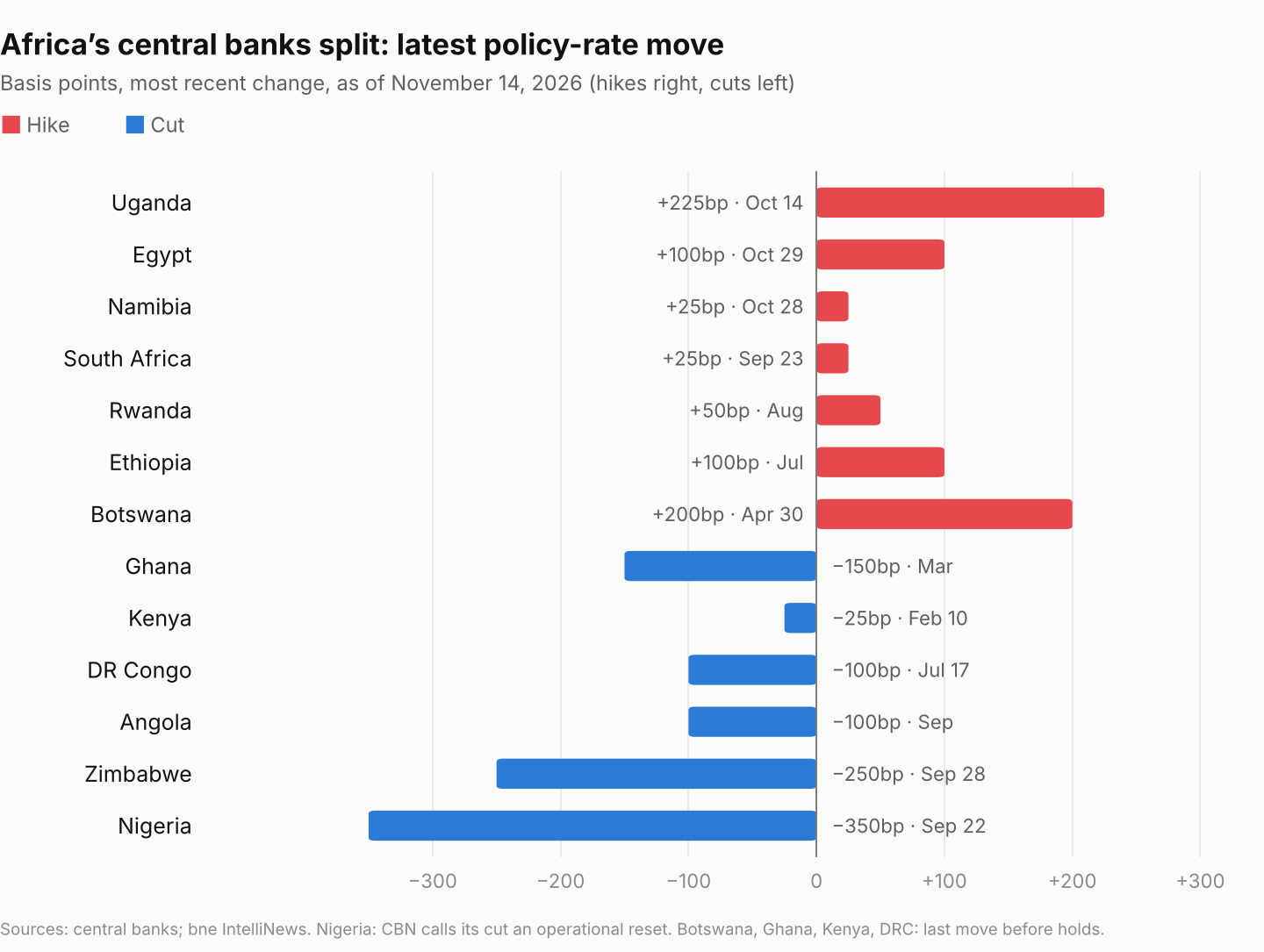
Latest policy-rate moves by African central banks, in basis points. Sources: central banks; IntelliNews.
The tightening camp
Egypt, Uganda and Namibia all raised rates in October. The Central Bank of Egypt (CBE) lifted its overnight deposit rate by 100bp to 20% on October 29, surprising all 13 analysts polled by Reuters, who had expected a hold. The bank cited an unfavourable external environment and rising uncertainty. The increase was its first since March 2024 and ended an easing cycle that had cut 825bp since April 2025. Jason Tuvey, deputy chief emerging markets economist at Capital Economics, said the hike was probably intended to support the pound without direct currency intervention, IntelliNews reported.
The Bank of Uganda moved first in October, raising its Central Bank Rate by 225bp to 12% at an emergency meeting on October 14 after a sharp fall in the shilling. It was the largest single increase since October 2011. “The fuel shock seems persistent, and this, combined with exchange rate depreciation and effects of El Niño weather could cause inflation to be entrenched if monetary policy does not contain these price pressures now,” the central bank said.
Days earlier, President Yoweri Museveni said he had rejected a proposal by the governor to sell foreign-exchange reserves to support the currency, IntelliNews reported. The central bank has not confirmed his account.
The shilling rallied on the day but failed to hold its gains. On October 22, the central bank told banks it was selling foreign currency, without disclosing the amount, and the next day the shilling briefly touched about UGX4,500 per dollar, its weakest level in 33 years. The Bank of Uganda held the rate on November 9 but widened its policy corridor and raised its inflation forecasts, projecting core inflation of 6–6.5% and headline inflation of 7.5–8% over the next 12 months, against a medium-term core inflation target of 5%. Headline inflation had risen to 5.8% in October.
Absa Bank Uganda has already lifted its prime lending rate to 21.75% from 19.5%, and Stanbic and Dfcu are following from December 1. Adam Mugume, the central bank’s executive director for research, said it was “pausing the tightening” but would keep shilling liquidity tight.
The Bank of Namibia followed with a 25bp rise to 7% on October 28, narrowing its gap with South Africa to 25bp to protect the Namibian dollar’s one-to-one peg with the rand. Namibian inflation rose to 5.6% in October from 5.4% in September, driven mainly by transport costs.
They joined earlier movers. Botswana was the first African central bank to respond to the oil shock, raising its rate by 200bp to 5.5% on April 30, and has since held. The South African Reserve Bank (SARB) raised its repo rate by 25bp in May, its first increase since 2023, and again to 7.25% on September 23 as fuel costs pushed up inflation. Ethiopia raised its rate by 100bp to 16% in July and held it on November 3, with inflation easing to 14.6% in October from 14.9% in September.
Rwanda’s central bank has raised rates three times this year, taking its rate to 8.75% in August after inflation reached 14.5% in July. Urban inflation, the central bank’s headline measure, has since accelerated to 19.5% in October from 17.2% in September, with urban food prices up 28.9%.
Oil shock and a hawkish Fed
Much of the pressure stems from the war that began when the US and Israel attacked Iran on February 28, after which Tehran closed the Strait of Hormuz. Adding to the strain, the US Federal Reserve raised its target range by 25bp to 3.75–4.00% on September 16, its first increase since July 2023, and the 10-year US Treasury yield broke 5% in mid-September for the first time since October 2023. The Fed held rates on October 28, but US borrowing costs have climbed again: the 10-year Treasury yield reached 5.15% on November 13, up from 4.88% on November 9, as markets priced in a December Fed hike.
Currency weakness preceded two of the sharpest moves, in Uganda and Egypt. The Egyptian pound fell to a record low of EGP56 per dollar on October 26, according to LSEG data, three days before the CBE acted, even though annual urban inflation had eased to 13.9% in September. The pound had recovered to around EGP54 by November 5, and urban inflation slowed to 12.7% in October.
Cutters keep their room
Elsewhere, the cycle runs the other way. The Central Bank of Nigeria cut its Monetary Policy Rate by 350bp to 23% on September 22, its largest single cut in nearly two decades. The bank described the move as an operational realignment rather than a change in its policy stance. Angola cut by 100bp to 14.75% the same month, and its inflation slowed to 8.16% in October, the lowest since March 2015.
Capital Economics said in late September that it expected a further 150bp cut in Nigeria in November, taking the rate to 21.5% by end-2026, IntelliNews reported. It said oil exporters Nigeria and Angola were riding out the energy shock while Kenya, Ethiopia and Mozambique were likely to face rate hikes and currency pressure. Ethiopia has since held its rate, and Kenya held at 8.75% in October, although Kenyan inflation has risen to 7.3%, near the top of its 2.5–7.5% target range. The CBN meets on November 23–24.
The Reserve Bank of Zimbabwe has cut by 750bp since June, most recently to 27.5% on September 28, with annual ZiG inflation at 3.7% in September; inflation rose to 4.3% in October. The Banque Centrale du Congo cut from 25% to 12.5% between October 2025 and July, before holding on October 8.
Real rates and currencies
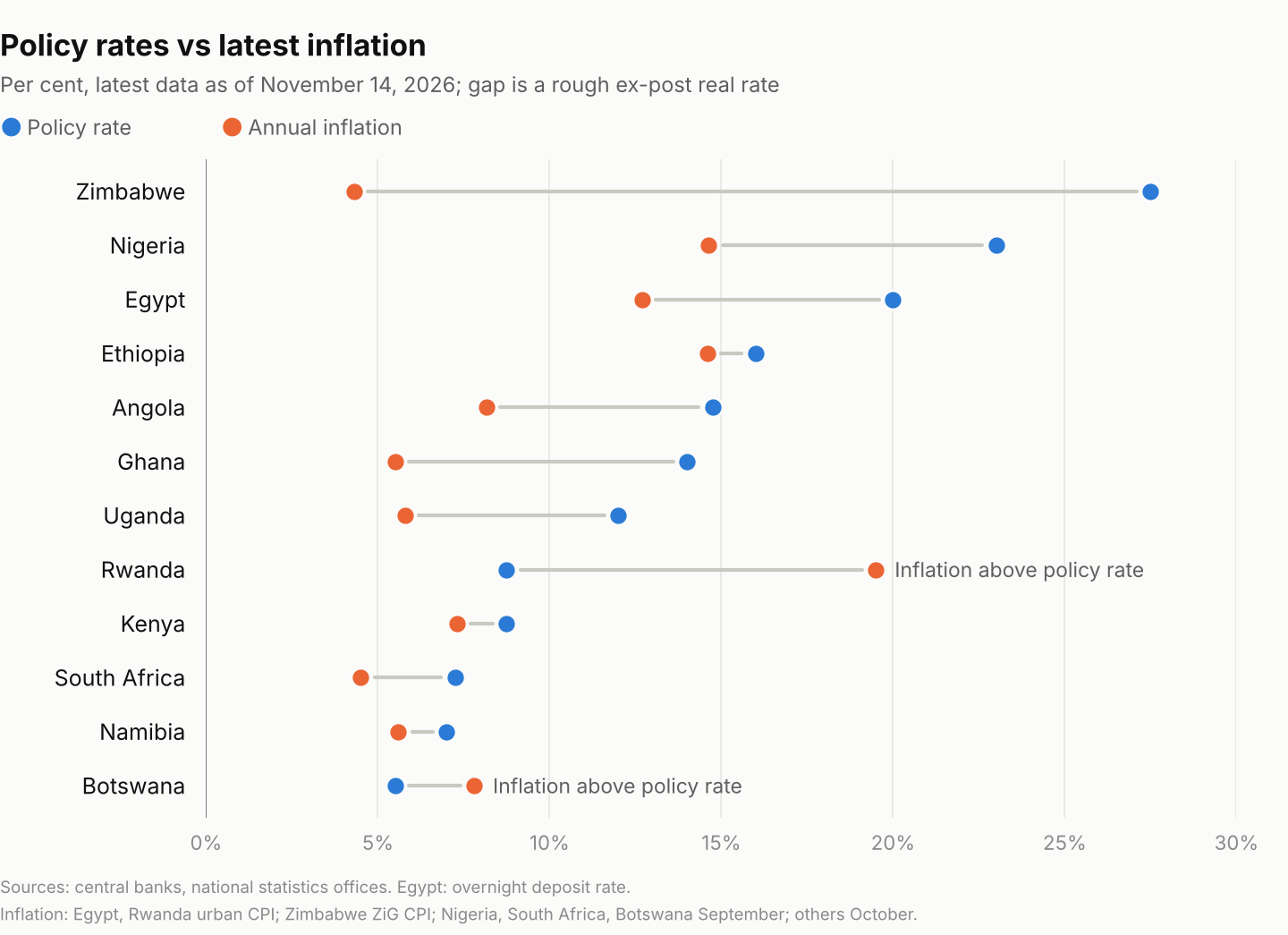
Real rates alone do not explain the split. On a rough ex-post basis, Zimbabwe’s policy rate sits about 23 percentage points above inflation and Nigeria’s about 8.4 points above September inflation of 14.63%, but Egypt’s deposit rate is also about 7.3 points above its October urban inflation, while Botswana is holding with inflation above its policy rate.
The spreads use different inflation measures and policy instruments, so they are not like-for-like gauges of policy stance, but the differing responses underline the role of exchange-rate pressures, inflation expectations and country-specific financial conditions. The CBE itself said it acted to anchor inflation expectations and safeguard disinflation.
Zimbabwe’s and Nigeria’s central banks presented their moves as realigning rates with lower inflation rather than loosening policy, and the IMF’s African Department director, Zeine Ould Zeidane, backed Nigeria’s cut, saying: “The stance itself remains a tight one.” He said further cuts should depend on incoming data and sustained progress towards the CBN’s inflation target.
In Nigeria, transmission has been patchy. Average prime lending rates rose in eight of 11 sectors between August 2025 and October 2026 despite cumulative cuts of 450bp, according to a Financial Vanguard analysis of CBN data reported by IntelliNews. Of that reduction in the published policy rate, 350bp came through the September 22 operational reset, shortly before the October reporting period. Average maximum lending rates across 10 sectors fell 1.2 percentage points over the same period, and a bank-by-bank comparison by Comercio Partners found more reductions than increases.
Next week’s decisions
The oil shock has moderated, complicating next week’s decisions. Brent fell from $117.64 a barrel on October 30 to settle at $91.49 on November 10, its lowest close since late August, on expectations of a diplomatic resolution to the conflict. It recovered to $95.84 on November 13, still well above its February average of $69. South African inflation rose to 4.5% in September, above the SARB’s 3% target and its one-point tolerance band. The bank’s October review projected inflation above 5% until the second quarter of 2027.
In early October, Bank of America economist Tatonga Rusike forecast a further 25bp SARB increase on November 19, to 7.5%, IntelliNews reported, though that call predates the fall in oil prices since early November. Nedbank still expects a 25bp hike, according to its November 13 weekly monitor, warning that higher fuel costs could push inflation above 5% in the final quarter, while Investec chief economist Annabel Bishop expects no increase without evidence of second-round inflation effects, citing softer oil prices and fuel-levy relief.
The Bank of Ghana held at 14% in September after cutting 400bp in January and March, and inflation has since risen to 5.5% in October from 5.2% in September, though it remains below the central bank’s 6–10% target band. Fitch Solutions said after the September meeting that a hold at 14% was the most likely outcome on November 18, and forecast a 200bp hike to 16% in 2027, with inflation seen reaching 6.8% by the end of 2026.
See IntelliNews: Uganda hikes key rate to 12% in emergency move to halt shilling slide
See IntelliNews: Central Bank of Egypt surprises markets with 100 bps interest rate hike
See IntelliNews: South Africa hikes repo rate to 7.25% as energy shock lifts inflation forecasts
See IntelliNews: COMMENT: Nigeria heads for 5% growth as Kenya faces rate hikes, Capital Economics say
Follow us online