

Africa's Sahara is greening and absorbing more carbon, scientists find
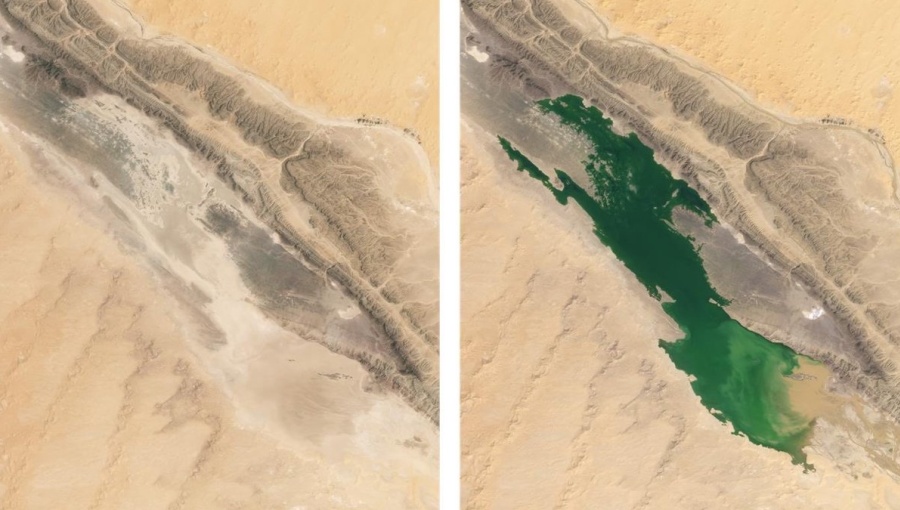
The Sahara is getting greener and soaking up more carbon dioxide during its wet season, US scientists have found, as rare deluges refill desert lakes across north Africa.
Rain over the desert between August and October is more than 17 times heavier than between January and March, and plant photosynthesis, tracked by satellites, is twice as high, according to the study Greener Southern Sahara: An Enhanced Carbon Sink, published in the Journal of Geophysical Research: Atmospheres on July 21. The extra growth pulls enough CO2 from the air to leave its concentration over the Sahara about four parts per million lower in the wet season than at the start of the year.
The researchers, from the University of Houston, Stanford, the University of California, Riverside and Caltech, found rising long-term trends in both rainfall and vegetation during the wet season. The desert "is becoming greener and evolving into a stronger carbon sink", they concluded.
On the desert's northern edge, Morocco expects a grain harvest of 9mn tonnes this year after floods in February ended a seven-year drought. Yet the trend is far from even: desertification now affects 84% of Mauritania's territory. The Sahara covers about 9.2mn square kilometres, so if only 5% of it turned green for good, that would be 460,000 square kilometres of potential grazing and farmland, about 11 times the size of the Netherlands.
Summer rainfall over the Sahara could rise by 75% in 2050-2099 compared with 1965-2014 under a high-emissions scenario, according to a University of Illinois Chicago study that ran 40 climate models and was published in npj Climate and Atmospheric Science in June 2025. It projects increases of 24% for southeastern Africa and 17% for south-central Africa, and a fall of up to 5% in the west of southern Africa. Warmer air carries more moisture, and more of it converges over the region.
Even so, the Sahara gets only about three inches (76 mm) of rain a year, a tenth of what falls on Chicago, according to the university, and differences between the models account for more than 85% of the uncertainty in the projections. "We have to start planning to face these changes, from flood management to drought-resistant crops," said lead author Thierry Ndetatsin Taguela.
An extratropical cyclone dropped up to 20 centimetres of rain on parts of Morocco, Algeria, Tunisia and Libya on September 7-8, 2024, about a year's worth in two days. Algeria's Sebkha el Melah, a lake that only six storms since 2000 have managed to start filling, covered 191 square kilometres to a depth of 2.2 metres by mid-October, NASA's Earth Observatory reported. A year earlier Storm Daniel, which killed thousands in Derna, left temporary lakes and rivers across the Libyan desert in Copernicus satellite images.
The Sahara has been green before. During the African Humid Period, which ended about 5,000 years ago, much of today's desert was savannah, wetland and lake, home to hippos, elephants, giraffes and herding communities.
Follow us online