

Australia’s battery boom enables more than half of new solar output to be shifted beyond daylight hours
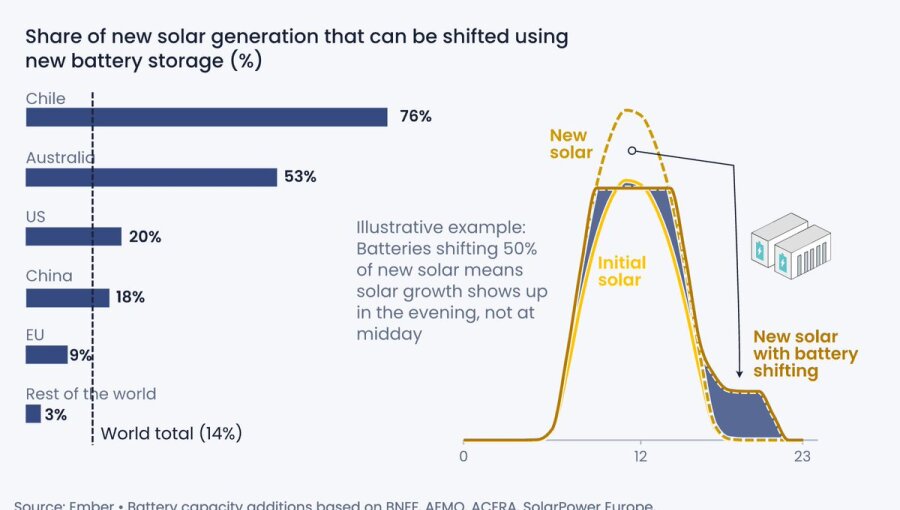
Australia installed enough battery storage capacity in 2025 to shift 53% of newly generated solar electricity beyond daylight hours, as the battery revolution accelerates.
The finding, cited by Australia’s Minister for Climate Change and Energy Chris Bowen, comes from analysis by energy think-tank Ember and highlights how batteries are increasingly being deployed alongside solar generation to store excess power produced during the middle of the day and release it during periods of higher demand.
As IntelliNews reported, Australia has already installed enough grid-level battery capacity to flatten the early evening spike in prices at peak demand.
Australia has one of the world’s highest rates of rooftop solar adoption, with more than four million households equipped with solar panels. The rapid growth of solar generation has created periods of abundant daytime electricity, increasing the importance of battery systems capable of shifting energy into evening peak hours.
Commenting on the latest figures, Bowen said: “Batteries...help reduce bills for everyone, not just those with batteries.”
The expansion of storage capacity has become a central element of Australia’s energy strategy as coal-fired power stations approach retirement and renewable generation accounts for an increasing share of electricity supply. Industry analysts have argued that batteries can help stabilise the grid, reduce price volatility and limit the curtailment of renewable energy during periods of strong solar output.
The market has also benefited from falling battery costs, driven largely by increased global manufacturing capacity and declining prices for lithium-ion technology. Australia has supported deployment through a combination of state-level programmes, utility-scale investment and growing consumer interest in household battery systems.
According to Ember, the ability to shift more than half of new solar generation beyond daylight hours demonstrates the extent to which storage is becoming integrated into renewable energy infrastructure. The development is particularly significant in a country where rooftop solar penetration is among the highest globally and where electricity demand peaks typically occur after sunset.
Follow us online