

Can Nigeria turn its oil wealth into lasting currency stability?

The Central Bank of Nigeria (CBN) and state-owned Nigerian National Petroleum Company Limited (NNPCL) have signed an agreement intended to strengthen foreign exchange inflows, improve the management and settlement of petroleum revenues and support financing for energy projects.
The memorandum of understanding, signed in Abuja on November 18 by CBN governor Olayemi Cardoso and NNPCL chief executive Bashir Bayo Ojulari, formalises a relationship that already places important parts of NNPCL’s foreign-currency operations within the central bank.
The agreement provides for working groups, implementation timelines and accountability mechanisms, with NNPCL treasurer John Etukudo overseeing implementation for the company, NNPCL said. Neither side disclosed a financing amount or a share of export proceeds to be channelled through the CBN.
Behind the agreement is a broader economic problem: Nigeria needs its oil and gas sector to supply government revenue and foreign exchange while also generating enough capital to finance higher production.
Export earnings versus usable dollars
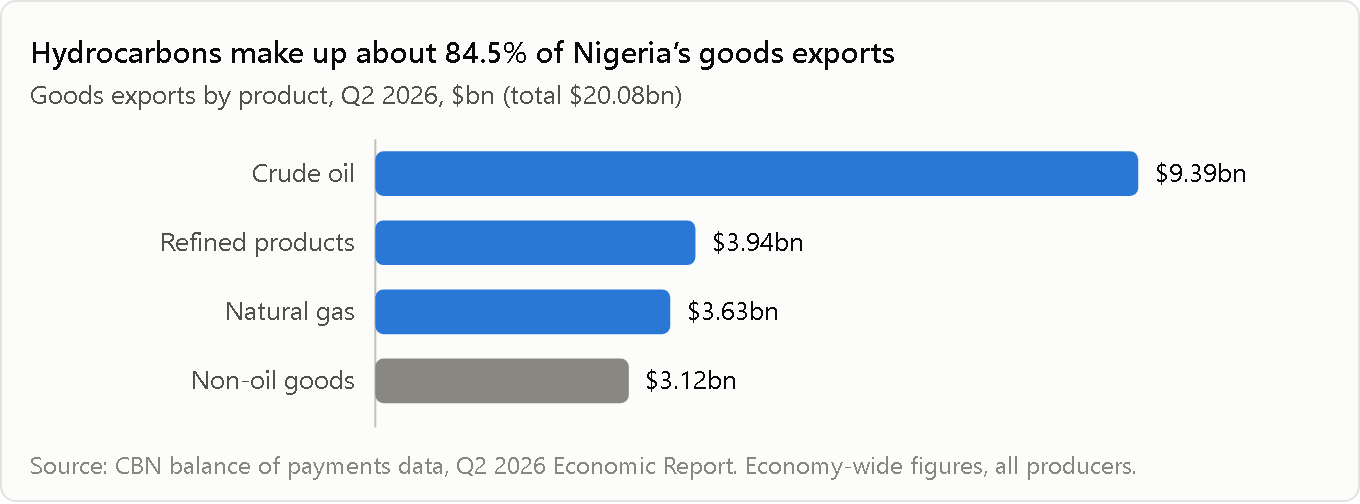
Hydrocarbons still dominate the country’s merchandise exports. CBN balance of payments data for the second quarter of 2026 showed goods exports of $20.08bn, of which crude oil accounted for $9.39bn, natural gas $3.63bn and refined petroleum products $3.94bn. Together they represented about 84.5% of goods export earnings. These are economy-wide figures covering all producers, including private companies, not NNPCL’s own receipts.
Gross export receipts are not equivalent to foreign exchange available to the CBN or the government. Partner entitlements, operating costs, overseas expenditure, debt repayments and reinvestment all reduce the amount that can be added to reserves or distributed fiscally. Oil cargoes can also be recorded as exports before the associated cash reaches Nigeria: the finance ministry has said payments may arrive 30 to 90 days after lifting, while some partner proceeds remain offshore and crude pledged against loans is used to repay lenders abroad, as IntelliNews reported in October.
Nigeria has sought greater visibility over those flows for several years. In February 2024, NNPCL said a significant proportion of its revenues and banking operations would be domiciled with the central bank, while commercial banks would continue to provide services where required.
The new agreement builds on that arrangement at a time when the composition, as well as the quantity, of Nigeria’s foreign exchange inflows remains an important policy issue. It could improve the visibility and management of petroleum proceeds, but any effect on reserves depends on the net amounts actually available to the central bank: dollars deposited at the CBN are not necessarily an unencumbered addition to reserve assets.
Reserves lean on financial inflows
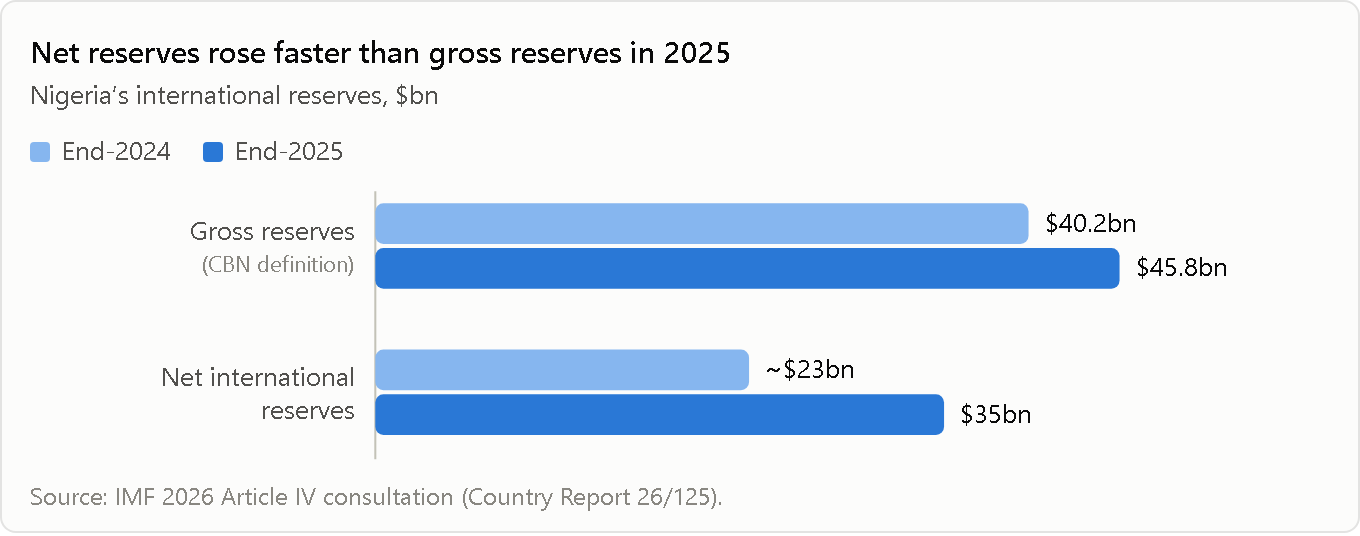
The IMF’s 2026 Article IV consultation showed gross international reserves, under the CBN definition, rising from $40.2bn at the end of 2024 to $45.8bn at the end of 2025. Net international reserves increased from about $23bn to $35bn. The IMF noted that reserves under its own definition were $8bn lower than the CBN figure at end-2025.
The current account surplus contributed to that improvement, but so did financial inflows. The IMF identified net non-resident purchases of CBN open market operation securities and a Eurobond issuance among the factors supporting reserves in 2025.
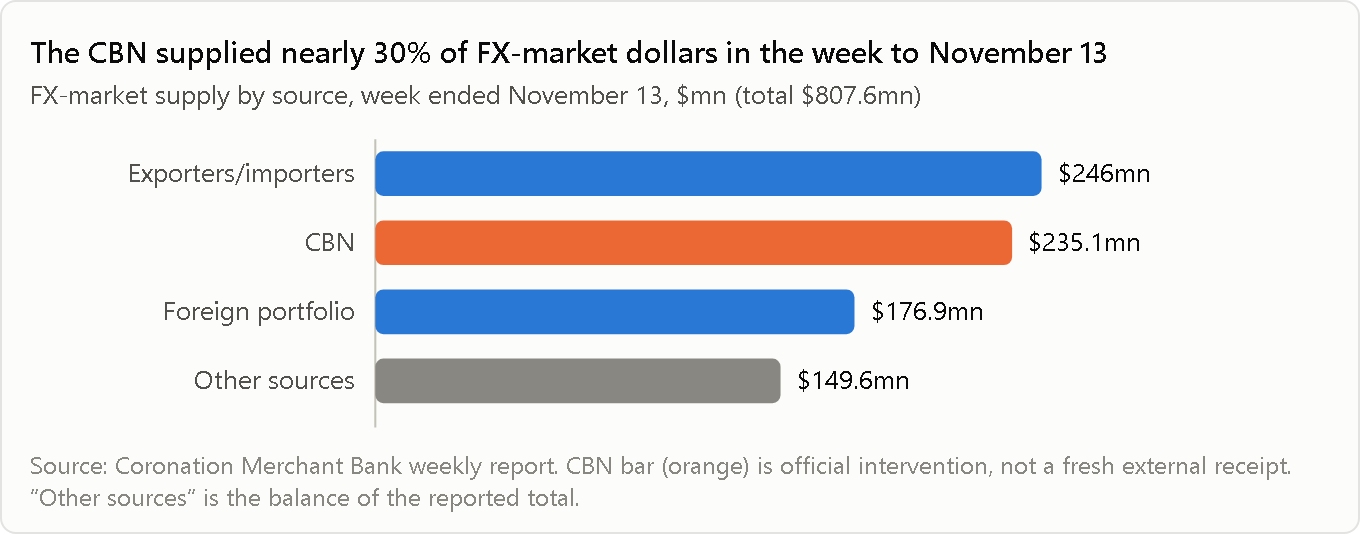
More recent market data illustrate the continuing dependence on multiple sources of dollar liquidity. Coronation Merchant Bank’s report for the week ended November 13 put FX-market supply at $807.6mn, down from $2.48bn the previous week and the lowest in at least five weeks. Exporters and importers supplied $246mn, foreign portfolio investors $176.9mn and the CBN itself $235.1mn; the central bank’s share is official intervention rather than a fresh external receipt. The bank said weaker autonomous inflows, greater CBN intervention, declining reserves and a wider parallel-market premium suggested increasing reliance on central-bank supply to support the official market. Separately, CBN data showed gross reserves at $54.87bn on November 12, down from a late-October peak of $55.26bn.
Portfolio and Eurobond inflows differ from export receipts in important ways: portfolio investors can withdraw or decline to reinvest, while Eurobond proceeds create future repayment obligations.
A larger contribution from petroleum exports to formal foreign exchange inflows could reduce, at the margin, Nigeria’s dependence on debt issuance and short-term capital, although it would leave the external position exposed to production volumes and energy prices.
Crude already pledged to lenders
Part of the complication is that NNPCL has used crude-backed and pre-export facilities to raise foreign currency against future production. The original $3.3bn Project Gazelle facility provided immediate liquidity in exchange for commitments against future crude deliveries.
In August, Nigeria’s National Economic Council approved a $4.5bn Project Gazelle 2 refinancing intended to repay about $1.5bn outstanding under the original transaction and provide a further $3bn of liquidity. Public disclosures reviewed for this article do not establish that the refinancing has reached financial close or been drawn.
The vice-president’s office said the proposed new structure would reduce the volume of crude pledged to the facility by 12.5%, to about 78,750 barrels per day from 90,000 bpd.
Even on improved terms, refinancing does not convert borrowing into export income. It changes the structure and timing of the claim on future petroleum cash flows. Barrels pledged to lenders do not add to freely available foreign exchange, so the pledge reduces the share of current output whose proceeds can reach reserves.
Production targets need capital
Nigeria is also trying to expand the revenue pool. The upstream regulator, the Nigerian Upstream Petroleum Regulatory Commission (NUPRC), reported crude oil and condensate production of about 1.688mn bpd in October 2026, down 1.7% from September. Crude production excluding condensate averaged about 1.51mn bpd, slightly above Nigeria’s 1.5mn bpd OPEC quota.
In 2025, NNPCL set crude production targets of more than 2mn bpd, sustained through 2027, and 3mn bpd by 2030. Ojulari has also set out plans for substantially higher gas production.
Those targets require capital. Cash distributed by NNPCL to its government shareholders is unavailable for reinvestment unless the company replaces it with internally generated funds or external financing. Retaining more cash for capital expenditure reduces what can immediately be distributed.
Ojulari said the November agreement would support financial structures to help NNPCL raise capital on the strength of its own balance sheet and assets, while Cardoso said the CBN would use its convening power to attract global institutions to finance gas development. Such funding may ease the immediate tension between investment and distributions, but it also creates claims on future cash flows, which can be met without squeezing distributions only if the projects financed generate sufficient additional production.
Natural gas offers another source of potential export income. Higher liquefied natural gas exports would add foreign exchange receipts, while increased domestic supply could support power generation and industry. The commercial test is whether new investment lifts production and earnings by more than its financing and capital costs.
Possible IPO raises the stakes
These trade-offs are becoming more relevant as NNPCL prepares for a possible initial public offering.
The Petroleum Industry Act of 2021 required the incorporation of NNPCL as a government-owned company operating on a commercial basis. Ojulari told Reuters on November 3 that the company was considering initially listing a 5–10% stake, primarily in Nigeria, with the possibility of a secondary listing in London or New York.
A flotation would expose the relationship between NNPCL and the state to greater scrutiny. Minority investors would need clarity over capital allocation, dividends, borrowing, related-party transactions and the extent to which the company is expected to support wider fiscal or monetary objectives.
Closer coordination with the CBN may improve transparency, payment infrastructure and management of petroleum receipts. Extensive use of NNPCL’s balance sheet or future production for broader government financing, however, could make the boundary between its commercial mandate and its role in state policy harder for investors to assess.
Follow us online