

China burns more coal than the rest of the world combined as its own use stalls
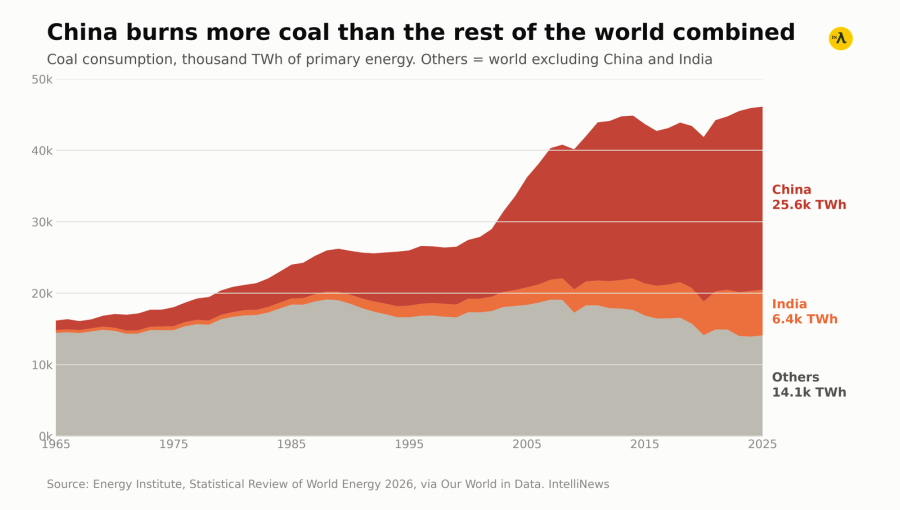
China burned 25,622 TWh of coal in 2025, 55.6% of the world total and more than every other country combined, the Energy Institute's Statistical Review of World Energy shows.
The rest of the world burned 20,498 TWh, about what it used in the late 1980s, according to the review's figures compiled by Our World in Data. China burned just over a fifth of the world's coal in 1988. It went past half in 2011 and has stayed there since.
China's share defines the climate arithmetic: a quarter-century of global coal growth is almost entirely Chinese, and the rest of the world has only shuffled its consumption between countries. Europe and the US cut, South and Southeast Asia added, and the total outside China barely moved.
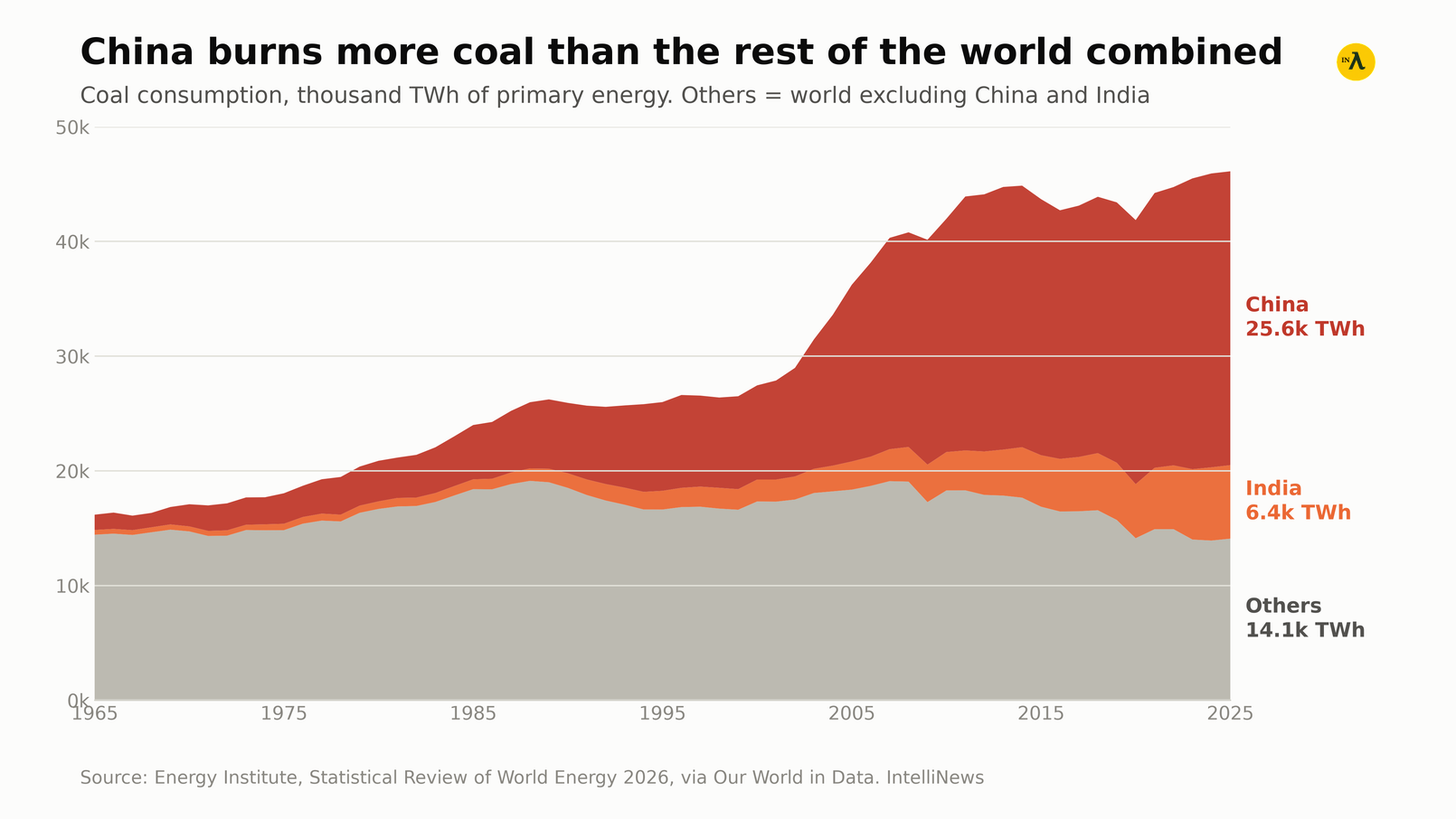
China overtook the rest of the world in 2011 and has burned more than half the world's coal ever since. Source: Energy Institute, Statistical Review of World Energy 2026, via Our World in Data. IntelliNews
China's own consumption
China's use was flat in 2025, at 25,622 TWh against 25,621 TWh in 2024, after rising by more than a tenth between 2020 and 2024. World consumption still set a record of 46,120 TWh, up 0.4%, because others kept burning more.
The pause did not last into 2026. Coal-fired generation rose 3.4% y/y in the first half after a 1% fall in 2025, the Centre for Research on Energy and Clean Air (CREA) and Global Energy Monitor said in an August review. China commissioned 30 GW of new coal power in the half, the most for a first half since 2016, and retired 2.7 GW.
The new plants are running less. Average utilisation fell to about 1,998 hours from 2,056 a year earlier, the lowest since 2021, while an estimated 360 TWh of wind and solar output was curtailed, up 49%. CREA said that wasted clean power could have covered all of the half's demand growth.
Monthly figures from think-tank Ember show the rebound fading. China's coal generation fell y/y in July, August and September, leaving January-September output 0.7% above the same months of 2025, and coal's share of the power mix slipped to 51.7% in September from 52.9% a year earlier.
CREA rejected the idea that the closure of the Strait of Hormuz had pushed China back to coal. Combined domestic coal output and imports fell 1.4% y/y in the first half, it said, even as LNG supply was disrupted.
Where the growth is now
India is the second-biggest consumer at 6,409 TWh in 2025, more than three times its use in 2000. Its coal generation was 5.6% higher in January-August 2026 than a year earlier on Ember's data, and power plants have been running down stocks as demand surges.
Indonesia burned 1,432 TWh, up 9% in 2025, and is weighing a higher 2027 output quota as prices recover. US consumption rose 10% to 2,425 TWh in 2025, its first big increase in years, while the EU's fell to 1,275 TWh, a quarter of its late-1980s level.
Some of the gas-fired growth that was meant to replace coal in Asia is also stalling: more than half of the LNG power plants and terminals planned in Vietnam, the Philippines, Thailand and Bangladesh have been cancelled or stalled since 2021.
China has 274 GW of coal power permitted or under construction, about 22% of its operating fleet, according to CREA. If all of it is built and generation stays at the 2025 level, average utilisation would fall to about 42% by 2030. CREA wants coal plants to move from baseload to flexible backup, starting with the long-term contracts that still reserve 60-70% of their previous year's output.
This article was produced with the help of the IntelliNews Lambda analytical tool
Follow us online