
Climate adaptation costs set to soar as global exposure rises - McKinsey

The world faces escalating and uneven costs from climate adaptation as rising temperatures, extreme weather events and sea-level rise strain public finances and economic productivity, according to new research from the McKinsey Global Institute.
In its report “Advancing adaptation: Mapping costs from cooling to coastal defences,” published in February, McKinsey warns that the financial burden of adapting to climate change will grow significantly over the coming decades, particularly in low-income and high-exposure regions. Just the cost of air conditioning is going to take up 40% of all adaption costs, according to the consultancy.
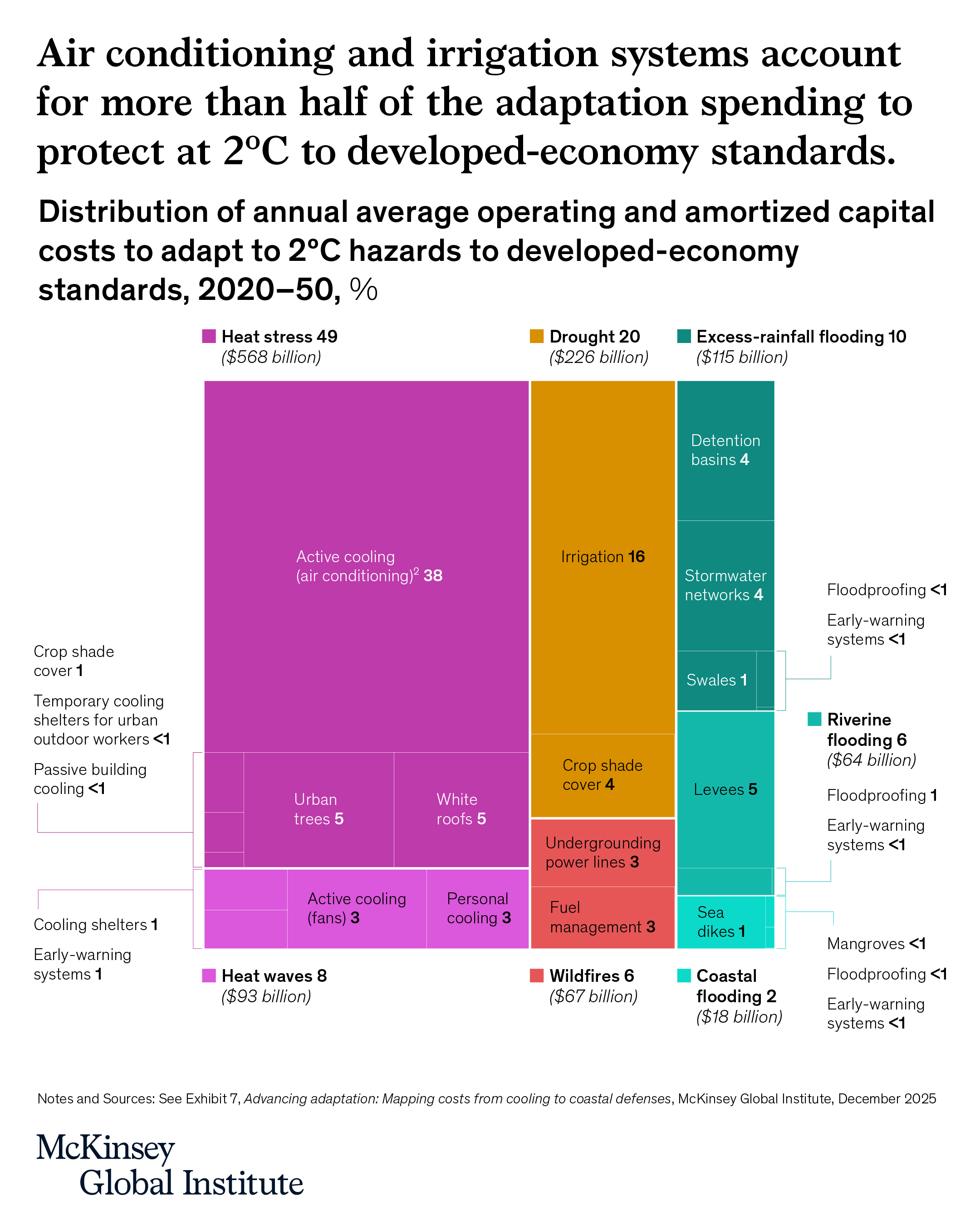
Currently the world spends around $190bn a year on climate related damage, but that spending will rise to 41.2 trillion a year when temperature increases above the pre-industrial base line rise above 2°C.
The temperature increases have already crossed the 1.5°C Paris target in 2025 for every month of the year. Previously, the 2°C threshold was forecast to come in 2050, but with an intense El Niño forecast to start in a few month’s time, the United Nations’ Intergovernmental Panel on Climate Change (IPCC) models are now predicting the deadline to. Reach 2°C above the baseline is likely to arrive as soon as 2030.
The Climate Crisis is accelerating. The IPCC says that the Paris Agreement goal of keeping temperature increases to less than 1.5°C-2°C above the pre-industrial benchmark has already been missed and temperature increases are on course to reach a catastrophic 2.7C-3.1C by 2050. At that point extreme temperature events will become routine and large parts of the world will become uninhabitable.
In just the last two years green bonds have gone mainstream as the annual cost of extreme weather events are increasing exponentially and demand for wildfire catastrophe bonds is also rising fast for the same reasons. The Climate Crisis is here and it's already doing a lot of expensive damage. The McKinsey report also tallies with an environmental damage impact report released by Fitch last week that warns exposed countries risk having their ratings downgraded by several. Notches due to exploding extreme weather damage or the transition costs of failing to move away from an economic dependence on fossil fuels.
McKinsey mapped over 200 adaptation responses across 80 geographies, focusing on five key areas: liveability and workability, food systems, physical assets, infrastructure services, and natural capital.
“Adaptation costs are rising and will differ widely across regions, sectors, and income levels,” the report said. “The challenge is not just about mobilising capital—it’s about doing so in a way that delivers equitable resilience.”
McKinsey noted that while global attention has focused on mitigation—reducing greenhouse gas emissions—adaptation investment remains inadequate, even as climate hazards intensify. In many countries, the impact is already measurable. For example, extreme heat could reduce effective working hours by up to 20% in some regions by 2050, with outdoor labour and low-income workers bearing the brunt.
“Without adaptation, productivity losses from heat exposure alone could exceed 2% of GDP in the hardest-hit regions,” McKinsey said. This includes parts of South and Southeast Asia, Sub-Saharan Africa, and the Middle East.
Cooling demand is expected to surge as a result, with residential and commercial cooling accounting for up to 40% of electricity demand in hot, fast-growing countries by mid-century. However, access to cooling is still highly unequal, creating both a human and economic vulnerability. “Closing the global cooling gap is one of the most urgent adaptation imperatives,” the report noted.
Sea-level rise and coastal flooding present another costly frontier. McKinsey estimates that $1.7 trillion to $2.4 trillion of GDP could be at risk annually by 2050 without adaptation, particularly in low-lying urban centres in Asia. Even modest investments in coastal protection—such as sea walls, wetland restoration, or building codes—could significantly reduce that exposure.
The report also highlighted the vulnerability of food systems to shifting rainfall patterns and water stress, warning that “agriculture in water-scarce regions will require both technological adaptation and significant capital to maintain yields.”
Critically, McKinsey argued that the economics of adaptation are context-dependent, with a strong case for action even in poorer regions. “Many of the most effective responses have positive net benefits over time,” the report said. “The barrier is often not cost—but coordination, financing mechanisms, and governance capacity.”
Despite the risks, global adaptation finance remains far below the levels required. The UN Environment Programme estimates a financing gap of $194bn to $366bn per year by 2030, far exceeding current commitments.
“The costs of adaptation will be substantial,” McKinsey concluded. “But the costs of inaction will be far greater—economically, socially, and environmentally.”
Follow us online