
Climate modellers cut the worst case for the first time in four generations
The highest warming scenario used by climate modellers has fallen to 3.3C by 2100 from 4.6C, the first time the top of the range has come down in four generations of modelling, Carbon Brief reported on September 1.
The seven new scenarios belong to the Coupled Model Intercomparison Project's seventh phase, CMIP7, which will feed the Intergovernmental Panel on Climate Change's seventh assessment. They were published in Geoscientific Model Development in April 2026 and the underlying emissions data was released on September 1.
For anyone financing energy assets with a 25-year life, the change at the top of the range is commercially relevant. The scenarios that banks and insurers have been running as their stress case were built on an assumption of coal-led growth and costly renewables, and the modellers have now written that future off as implausible.
What changed
The old high-emissions pathways "have become implausible, based on trends in the costs of renewables, the emergence of climate policy and recent emission trends", according to the study Carbon Brief cites.
The numbers behind that judgement are large. The new high scenario carries cumulative CO2 emissions of 3,820 GtCO2 between 2024 and 2100, against roughly 7,600 GtCO2 in SSP5-8.5, the highest scenario of the previous generation. The worst case has been halved.
Four other things changed with it. The scenarios are named by emissions trajectory rather than by radiative forcing. There is no longer a no-climate-policy scenario, the range instead running from current policies weakening to current policies strengthening. The models now calculate atmospheric CO2 concentrations from emissions rather than having concentrations prescribed. And the runs extend to 2150, with extensions to 2500, rather than stopping at 2100.
The socioeconomic assumptions were revised in 2024 towards higher population and lower income per capita. Global population in 2100 under the middle pathway is now put at 9.9bn, a billion higher than before, with income per capita 10% to 25% lower than the original assumptions across most scenarios.
The seven scenarios
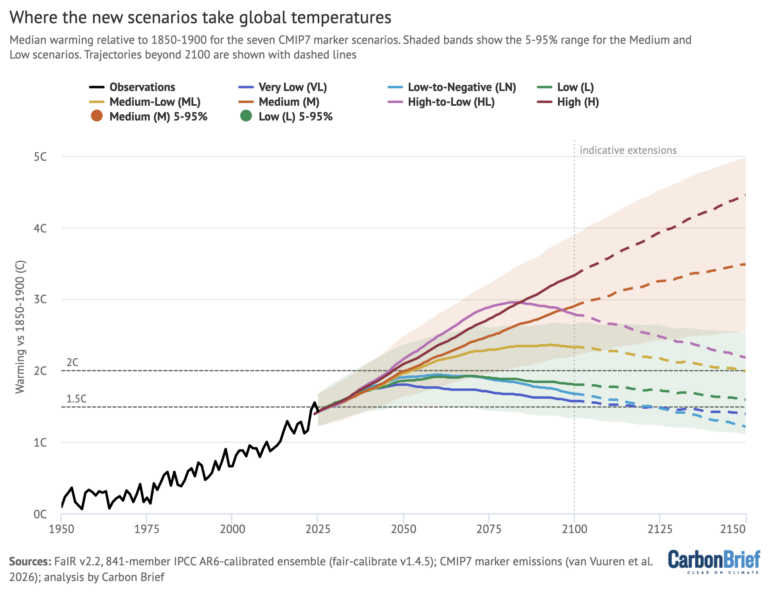
The high scenario reaches 3.3C by 2100, with a range of 2.6C to 4.4C. Medium, which freezes current policies at 2025 levels, reaches 2.9C. High-to-low, which runs high to mid-century then reaches net zero CO2 by 2100, gives 2.8C. Medium-low gives 2.3C.
At the bottom, low reaches 1.8C, low-to-negative 1.7C and very-low 1.6C. Only those last three are consistent with the Paris temperature goals, and all three require carbon removal at industrial scale.
Cumulative removals to 2150 run from 655 GtCO2 in the very-low scenario to 2,360 GtCO2 in low-to-negative. In that last case about 1,750 GtCO2 of engineered removal, from bioenergy with carbon capture and from direct air capture, would need geological storage by 2150.
Cutting the top of the range does not move the near-term problem. On the medium scenario, which is the one that assumes today's policies simply continue, 1.5C is essentially locked in by the late 2020s or early 2030s and 2C is crossed around 2050. It takes until about 2110 to reach 3C, and there is a one-in-four chance of 4C by 2150.
The comparison across generations shows how far the ceiling has moved. SRES A1FI gave 4.6C in 2100, RCP8.5 gave 4.9C and SSP5-8.5 gave 4.6C. CMIP7's high gives 3.3C.
The first model runs took place in the spring of 2026 and initial results are expected later this year.
Follow us online