
Coal mines are leaking vast amounts of methane into the atmosphere and almost no one is measuring it - Ember

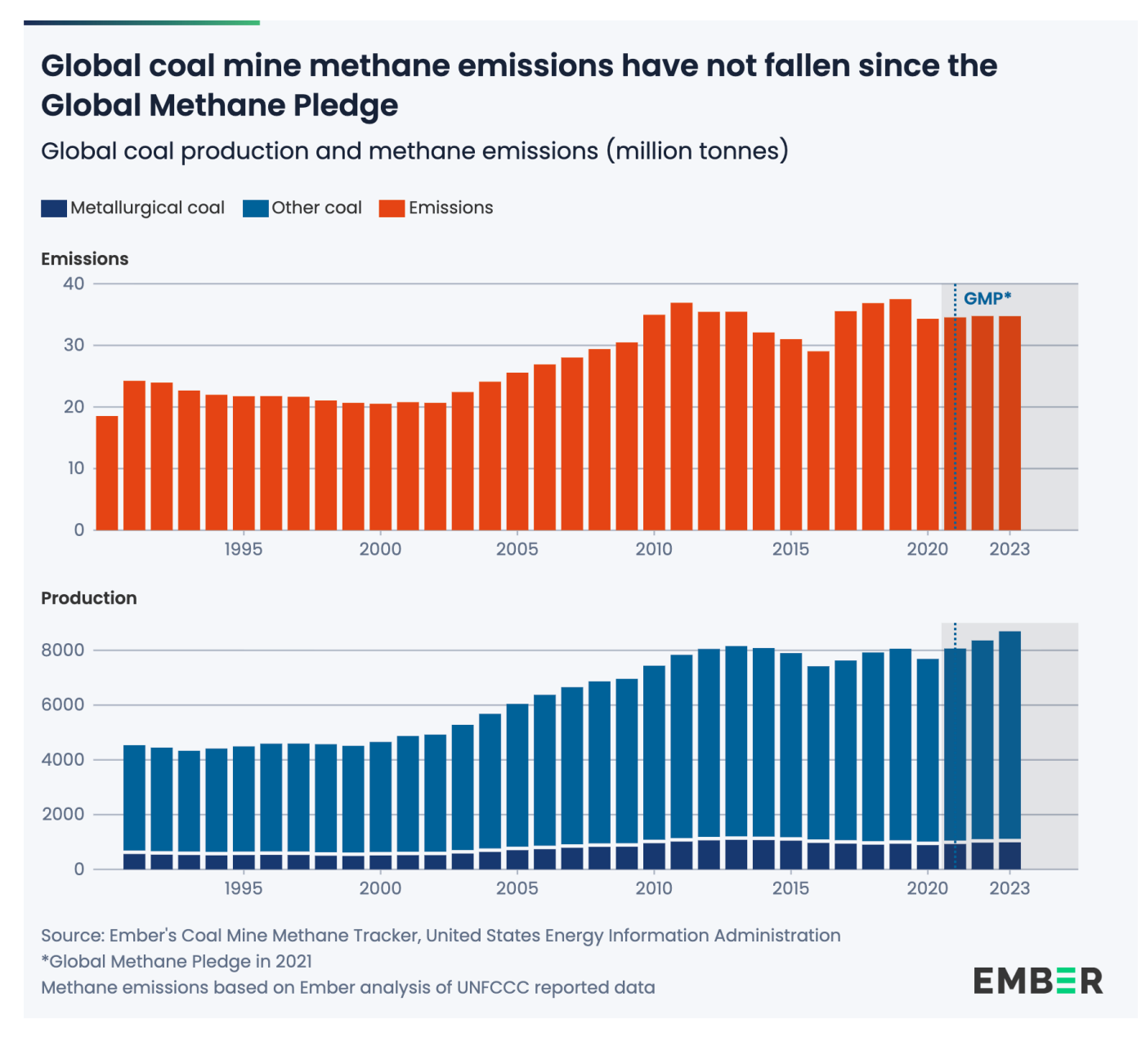
Almost five years after 159 countries signed the Global Methane Pledge committing to cut anthropogenic methane emissions by 30% by 2030, coal mines are releasing roughly the same amount of the potent greenhouse gas as they were when the ink was still wet on the agreement. Global production has increased. Emissions have not fallen. And for the vast majority of the world's coal, no one is measuring what is actually escaping, according to Ember's first annual Global Coal Mine Methane Review.
The report was compiled from data covering 73 countries between 1990 and 2024. It simultaneously identifies one of the most significant and tractable near-term climate opportunities available — and documents in forensic detail why it is being almost entirely missed.
"Coal mine methane remains a major blind spot in global climate action," said Nishant Bhardwaj, coal mine methane programme director at Ember. "Emissions are largely unreported, yet proven solutions already exist to cut more than half of them this decade. Global methane targets will not be met unless coal mine methane is addressed directly. This is a clear, actionable part of the problem that has been overlooked for too long. Addressing it now would deliver immediate climate benefits at a pace that few other measures can match."
The scale of the problem
Coal mining emitted approximately 34.7mn tonnes of methane in 2023 — comparable in scale to total emissions from either the oil or gas industries, and enough to represent a major driver of near-term global warming. Methane traps roughly 80 times more heat per tonne than carbon dioxide over the first twenty years, making reductions in its atmospheric concentration one of the fastest available levers for slowing the pace of warming before longer-term decarbonisation efforts take hold.
The good news is that last year renewables overtook coal in total power generation for the first time. Renewables reached a 33.8% share of global electricity generation while coal fell below a third for the first time in history, to 33.0%, according to Ember's Global Electricity Review 2026
In the EU, half of all power is now generated using renewables and renewables met all of last year’s growth in power demand. The bad news is that coal still plays a far too important role in power generation and the volume of coal used is still going up, not down, used to fuel economic growth in countries like India. The global energy shock by the Gulf war is only making coal’s use more prominent.
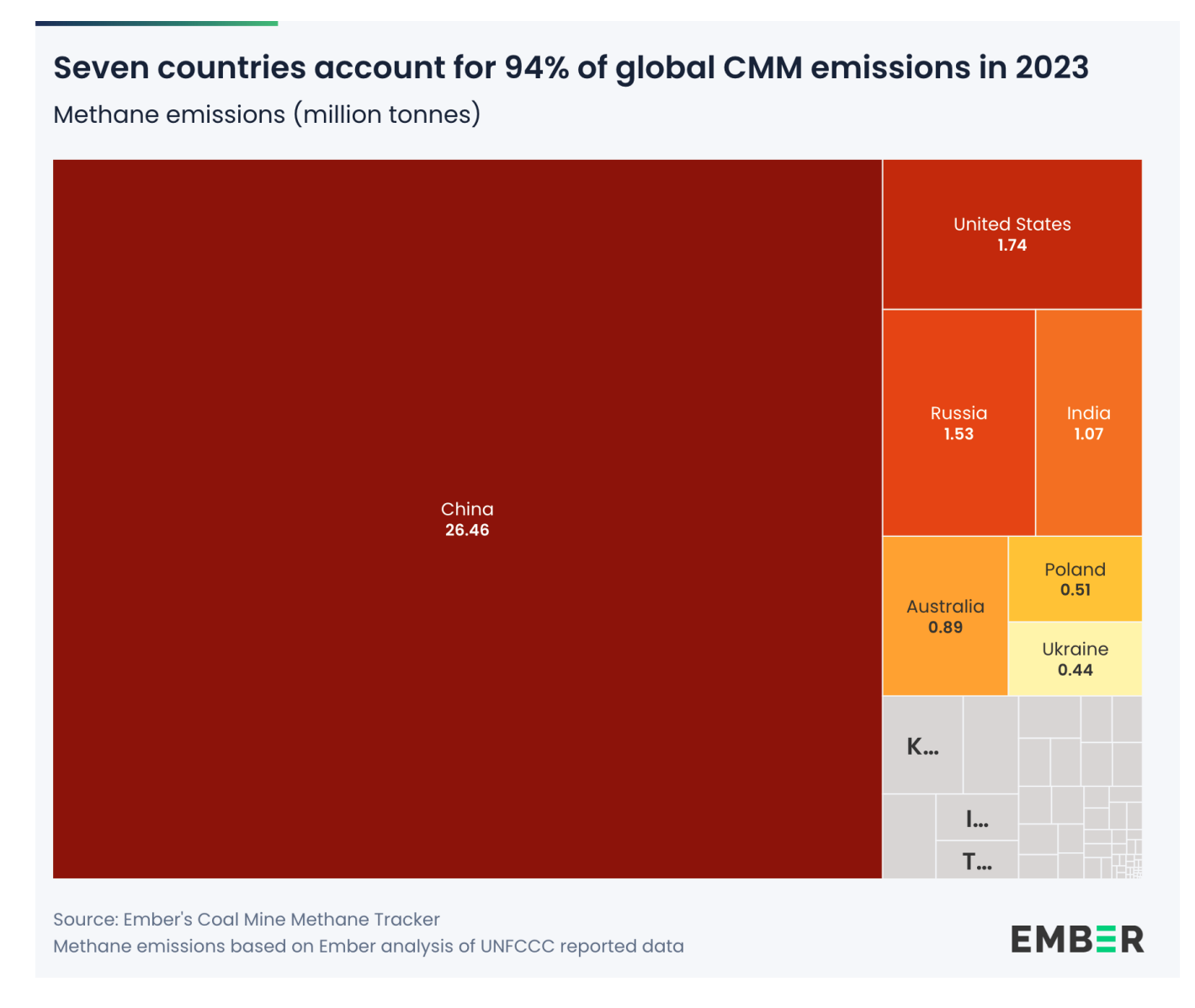
Seven countries account for almost all of it. China alone contributed 76% of global coal mine methane emissions in 2023, with the United States, Russia, India, Australia, Poland and Ukraine together accounting for a further 18%. Nine countries together account for 94% of reported global emissions.
Yet in 2023, six of those nine largest emitting countries — China, India, Indonesia, the United States, South Africa and Kazakhstan — submitted no coal mine methane data whatsoever to the United Nations Framework Convention on Climate Change. Of the 73 countries that mined coal in 2023, only 23 submitted any emissions report at all. Those 23 countries reported a combined 3.8mn tonnes — roughly 11% of the UNFCCC-derived estimate of total global emissions, leaving 89% unreported.
The unreported emissions — approximately 31mn tonnes — are not a rounding error. They represent a volume of gas that policymakers are being asked to manage without any reliable data on its existence, location or scale.
The measurement gap
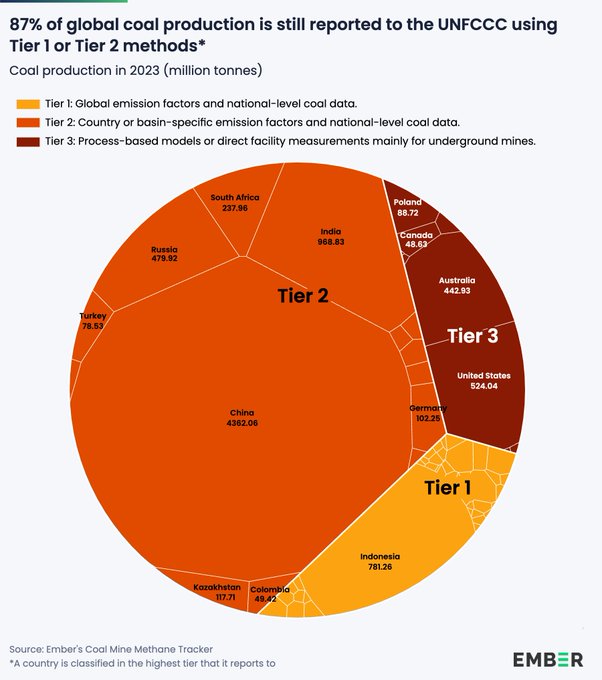
The problem is not simply that countries fail to report. It is that even where reporting exists, it is almost entirely based on generic estimates rather than direct measurement. Of the 73 countries assessed, 67 rely exclusively on Tier 1 or Tier 2 methods — applying global or national emission factors to coal production statistics — rather than conducting direct mine-level measurements. These Tier 1 and Tier 2 approaches represent 87% of global coal production.
The consequences of this methodology gap are visible in the divergence between official figures and independent estimates. South Africa reports coal mine methane emissions of approximately 0.06mn tonnes per year. The IEA estimates the true figure is 2,300% higher. The Global Energy Monitor estimates it is 1,800% higher.
Indonesia, which uses global emission factors and does not account for emissions from underground mines, reports figures that independent estimates place 400 to 1,300% higher.
Even Australia, which has reported falling methane intensity from its coal sector over the past decade — largely due to a shift toward open-cut surface mining believed to carry lower emissions — is now attracting scrutiny from satellite data. TROPOMI satellite plume detections indicate approximately 40% more methane from Australian coal mines than appears in national inventories. Australia has begun reviewing its estimation methods for open-cut operations.
Russia reports that improved methane management at underground mines has reduced emissions intensity by 1.6 tonnes per thousand tonnes of coal produced over the past decade. Independent estimates from the IEA place Russian emissions at 154% higher than the official UNFCCC-derived figure, though the report notes particularly large uncertainty in Russia's case due to sparse TROPOMI satellite coverage at high latitudes.
"Coal mine methane emissions are largely unreported, masking their true scale," said Rebekah Horner, Ember's data analyst for coal mine methane. "Transparent, measurement-based reporting would raise confidence in official figures, and existing abatement technologies could reduce emissions by more than half within this decade. Solutions already exist and are ready to be widely implemented."
Satellites, super-emitters and a 1,400% increase in detection
The gap between what governments report and what satellites can observe is narrowing — but unevenly. Between 2019 and 2024, satellite observations of methane emission plumes from coal mines increased from 101 to 1,509, an approximately 1,400% increase, as new instruments including TROPOMI, EMIT and Carbon Mapper's Tanager-1 — which became fully operational in summer 2025 — have expanded detection capabilities.
Yet despite 71% of global hard coal production being located in regions with theoretically favourable conditions for satellite detection, only 10% of that production has been observed via satellite at all — defined as having at least one attributed methane plume detected. Almost none of India's hard coal production has publicly available satellite detections, despite 73% lying in regions classified as favourable. South Africa's coal production is in 99.5% favourable conditions, yet only 7% has had a plume attributed to it.
In Poland, the EU Methane Regulation's stringent venting restrictions and mandatory reporting requirements have driven greater regulatory scrutiny, resulting in detected plumes across 49% of hard coal production. Canada, supported by Carbon Mapper's North America-focused programme, achieves 31% detection despite only 16% of its mines being classified as theoretically favourable.
The economics of action — and inaction
The report's most striking finding may be the cost of fixing the problem. According to IEA and UNEP estimates, fully deploying proven abatement technologies could reduce global coal mine methane emissions by 54 to 63% — cuts of between 19 and 27mn tonnes per year by 2030.
The total cost of cutting emissions in half would be less than $4bn per year — equivalent to approximately 16% of global coal mining profits in 2025, which the report estimates at $23.7bn based on aggregated data from the 131 most profitable coal mining companies. 12% of potential abatement is available at no net cost at all. Drainage station capture — which involves collecting methane from the coal seam before and during mining and using it as fuel — actually generates revenue in 62% of cases, meaning the abatement pays for itself.
Anglo American (LSE: AAL) has demonstrated the commercial viability of the approach at its Queensland metallurgical coal mines, spending approximately $100mn per year on gas mitigation infrastructure — equivalent to around $20 per tonne of CO₂ equivalent — and capturing gas before and during mining, abating approximately 60% of reported methane emissions in 2023, rising to 70% in 2024 with improved sealing practices.
Yet despite this clear economic case, uptake across the industry remains negligible. Only 130 of 1,800 active mines globally have reported any mitigation project to the Global Methane Initiative.
Put another way, cutting global coal related methane emissions in half would cost less than one day's global military spending. As IntelliNews reported, we are fighting the wrong war: since the Paris Agreement in 2015 a total of $7 trillion has been invested in tackling the Climate Crisis, whereas $28 trillion has been invested into defence. Reversing that four-to-one ratio would quickly solve the worst climate problems.
Health, food and the Hormuz connection
The report draws a direct line between coal mine methane abatement and public health. The Global Methane Status Report estimates that implementing all technically feasible methane mitigation measures could prevent over 180,000 premature deaths annually by 2030, avert nearly 19mn tonnes of annual crop losses and save 53bn hours of lost outdoor worker productivity due to extreme heat. The monetised value of those benefits exceeds $330bn per year — more than double the estimated $127bn annual cost of implementation.
The disruption to the Strait of Hormuz since March 2026 has focused global attention on the fragility of fossil fuel supply chains. Yet coal mine methane — a fossil fuel emissions source that could be captured and utilised — remains almost entirely unmonitored and unmanaged. The methane recoverable from coal mine drainage systems represents approximately 15bn cubic metres of gas annually, equivalent to roughly one-eighth of the 112 bcm of LNG that transited through the Strait of Hormuz in 2025. It is, in other words, a potential gas supply sitting largely untapped beneath the world's coal fields.
Follow us online