
COMMENT: Russia, China, US and Saudi all chase Bangladesh and Pakistan power investments

Washington, Beijing, Moscow and Riyadh all put money on the table in Bangladesh and Pakistan in mid-November, but only the Russian money has produced any electricity.
In the space of about 36 hours on November 16-17, the US International Development Finance Corporation (DFC) made Bangladesh eligible for its loans and guarantees, the Russian-built Rooppur 1 reactor sent its first power to the Bangladeshi grid, and Delta Energy Saudi agreed with Pakistan's Inter State Gas Systems to study about $30bn of gas infrastructure. Days earlier, on November 12, a Dhaka cabinet committee had cleared a Chinese-built LNG terminal at a fee well above what the country already pays.
The four commitments differ sharply in weight: Russia's money is already spent and tied in for decades, China's is a fixed charge Dhaka will owe whether or not it can afford the gas, and the American and Saudi offers have so far cost their sponsors nothing. Both host countries have been short of gas since the Iran war shut the Strait of Hormuz, one of the world's chokepoints, and neither is in a position to turn anyone away.
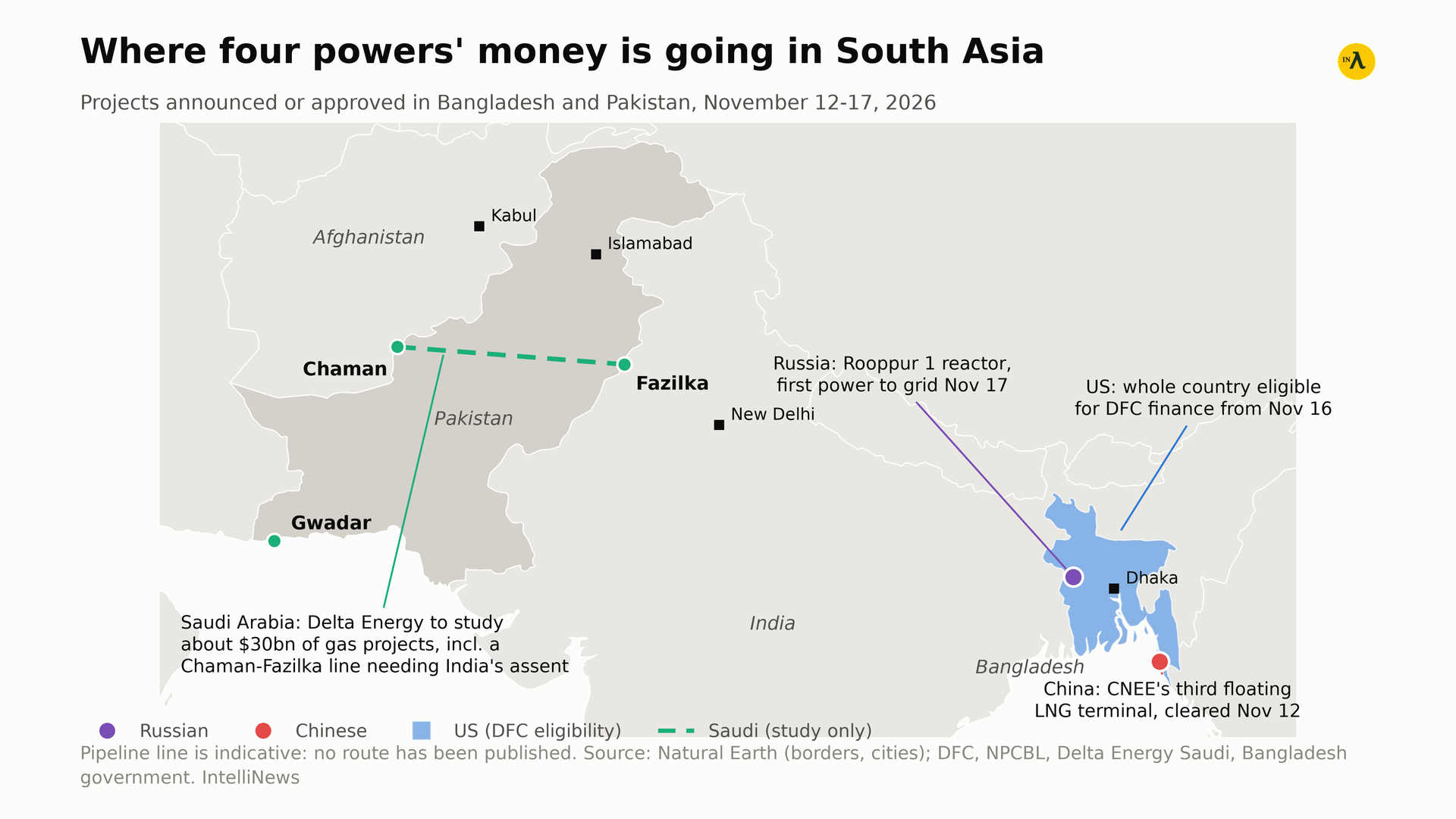
Where US, Chinese, Russian and Saudi money is going in Bangladesh and Pakistan. The Chaman-Fazilka line is indicative; no route has been published. Source: Natural Earth, DFC, NPCBL, Delta Energy Saudi, Bangladesh government. IntelliNews
Moscow's money is in the ground
Rosatom is building Rooppur's two 1,200 MWe reactors under a $12.65bn contract signed in December 2015. Unit 1 was connected at 15:16 local time on November 17 at 350 MWe on a trial basis, and full commercial supply will follow a 10-month trial run with Russia, according to the operator, Nuclear Power Plant Company Bangladesh Limited (NPCBL).
Russia lent Bangladesh about $830mn in July-March, more than the World Bank's $765mn and China's $520mn, according to Economic Relations Division figures reported by Prothom Alo. Rosatom's fuel arm TVEL is the sole supplier for the reactors' 60-year life, the kind of tie that has made uranium the new gas in Moscow's dealings with emerging markets, and Rooppur is one of the projects behind the claim that Russia's nuclear exports are booming. That supply line has a weak point: Pakistan withheld airspace clearance from a Russian fuel flight in September.
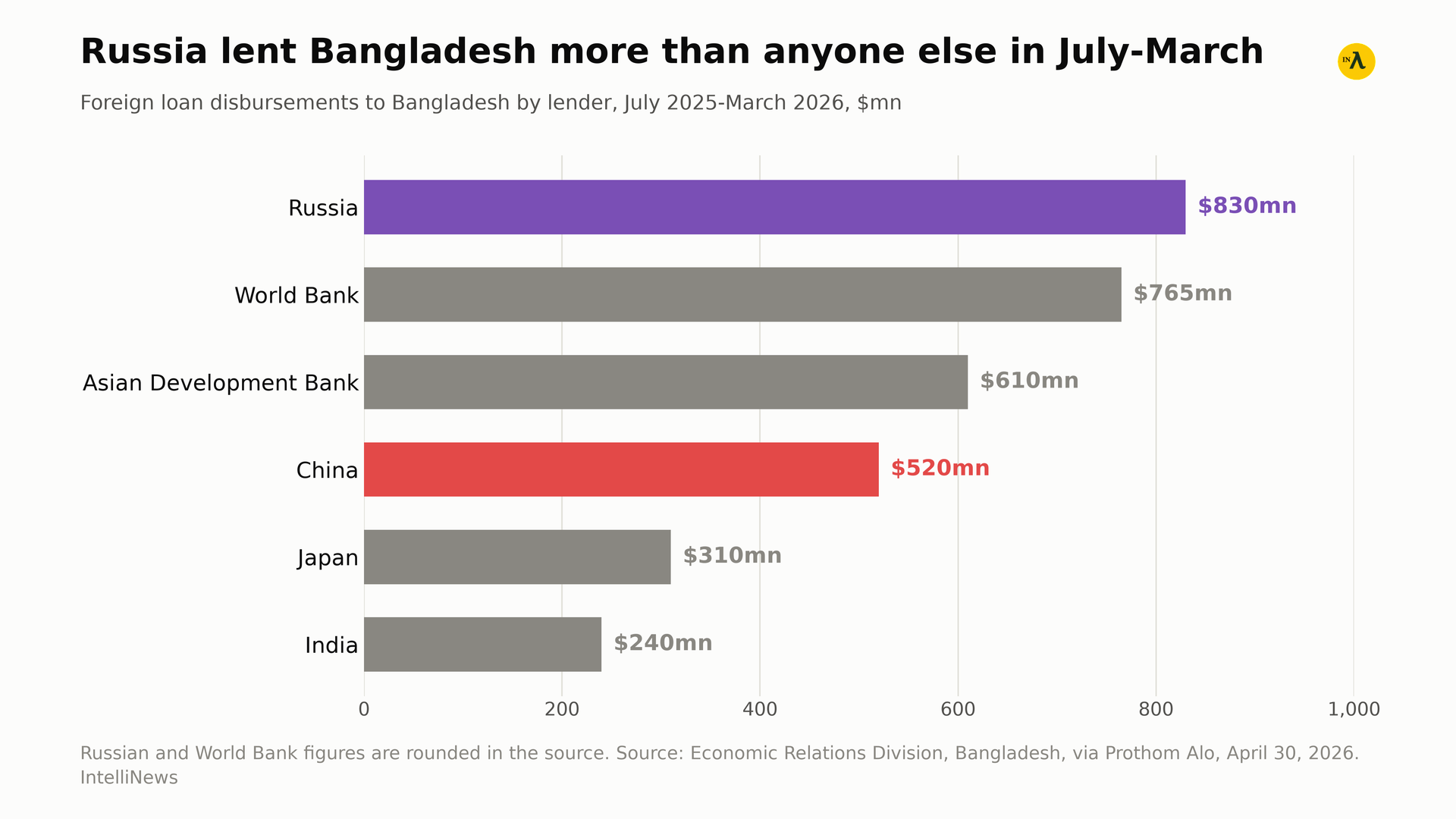
Foreign loan disbursements to Bangladesh by lender, July 2025-March 2026, $mn. Source: Economic Relations Division via Prothom Alo. IntelliNews
Beijing sets the price
China National Energy Engineering and Construction (CNEE) will build, own and operate the floating terminal at Maheshkhali, lifting Bangladesh's regasification capacity from about 1,100mn cubic feet a day to 1,700mn from 2028. Its 15-year offer is $342,000 a day, against $254,000 paid to Excelerate Energy and $249,115 to Summit LNG for the two units already there, The Daily Star reported. The contract was not tendered. At the 15-year rate the unit costs about $125mn a year, due whether or not Dhaka can pay for cargoes to fill it.
Dhaka is buying capacity because it lacks gas. Demand of about 3,800mn cubic feet a day runs against supply of roughly 2,700mn, and QatarEnergy, which supplied close to 60% of Bangladesh's LNG before the war, has extended force majeure month after month.
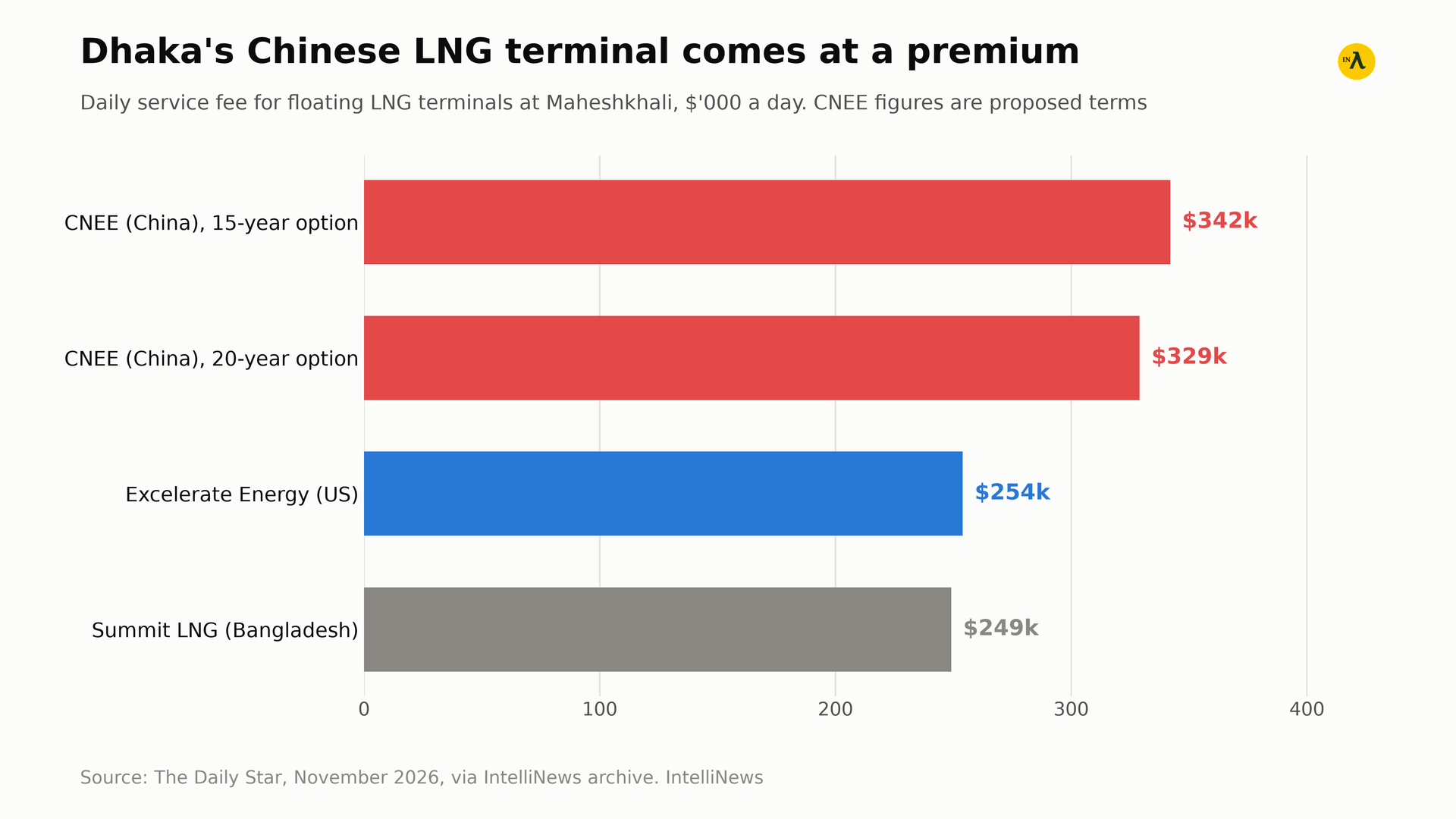
Daily service fees for floating LNG terminals at Maheshkhali, $'000 a day. CNEE figures are proposed terms. Source: The Daily Star. IntelliNews
Washington offers access, not cash
"Bangladesh's eligibility for DFC financing marks an important opportunity to deepen our economic partnership and mobilize private investment that delivers lasting growth," DFC chief executive Ben Black said in the agency's statement.
No project or sum has been named. Eligibility follows the Agreement on Reciprocal Trade of February 9, after which Dhaka committed to buy 25 Boeing aircraft and more American oil and wheat, and a civil nuclear memorandum signed with Washington in September.
Riyadh's line runs through New Delhi
Delta Energy's plan includes a pipeline from Chaman, on the Afghan border, across Pakistan to the Indian frontier near Fazilka, fed from Afghanistan's Kashk concession and other Afghan reserves. The company calls the route a "core strategic commitment" but says it needs formal agreements with both Pakistan and India. The deal sets terms for a study and commits neither side to fund or build anything. TAPI, the Turkmen line that was also meant to end in India, has taken three decades to reach Herat.
Gulf money has so far reached Pakistan mostly as central bank deposits, which can be called back: the UAE demanded repayment of $3.45bn once the Iran war began.
Russia is the only one of the four whose capital has generated electricity, and Moscow will control the fuel for 60 years. China's terminal is a bill Bangladesh has accepted before securing the gas. Washington and Riyadh have bought a seat at the table for the price of a press release and a feasibility study.
Follow us online