
COMMENT: Why China is hedging for now in the Middle East

As the US-Israel-Iran war enters its second month, one of the most consequential geopolitical actors has been conspicuous by its silence. China has not intervened, has not condemned, and has not chosen sides in any meaningful public way. But Beijing is not simply watching. It is calculating — and according to a note by Joseph Webster, a senior fellow at the Atlantic Council's Global Energy Center and editor of the independent China-Russia Report, that calculation is driven almost entirely by commerce, and may not hold.
The two-week ceasefire was due to expire today, but US President Donald Trump extended it indefinitely on April 21 as the consequence of an escalation of the war has catastrophic implications for the global economy and it is increasingly clear that this is a war that the US cannot win.
That means more diplomacy. And as China is by far the biggest customer for Gulf oil, Beijing is stepping up its game to end the conflict.
The clearest public signal of Beijing's current position came on April 20, when Xi Jinping spoke by telephone with Saudi Crown Prince Mohammed bin Salman (MbS). The readout in the authoritative People's Daily was pointed.
"China advocates an immediate and comprehensive ceasefire and supports all efforts conducive to restoring peace, while adhering to resolving disputes through political and diplomatic means," Xi said. "The Strait of Hormuz should remain open to normal navigation."
The explicit reference to Hormuz — directly contrary to Iranian preferences — was not accidental. It came days after the Crown Prince of Abu Dhabi, Sheikh Khaled bin Mohamed bin Zayed Al Nahyan, had visited Beijing and met with Xi in person. Read together, Webster argues, the signals point toward a coherent if limited posture. "Taken in tandem, the visit and the call with Arab leaders suggest that Beijing may be considering a sort of 'pro-Arab neutrality' amid the US-Israel-Iran war," he writes.
Webster is careful to define what that neutrality does and does not mean. "This doesn't mean that Beijing will desist from supplying intelligence, defence industrial base support, or even weapons to Tehran," he says. "Instead, it suggests limited enthusiasm in Beijing for a region-wide war that would damage key oil suppliers and export markets."
The commercial arithmetic
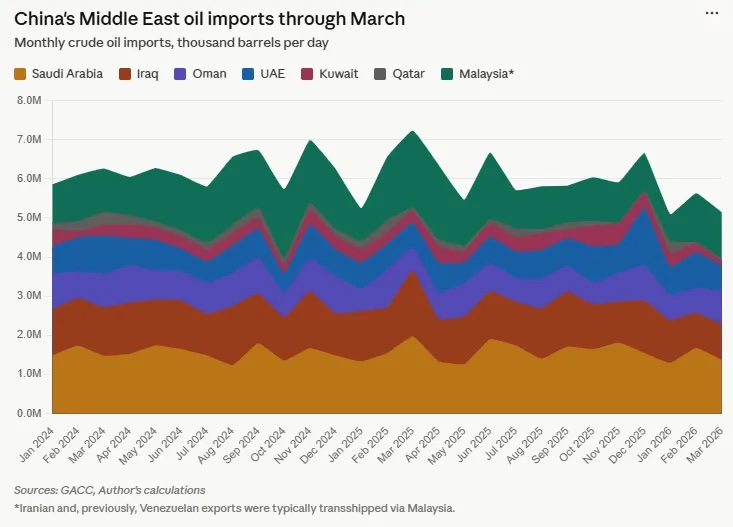
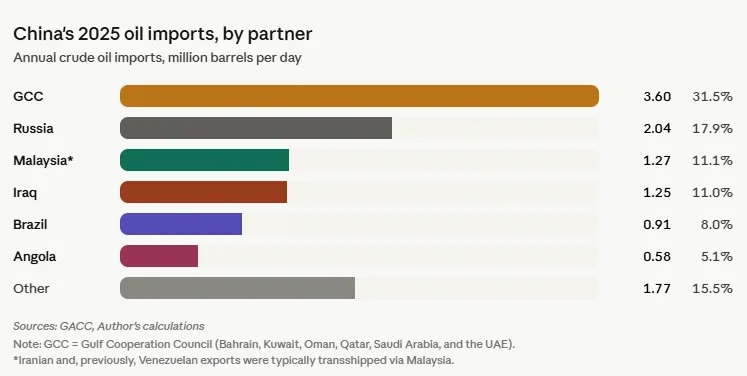
The reason for Beijing's restraint is written large over its trade data. China's total oil imports ran at approximately 11.43mn barrels per day in 2025, sourced from a deliberately diversified range of suppliers. Russia is the single largest individual source, accounting for around 18%, but if the GCC countries are treated as a whole — Saudi Arabia, the UAE, Qatar, Kuwait and their neighbours — they constitute a significantly larger share of China's total imports.
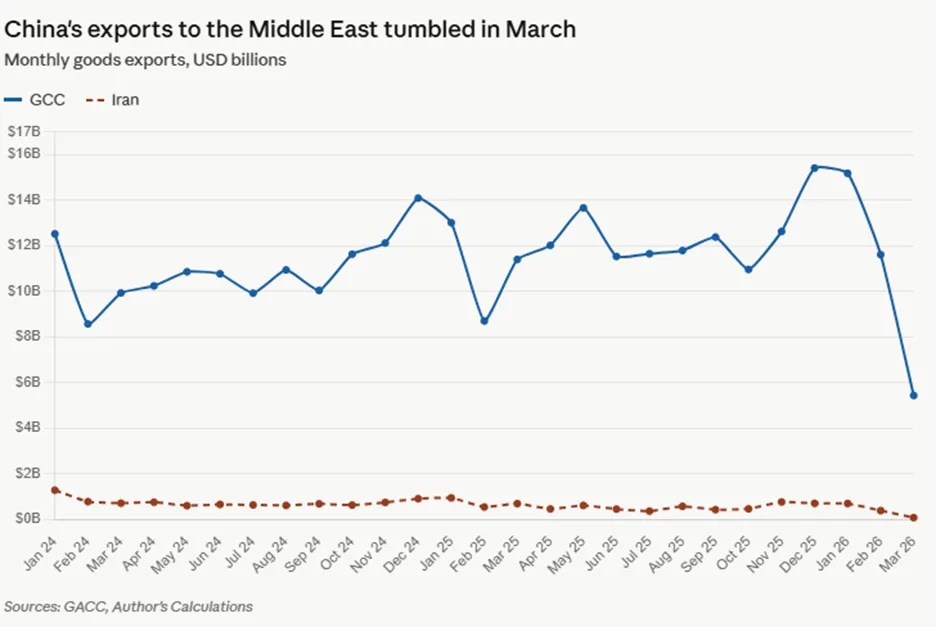
And it is not just imports of oil from the Gulf that is in play. The GCC countries accounted for approximately 6% of China's total merchandise exports in 2025. Since exports comprised around 19.3% of Chinese GDP that year, shipments to the Gulf translated directly into 1.1% of total Chinese economic output. Those exports have already tumbled in the March data — the latest available — as the conflict's economic shockwaves ripple through the region.
"Beijing sees more risks than opportunities from a Middle East war, for now," Webster argues.
Beijing's muted response to the conflict has included an eye-catching omission: China skipped trilateral naval exercises with Iran and Russia in the weeks immediately before hostilities began. Webster reads this as a deliberate act of distancing rather than scheduling happenstance. China has actively cooperated with Russia in a series of naval exercises in the last few years, messaging to the US that its navy has come of age and is able to counter any implicit threat to block China’s trade. A special focus has been on the potential of China’s navy to impose a naval blockade on Taiwan that would bring its economy to its knees in a matter of weeks.
While China will absorb economic damage from the war's disruption of commodity and export flows, it has spent years stockpiling oil reserves (an estimated 1.4mn barrels) and is "relatively well-prepared for the crisis, at least when compared to regional rivals."
The Malacca dilemma unravelling
The more structurally important argument in Webster's analysis concerns the medium and long term — and it carries significant implications not just for the Gulf states but for Washington and Taipei.
For decades, one of the US' most potent coercive instruments against China in any Taiwan contingency has been what strategists call the Malacca Dilemma: the vulnerability of Chinese oil tankers to US naval interdiction as they transit the Strait of Malacca. As IntelliNews reported, the Strait of Hormuz is not the only global chokepoint in play in the current tensions, although no action has been taken to close the other key shipping lanes yet.
To counter the Chinese blockade of Taiwan, the US could cut the oil flow through the Malacca straits, the argument runs, and bring China's economy to its knees without firing a shot in the Taiwan Strait.
Webster argues that the instrument is eroding faster than Western policymakers have registered. "Beijing is rapidly mitigating its Malacca Dilemma," he says, pointing to the structural transformation of China's transport sector.
Thanks to the EV revolution, where sales of electronic vehicles overtook those of conventional cars this year, Chinese gasoline consumption has already peaked. Diesel demand is under mounting structural pressure as battery electric heavy-duty vehicles nearly tripled in sales in 2025. "While some of these sales were pulled forward from 2026 due to tax incentives, the trend is clear and will accelerate when more energy-dense batteries, such as solid-state batteries, are commercialised," he argues. China has emerged as the global green energy champion and is rapidly becoming the world’s first electrostate that will cushion it from the looming oil crisis.
Fleet turnover takes years, not months, and Webster acknowledges the transition will be gradual. But the direction is unambiguous. "As PRC dependence on interdictable Middle East crude declines, so does the coercive value of a US naval blockade along the Malacca Strait in a Taiwan contingency," he warns. "Washington and Taipei need to think now about what deterrent instruments can replace the Malacca dilemma."
When the calculus inverts
For Beijing, it is not about the present crisis but the next one. As China's structural dependence on Gulf oil diminishes, its interest in Gulf stability may diminish with it — and could eventually invert entirely.
"In the medium term, and given its relative energy self-sufficiency, Beijing may have an interest in instigating a future Middle East energy crisis through an Iranian proxy," Webster writes. The logic is simple, as an electrostate ramping up the current energy crisis would hurt China’s rivals more than China. An energy shock that damages Europe and the US while leaving an increasingly self-sufficient China relatively unscathed could be geostrategically attractive.
"As Beijing's energy self-sufficiency grows, its structural alignment with the GCC weakens, raising the possibility that Beijing's calculus on regional instability could eventually invert."
The conclusion is a warning addressed explicitly to Gulf capitals. "In the future, both Moscow and Beijing may have an interest in ensuring an unstable Middle East," Webster says. The GCC states, he argues, should weigh not only how Beijing is behaving in this crisis but how it might behave in the next one — when the commercial logic that is currently restraining Chinese opportunism no longer applies.
For now, Xi's call for Hormuz to stay open reflects a Beijing that needs the Gulf more than it wants to admit as its green revolution is not complete. The question Webster poses is how much longer that remains true.
Joseph Webster is a senior fellow at the Atlantic Council's Global Energy Center and a nonresident senior fellow at its Indo-Pacific Security Initiative. He is editor of the China-Russia Report, an independent nonpartisan newsletter. The views expressed are his own.
Follow us online