

Data on super-polluting plumes show Turkmenistan’s joining of Global Methane Pledge has achieved little
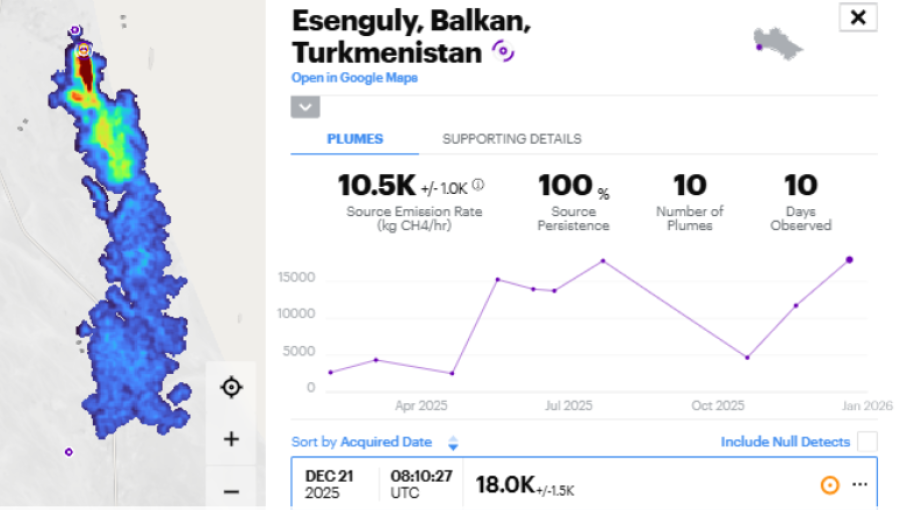
Back in December 2023, Turkmenistan proclaimed that it had joined the Global Methane Pledge and was set to tackle its proliferation of super-polluting plumes. Around 28 months later, new analysis has shown that it is still one of the worst countries in the world when it comes to potent methane mega-leaks that contribute hugely to global heating, even though the gas releases are typically simple and cheap to fix.
A top 25 list of such mega-leaks, produced by the Stop Methane Project at the University of California, Los Angeles (UCLA), is dominated by facilities in Turkmenistan. Researchers at the project have called the situation with Turkmenistan and other culprits “maddening”.
As the Guardian reported on March 17, Turkmen officials claimed last October that the gas-rich Central Asian country’s methane mega-leaks had been reduced.
“Management has placed this under special control, and leaks are being repaired locally within two to three days,” state media outlet Turkmenportal quoted Muhammetberdi Byashiev, head of the environmental protection department at state company Turkmengaz, as saying as he pointed to collaboration with the UN, International Energy Agency (IEA) and EU. However, there is no sign of Turkmenistan making meaningful progress in sealing sources of its giant methane plumes.
“It’s clear that Turkmenistan is trying to access the European [gas] market,” Cara Horowitz at UCLA told the Guardian, adding: “European potential buyers should pay attention to our results and think of this as a ‘buyer beware’ moment.”
The EU is bringing in supposedly tight limits on methane leaks linked to imported gas.
“Methane was the stealth pollutant gas for many years: invisible, out of sight and out of mind,” Horowitz was also reported as saying. “But we can now see these tremendously powerful emissions using satellites and use that as a wake-up call for the world,” she added.
The UCLA Stop Methane analysis is based on data from Carbon Mapper. It itemises 4,400 significant plumes recorded in 2025. Each emitted at a rate of more than about 100kg/hour, or the equivalent of running 20,000 SUVs.
Follow us online