

Despite reserves, Venezuela produces little oil – STATISTA

On January 3, the US military conducted a series of strikes across northern Venezuela including in the capital, Caracas, and extrajudicially captured Venezuelan President Nicolás Maduro and his wife, Cilia Flores, Statista reports.
The military operation, estimated to have killed at least 80 people, marks a dramatic escalation in the tensions between the two nations. Over the past months, Washington had expanded its presence in the Caribbean. President Maduro and his wife were flown to New York, where the Venezuelan leader faces four criminal charges: narco-terrorism conspiracy, cocaine importation conspiracy, possession of machine guns and destructive devices and conspiracy to possess machine guns and destructive devices.
While US President Donald Trump has long maintained that his country's targetting of Venezuela is part of a campaign against drug trafficking, he has since been unambiguous that the country's large oil reserves were a primary factor for the removal of President Maduro.
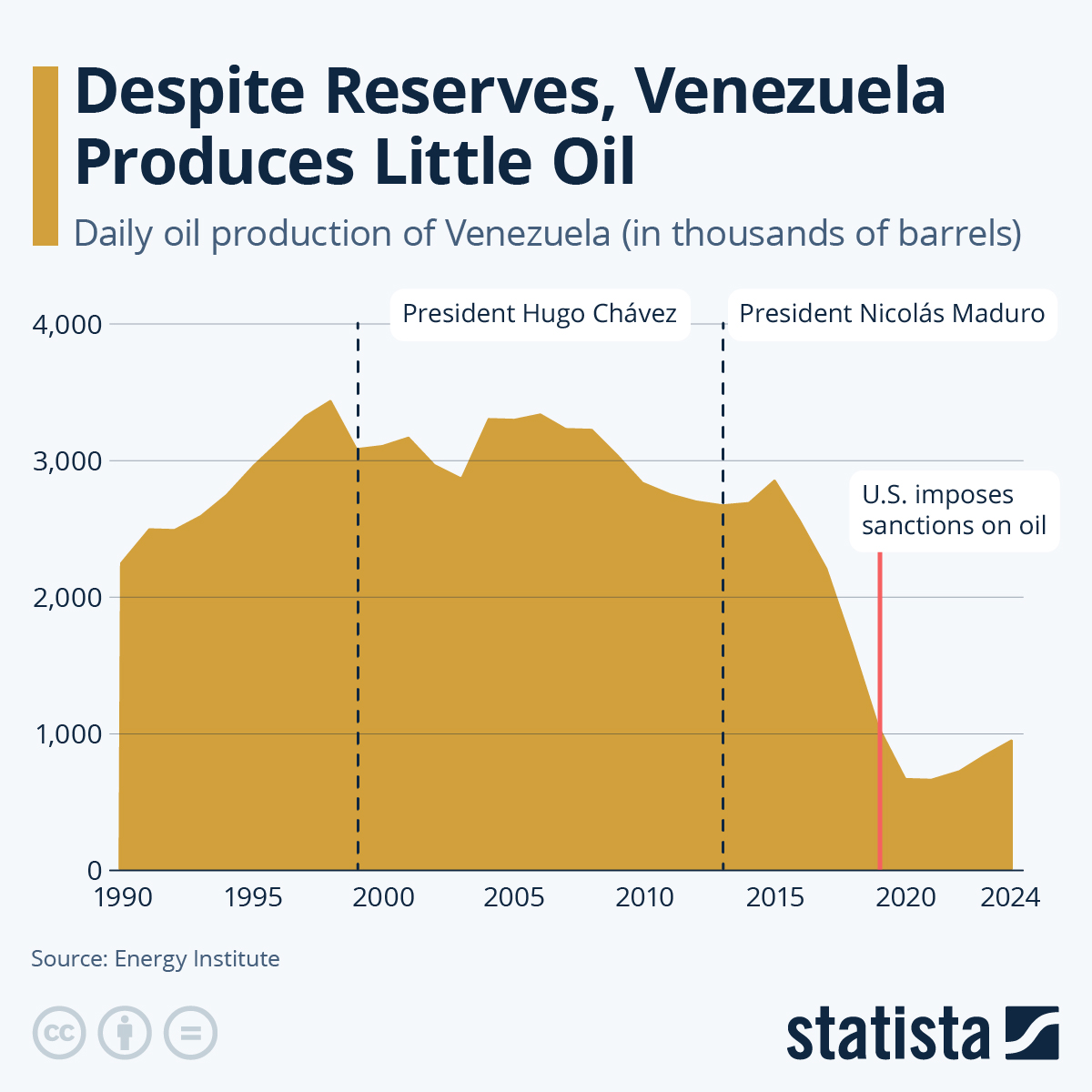
Venezuela holds the world's largest crude oil reserves: more than 300bn barrels, or nearly one fifth of the world's proven reserves. Despite this, Venezuela's oil production is relatively small, and has seen a sharp decrease in the last decade.
This is due in part to the country's declining oil infrastructure, which has suffered from a lack of investment, but also to the sanctions imposed by the US from January 2019 during the Venezuelan presidential crisis. Today, Venezuela produces less than 1 mn barrels of oil a day (bpd); comparatively, the US produces over 20mn bpd, and Saudi Arabia just under 11mn. Venezuela exports most of its oil production to China.
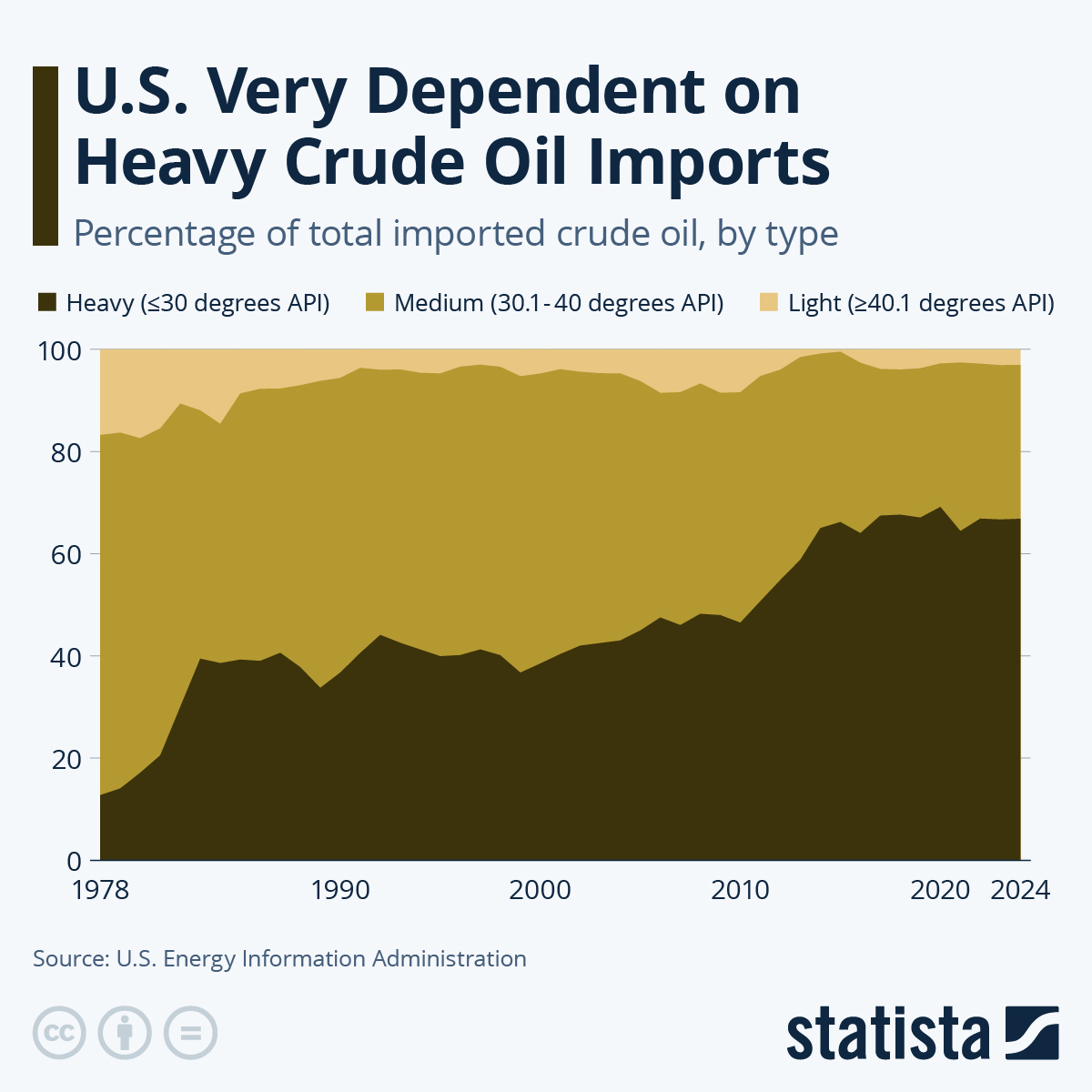
While Venezuela sits on the world's largest proven oil reserves, the country produces far less oil than the US. However, it's the type of oil found in Venezuela that explains America's interest. Most of America's refineries are set up to process heavy crude oil (under 30 degrees API), exactly the type of crude oil found in Venezuela, while the vast majority of the oil now produced in the US is light crude (over 40 degrees API).
In other words, US refineries can't process most of the oil produced in their own country, and overhauling these refineries would cost billions of dollars.
As our infographic shows, US dependency on heavy crude has grown significantly in the last four decades: it represented close to 67% of the crude oil imported in the country in 2024, compared to 13% in 1978, according to data from the US Energy Information Administration.
 You will find more infographics at Statista
Follow us online