
Europe killed 25,000 of its own people this summer for want of air conditioning

Extreme heat has killed more than 25,000 people across Europe this year, on data compiled by Insurance Journal from government agencies and research institutions in Germany, Spain, France, the UK, Switzerland and the Netherlands. Germany alone accounts for an estimated 11,900 excess heat deaths since April, according to the Robert Koch Institute.
Western Europe has been hit by four separate heatwaves since May. The late-June wave alone produced more than 10,000 excess deaths on EuroMOMO's monitoring, with France recording at least 5,764, some 36% above the expected level.
This is what happens to a continent that never built cooling into its housing stock. Air conditioning is not a luxury question in a 40C city; it is the difference between an uncomfortable week and a mass-casualty event, and Europe has spent decades treating it as an unnecessary luxury.
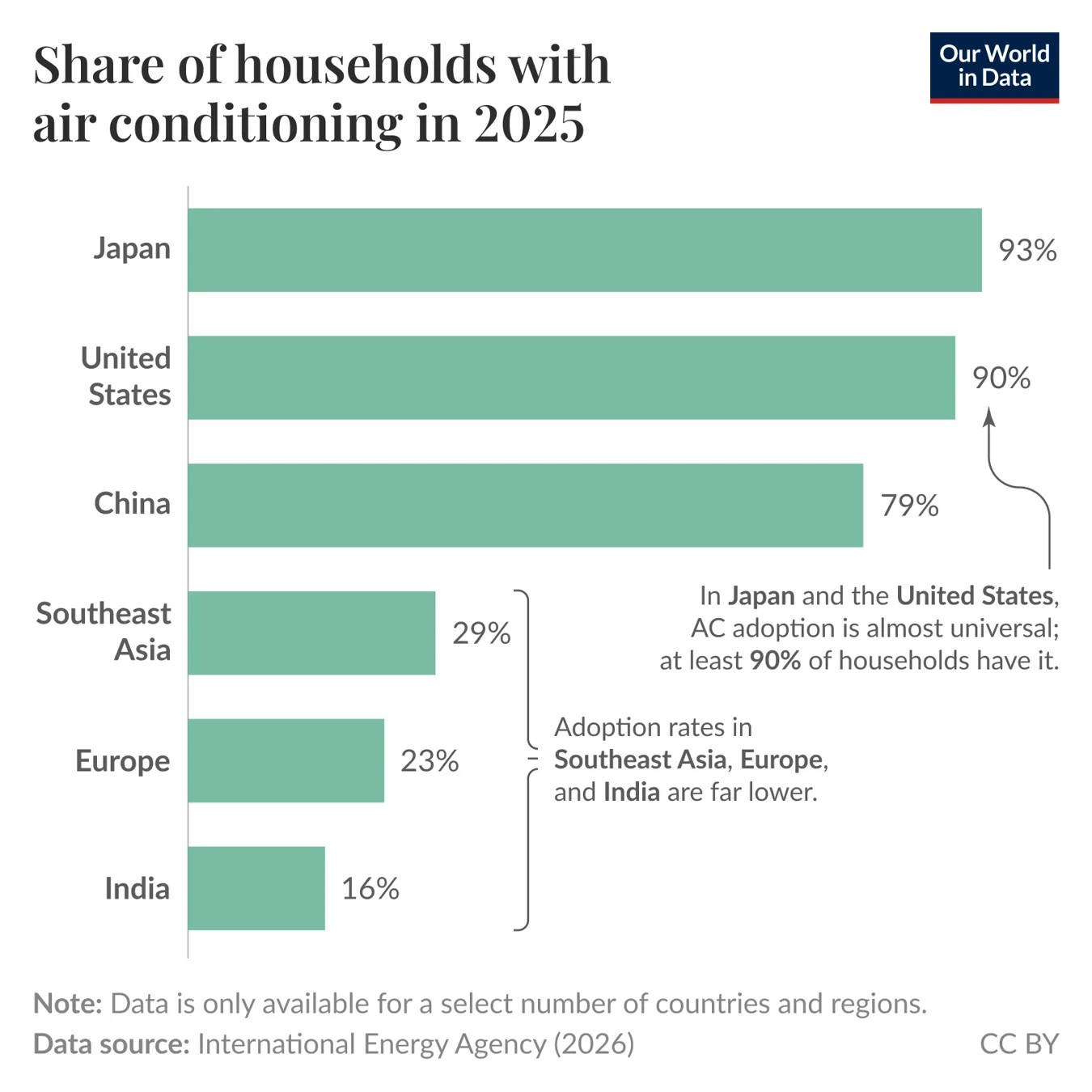
Share of households with air conditioning in 2025. Source: International Energy Agency (2026), via Our World in Data, CC BY.
The gap is not small. Some 93% of Japanese households and 90% of American ones have air conditioning, and 79% of Chinese ones - a share that has climbed rapidly over the past decade. In Europe it is 23%. In Southeast Asia it is 29%, and in India 16%. A large part of the gap is the populations in the rich world can afford the electricity bill that comes with cooling, whereas a recent study found the average Indian household cannot afford to run an air conditioning unit for more than 44 minutes a day.
Two different reasons for the same number
The low European and Asian figures look alike and are nothing of the sort, as Hannah Ritchie set out in a data insight for Our World in Data drawing on new International Energy Agency estimates.
"In lower-middle-income countries like India, the reasons are often economic: AC would bring huge benefits, but many households cannot afford the upfront cost or the power to run it," she wrote. "Much of Southeast Asia faces a similar barrier."
Europe's barrier is in its head, not its wallet. "AC was not seen as a necessity because heatwave events were less frequent and intense than they are today," Ritchie wrote. "That is changing, and will continue to do so as the planet warms."
A rich continent that chose not to buy cooling can change its mind in a decade. A poor one that cannot afford the electricity cannot. Measured against average residential electricity consumption, a household in India could run a typical 1,000-watt air conditioner for 44 minutes a day if it spent every unit of power it has on cooling and nothing else - no lighting, no cooking, no charging a phone.
Sri Lanka gets 39 minutes on the same calculation, Pakistan 37, Zimbabwe 25, Nigeria 13, Kenya 10, Haiti eight, South Sudan four, Rwanda three and Chad one, on Our World in Data's own analysis. Billions of people have access to less electricity per day than an air conditioner needs to run for an hour.
Which is why cooling access, not cooling efficiency, is the question that decides how much of the world stays habitable. The three billion people projected to be living inside uninhabitable zones by 2070 are overwhelmingly in the places where nobody can afford to run a compressor. Wet-bulb temperatures that make outdoor life lethal arrive on the same map as one-minute-a-day electricity.
The market moves first
Turkey shows what the adjustment looks like when it starts. Household air conditioner ownership there is set to nearly double within a decade, from a stock of roughly 11mn units in 2025, on assessments compiled by the energy ministry, which puts the cause plainly: hotter summers and more frequent heatwaves.
The electricity bill roughly doubles with it. Power consumed by Turkish household air conditioners, for cooling and heating together, is projected to rise from around 6,000 GWh in 2025 to more than 12,000 GWh within ten years.
That is the trap. Cooling demand rises fastest exactly where the grid is already straining in summer, and every additional unit of demand met by fossil generation makes next summer hotter. Venezuela's electricity demand hit an eight-year high this month for exactly this reason.
The demand for air conditioning is rising at the same pace as temperatures are during the annual disaster season. July 2026 was the joint second-warmest July on record globally, at 16.90C, 1.47C above the pre-industrial baseline, and western Europe's hottest June-July period ever recorded at 21.62C, 2.79C above average, according to the Copernicus Climate Change Service. Extra-polar ocean surface temperatures set an outright July record of 20.96C.
Soil moisture across western Europe was lower than in the drought summer of 2022, the Seine, Rhine and Danube all ran well below normal flows, and wildfire activity across western Europe was exceptional by both burned area and emissions. Further east, Uzbekistan recorded 49.7C in July, Turkmenistan was hit by severe heatwave and drought, and five Iraqi cities ranked among the hottest places on earth.
This is the annual disaster season, arriving on schedule and harder each time. Europe will buy its way out of the death toll, because it can. The 16% of Indian households with air conditioning, and the households in Chad with one minute of it a day, will not.
Follow us online