

Europe's heating season underway as gas drawdowns start from record low storage

Europe has started burning through the smallest winter gas reserve since records began in 2011, with EU storage sites 74.6% full on November 1 after five days of withdrawals.
Storage topped out at 74.96% on October 27 and has slipped every day since, to 844 TWh (80bcm), according to Gas Infrastructure Europe's AGSI transparency platform.
The previous lowest seasonal peak was 77.5% in October 2021, on the eve of the 2022 energy crisis. A year ago the bloc's sites were 82.8% full on November 1, and the average for the date over 2011-2025 is 90.5%.
Europe is going into the cold months with about a sixth less gas in hand than usual, and prices have become hostage to the headlines from the Gulf. The Dutch TTF benchmark broke through €100 per MWh ($1,180 per thousand cubic meters, €29.31/MMBtu, or $32.87/MMBtu) in October for the first time since December 2022, and the October average was about $1,000 per 1,000 cubic metres - 2.6-times the level of a year earlier, TASS calculated from ICE data.
The December TTF contract then fell more than 3% at one point on November 2, to about €95.21 per MWh, its lowest since October 29, after Iranian President Masoud Pezeshkian said Supreme Leader Mojtaba Khamenei had authorised talks with the US, the agency reported.
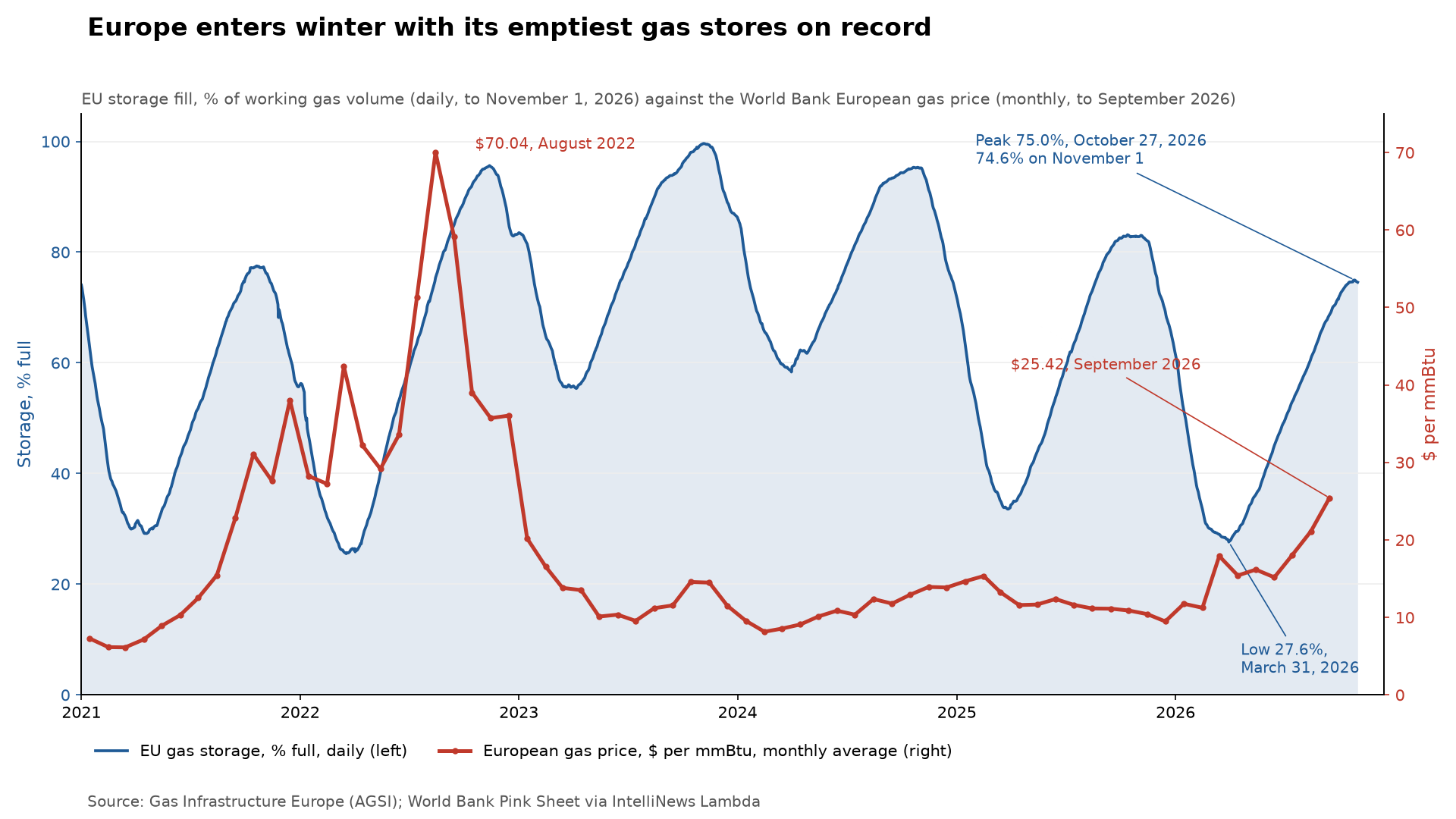
EU gas storage, % full (daily, left, to November 1, 2026) against the World Bank European natural gas price, $ per mmBtu (monthly average, right, to September 2026). Source: Gas Infrastructure Europe (AGSI); World Bank Pink Sheet via IntelliNews Lambda.
The monthly figures show how far the price has climbed without pulling enough gas into the stores. The European gas price averaged €77.33/MWh ($25.42 per mmBtu) in September, according to the World Bank's Pink Sheet, the highest since December 2022 and more than double the €33.83/MWh ($11.12/mmBtu) of September 2025.
It had stood at €28.84/MWh {$9.48/mmBtu) in December 2025, before the US and Israeli strikes on Iran at the end of February cut LNG flows through the Strait of Hormuz.
Storage hit its low for the year of 27.6% on March 31 and gained only about 47 percentage points over the summer. In 2022, when the price peaked at €213.07/MWh ($70.04/mmBtu) in August, the bloc added 70 points.
EU rules require member states to have their storage 90% full at some point between October 1 and December 1, with up to 10 percentage points of leeway when filling proves difficult. With withdrawals under way below 75%, even the lower bar is now out of reach, and forecasters had already warned of a 14bcm winter shortfall. Germany, the EU's biggest consumer, was only about 61% full, and its failure to fill its tanks has opened a row with Italy.
Storage at its lowest in 15 years leaves Europe more exposed than usual this winter, especially if the weather turns cold, Equinor CEO Anders Opedal told the ADIPEC conference in Abu Dhabi on November 2, according to TASS. Many buyers, including Equinor's own customers, are now looking for long-term contracts, he said.
LNG has been carrying the load. Sendout from European terminals reached about 11.1bcm in October, the most in five months and 4% more than in September, though 12% less than in October 2025, according to the agency's calculations from GIE data.
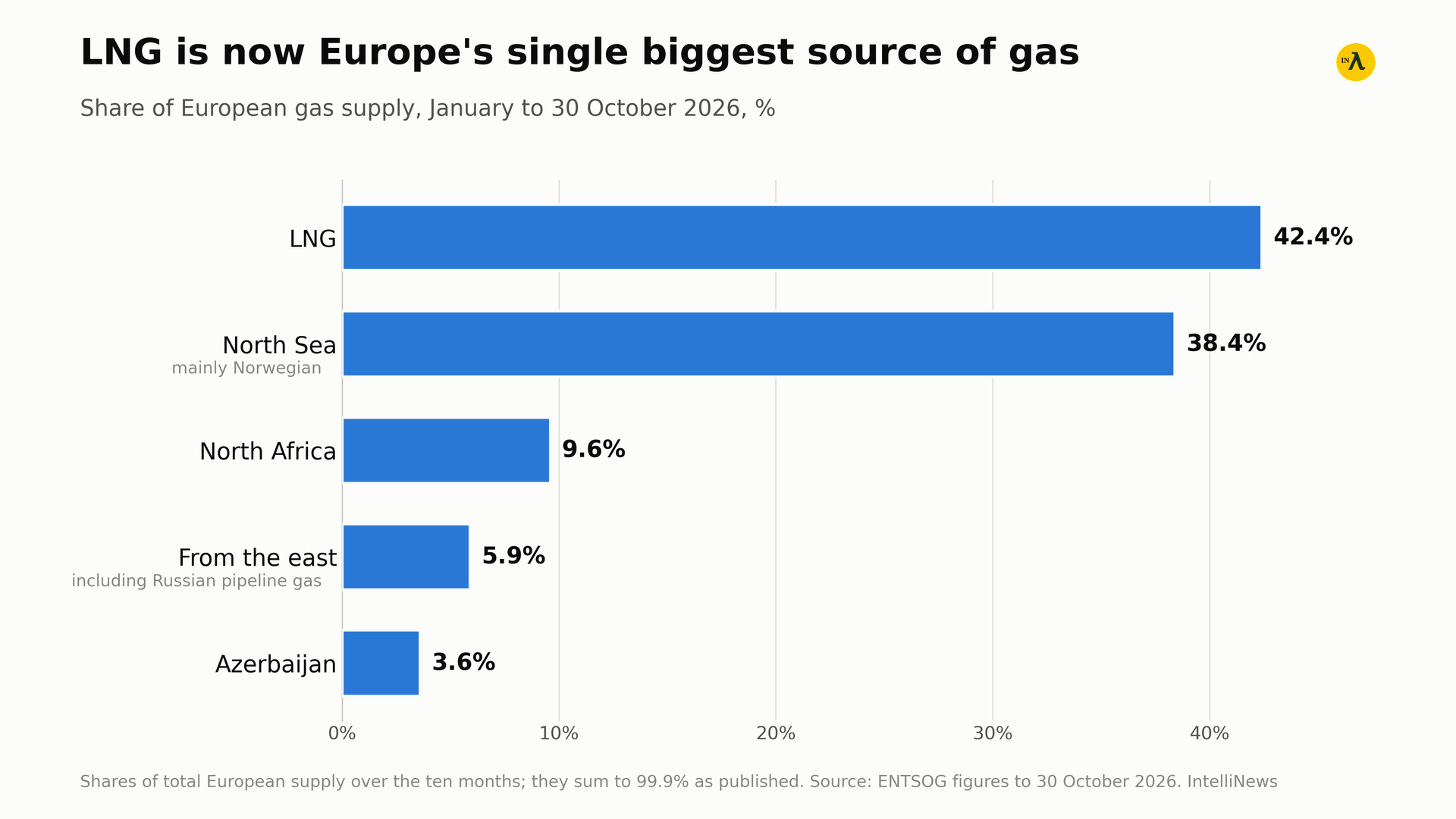
LNG accounted for 42.4% of European supply over January-October, ahead of North Sea gas, mainly Norwegian, at 38.4%, North Africa at 9.6%, supplies from the east including Russian pipeline gas at 5.9% and Azerbaijan at 3.6%, ENTSOG figures to October 30 show.
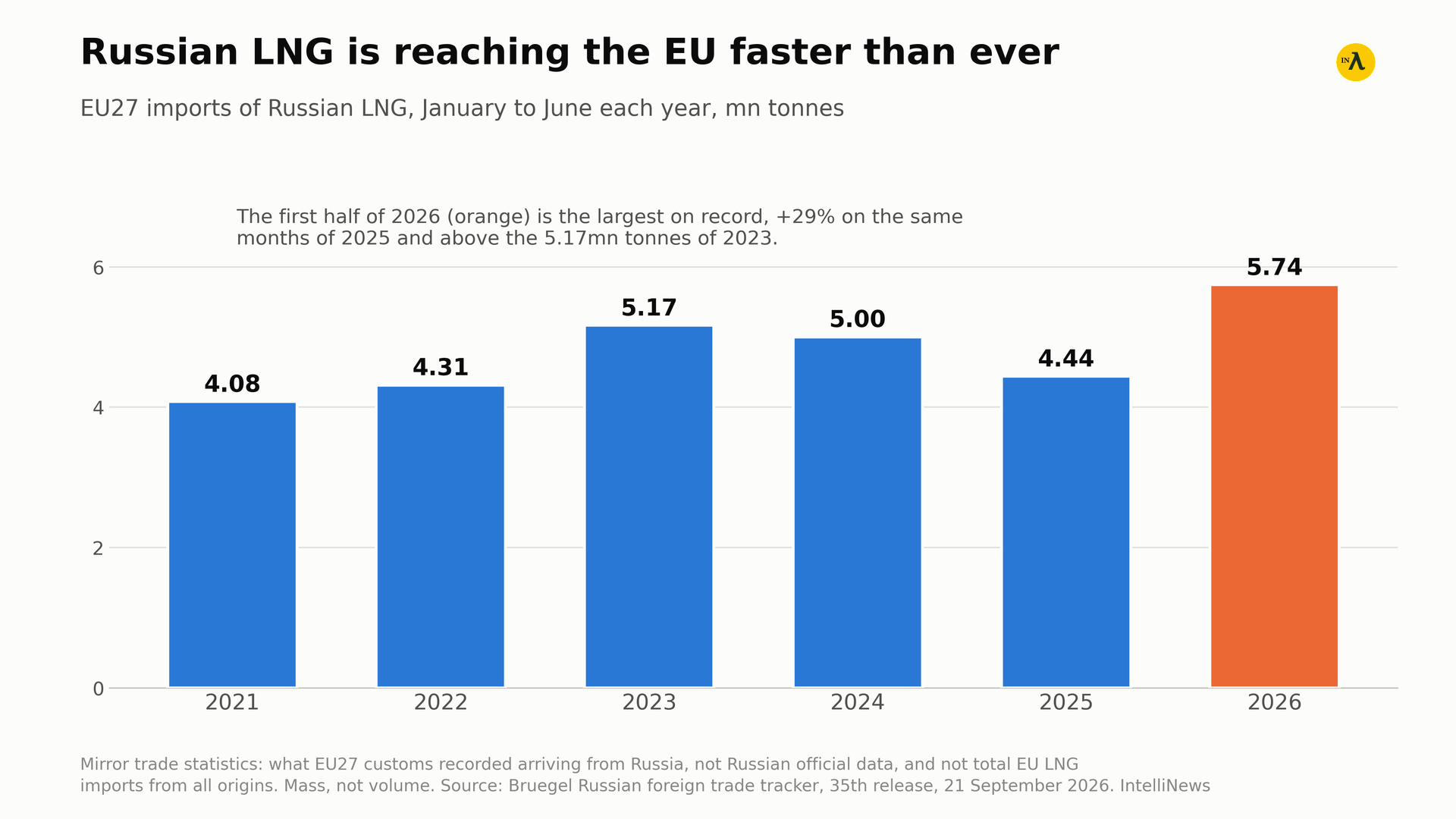
EU imports of Russian LNG rose 10% y/y to about 16.5bcm in the first nine months, the agency estimated from Bruegel data, while the bloc's total LNG purchases fell 5% to 104bcm. Russia still covers about 11% of Europe's gas consumption, down from 45% before the 2022 invasion of Ukraine, The Moscow Times reported.
The EU has committed to ending all Russian gas imports by the end of 2027, a phase-out the World Bank says could push European prices higher. Goldman Sachs estimated prices could rise to €150/MWh if this winter is cold and UNHCR just warned that is exactly what is expected.
The Kremlin poured cold water on a US idea, reported by the Wall Street Journal, of restarting Russian gas transit through Ukraine as part of a winter energy truce, an idea Brussels had already rejected.
"It is hardly possible to talk about that so far. Actually, the state of affairs on the ground more than clearly demonstrates impossibility of implementing such plans at the moment. But we will see what will be in the future," Kremlin spokesman Dmitry Peskov said on November 2, according to TASS.
Moscow is looking elsewhere. Gazprom set a new daily record for exports to China through the Power of Siberia pipeline on November 1, and Gazprom CEO Alexei Miller has warned that European prices could reach $2,500 per 1,000 cubic metres in a cold winter.
This article was produced with the help of IntelliNews Lambda analytical tool
Follow us online