
Europe's June heat wave is most severe ever recorded — and the new normal

The heatwave that seared much of Europe in late June is officially the most severe ever recorded in the region, according to a rapid-attribution study published on June 26.
Worst of all, scientists warn: “Get used to it. This is going to be normal from now on.” Climate research released this week says that even if CO₂ emissions are cut to zero now, baking hot summers will be a permanent feature of the annual disaster season as CO₂ lingers in the atmosphere for millennia.
This year’s heatwave follows on from a similar heatwave last summer and the last four years have been hottest in recorded history as the Climate Crisis accelerates faster than scientists predicted. Researchers at World Weather Attribution, who examined heat and humidity levels during both day and night across three consecutive days in June, found temperatures running between 5°C and 12°C above seasonal averages across France, Germany, Italy, Spain and southern England.
“Heat waves are driven by weather patterns but occur on the backdrop of a rapidly warming world. Without climate change the current European heat wave would have been ~3.2°C cooler,” climatologist Zeke Hausfather said in a social media post. Europe has been warming at a much faster rate than the world: roughly twice as fast as the global average, and 40% faster than the global land average.
Theodore Keeping, a research associate at Imperial College London and a co-author of the study, said the timing made the event particularly alarming. "This was the most severe heatwave for any time of the year, not just June," he said, reports Bloomberg. At the same time, "June is heating faster than any other month and now these temperatures are expected regularly."
Reports of extreme temperatures flooded social media. All-time high temperatures are being broken on an hourly basis and sometimes by a full degree. In Paris it is so hot that residents are frying bacon and eggs in frying pans left on the windowsill to be heated only by the sun – something that is more normal for residents of Dubai.
Teachers in British classrooms across the country reported indoor temperatures reaching as high as 38°C this week, according to Global Witness, even as the UK government's official advice was for schools to remain open. Many schools closed regardless. The National Education Union, the UK teachers' trade union, recommends that classroom temperatures should not exceed 26°C.
Britons will struggle to put food on table as heatwaves become the norm say scientists, the UK Independent newspaper, warned readers. Within a matter of years the heatwaves will escalate causing harvests to fail, according to one University of Oxford professor.
Temperatures in the main hospital in Freiburg in southern Germany hit 38°C, with patients lying naked in their beds, bathed in sweat. The hospital has convened an emergency task force for the first time in its history. Germany had its hottest day in recorded history: temperatures provisionally hit 41.3°C on June 26, edging above its official all-time record of 41.2°C.
More seriously, the soaring temperatures started to have health and economic consequences. Deaths from heat strokes jumped to 300 in a single day in the French capital, while its nuclear reactors are going offline, unable to source enough cooling water.
The numbers behind the records
France is bearing the brunt of the grilling. After temperatures broke above 40°C, the country recorded its hottest day since records began nearly 80 years ago on June 23.
The national thermal indicator — an average of temperatures measured at 30 weather stations — hit 29.8C, only to shatter that record again the following day. The southwestern town of Pissos recorded an individual peak of 44.3C, while temperatures across the country touched 45C in places, according to the European weather monitoring service Severe Weather Europe. Météo France placed 54 of the country's 96 mainland departments — roughly half the country — under its highest red heat alert.
“The June 2026 heatwave will go down as the most statistically anomalous heat event ever observed at any time of year in metropolitan France. The 4-day mean temperature anomaly breached the extraordinary +10°C mark,” climatologist Nahel Belgherze said in a social media post.
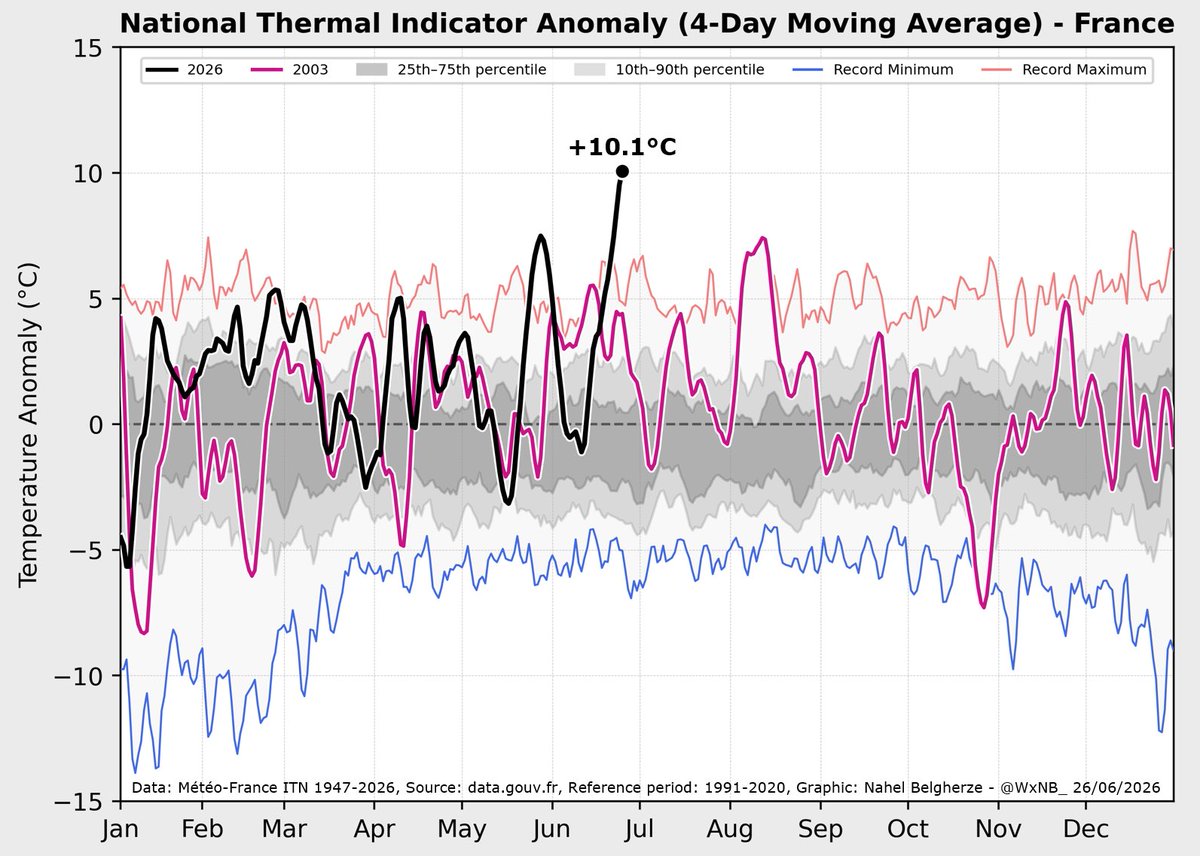
The human toll has mounted quickly. France's health ministry reported a four-fold increase in emergency-room visits for heat-related causes nationwide, with 44 cardiac arrests recorded in Paris alone in a single 24-hour period, against an average of fewer than 10. Authorities have linked at least 50 weather-related deaths to the heatwave, with figures continuing to rise; Météo-France has explicitly compared conditions to the catastrophic August 2003 heatwave, which lasted 16 days and caused an estimated 80,000 excess deaths across Europe. France's death toll from this event is already running at roughly three times the level being recorded in the UK, according to comparative reporting on the two countries' heat-related mortality.
The UK was not spared the continent's most extreme conditions. The Met Office issued only the second extreme-heat weather warning in its history, with London and southern England forecast to reach 39°C and southern Wales up to 35°C — placing Britain, by some measures, among the two or three hardest-hit countries in Europe alongside France and Spain. Train operators including the Gatwick Express cancelled or reduced services, with passengers urged to travel "only if absolutely necessary." Deutsche Bahn, the German train operator, also issued an offer to reimburse any and all tickets purchased for the upcoming days for those that want to stay home due to the extreme temperatures.
What trapped the heat in place
Meteorologists have attributed the severity and duration of the event to an atmospheric pattern known as an "omega block" — a high-pressure system flanked by two areas of low pressure, forming a shape resembling the Greek letter Ω.
The block acted, in the words of one forecasting service, "as a lid that traps a stagnant mass of dry Saharan air and relentlessly compresses it downward," holding the heat in place over central and northern Europe for days rather than allowing it to move through as a normal weather system would. Unlike a typical heatwave that passes within a day or two, an omega block can persist for a week or more, which is precisely what made this episode so savage: heat absorbed by buildings, roads and soil during the day had no opportunity to dissipate before the next day's heating began. Cities are literally baking in an oven where you can’t open the door.
Economic consequences
In the middle of the extreme heatwave where power demand surges, three of France’s 54 nuclear reactors were shut down due to the heatwave. The Golfech power plant (Tarn-et-Garonne), two other nuclear reactors in Bugey (Ain) and in Nogent-sur-Seine (Aube) were turned off as they ran out of water to cool the reactors. If the cooling waters drawn from local rivers gets too warm, it becomes ineffective in keeping the reactors cool enough, which could cause a runaway meltdown.
High heat is already hitting the poorer parts of the world. As IntelliNews reported, India's increasingly severe summer heatwaves are becoming a structural threat to economic growth, as workers refuse to work in the hottest months of the summer, or are restricted to working in the early mornings and evenings of the day.
Now these problems have migrated to the Global North. Germany’s economy is also going to be hit as water levels in rivers fall so far cargo can no longer be transported. Rhine water levels at Kaub – a key bottleneck on Europe’s industrial waterway – have fallen 0.20m in just 3 days to around 0.83m, the lowest since April 2025.
“That matters: the Rhine is a crucial transport route for Germany’s chemical industry, including BASF, Covestro and Evonik. Low water can restrict barge loads, raise logistics risks and disrupt supply chains. For now, barge rates to Basel are still flat – but the heat is on,” Holger Zschaepitz, economics correspondent for Die Welt said in a social media post.
Health consequences
Extreme weather will kill more people in poor countries than in developed countries where currently cold weather kills more than hot weather. But these problems, normally restricted to subtropical emerging markets, are now coming home to developed world northern markets.
High night-time temperatures and humidity made this year’s heatwave unusually dangerous, scientists say, because the body's ability to recover overnight was compromised. Researchers found that 45% of 854 cities across 30 European countries broke, or are expected to break, records for wet-bulb globe temperature — a composite measure of heat stress that accounts for the body's ability to cool itself through sweating. If temperatures and humidity rise to 35°C and 100% respectively simultaneously and stay there for six hours that is outside the range humanity can tolerate. As IntelliNews reported, in the near future, air conditioners will become an existential investment.
A study published in the British medical journal The Lancet found that while heat-related mortality remains lower than in southern Europe, extreme heat still poses a significant and growing public health risk, particularly for older people.
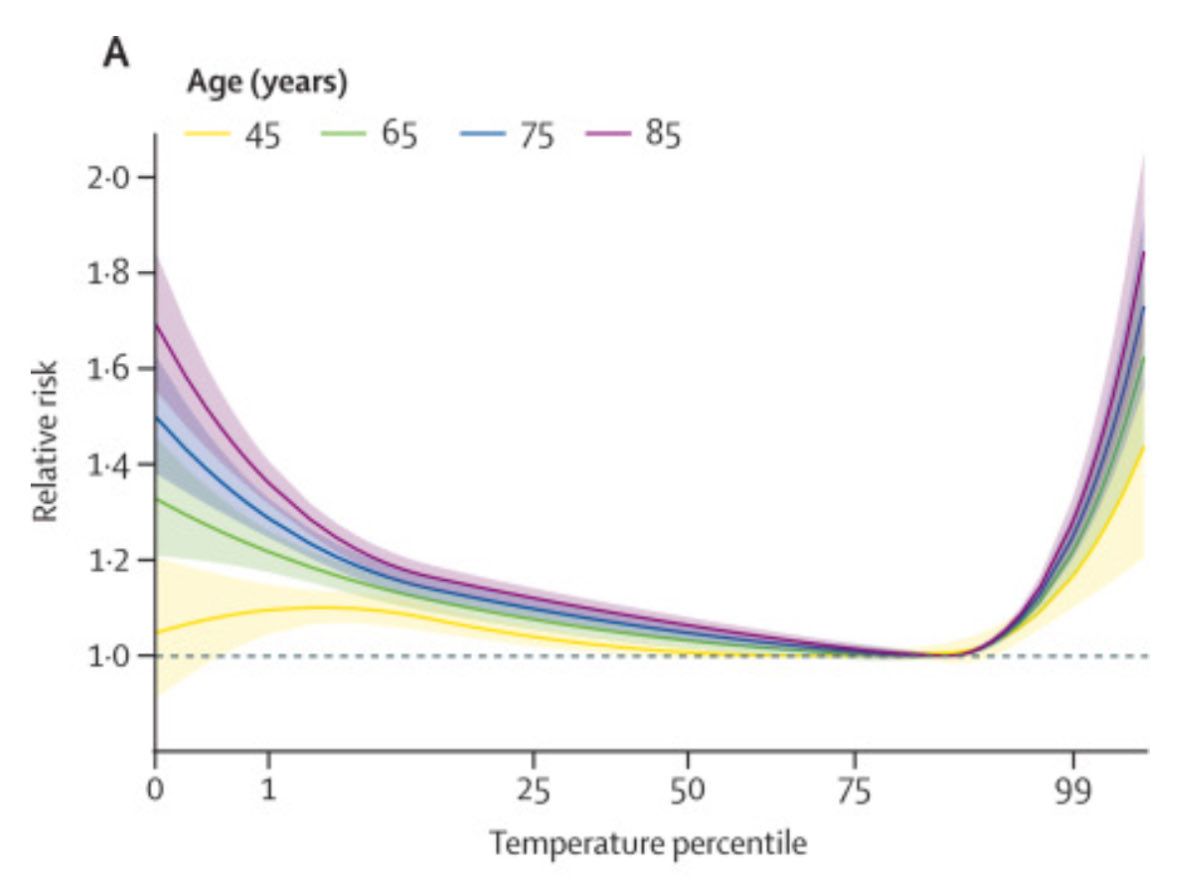
The study analysed temperature-related mortality across 854 European cities, and estimated that heat causes around 488 excess deaths each year in UK cities, equivalent to 0.16% of all deaths, or about 2 age-standardised excess deaths per 100,000 people annually. Britain's urban populations are especially vulnerable during heatwaves events because they are less acclimatised to high temperatures. And the mortality risk rises sharply with age. People aged 85 and over face the greatest danger.
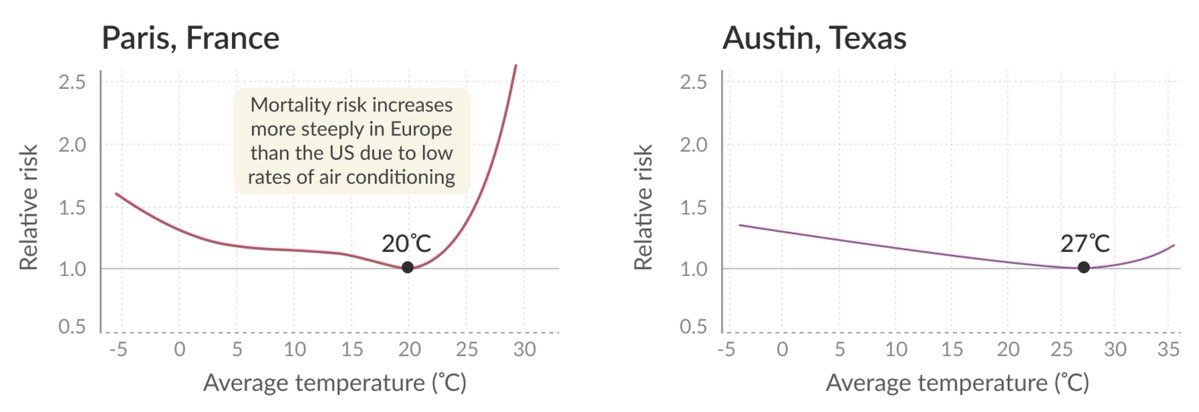
While air conditioners are widespread in the US, which is facing a similar heatwave, they remain rare in Europe. The World Resources Institute estimates that only around 20% of buildings across Europe have air conditioning — a far lower share than in comparably hot regions of the US or Asia — leaving much of the continent's housing, school and transport infrastructure built for a climate that, on the evidence of this June, no longer exists. Excess mortality rates in Paris are far higher during heatwaves than they are in Austin, Texas, despite the fact that summer temperatures are regularly higher in Texas than in Paris.
Insurance system impact
The current heatwave is now reshaping how financial institutions think about climate risk, according to Sarah Kapnick, JPMorgan Chase & Co's (NYSE: JPM) global head of climate advisory.
"The stresses that we see today are only going to get worse because heatwaves like this ten years from now will be over 40°C and it will keep going," Kapnick told Bloomberg Television, describing the pattern as a "structural investment trend" rather than a one-off event.
As IntelliNews reported, the increasing destruction of the disaster season has already led to the creation of new financial products as insurance companies scramble to reassess the risk of billions of dollars of damage the climate change is starting to do. Last year saw a new record set of wildfires that burnt over one million hectares of land for the first time ever. New catastrophe bonds have been rolled out in an attempt to create funding to pay for the estimated $28 trillion of damage inflicted in the last four years alone.
A hellish “hothouse world” looms, scientists warn as climate tipping points approach which are impossible to reverse once they are passed. Currently temperatures are rising faster than all of the two dozen climate models used to set the Paris Agreement agenda predicted as positive feedback loops between the various variables at play in global warming start to kick in.
Climate change, not El Niño — and what comes next
The June heatwave comes ahead of another mega weather event that will also boost temperatures this year – an all-time record super El Niño is on its way where water in the Pacific is expected to warm to unusually high temperatures that will have a major impact on global weather systems and usually results in floods and droughts that will disrupt agriculture world-wide.
However, the World Weather Attribution researchers were explicit that the cyclical effects of the emerging super El Niño pattern in the Pacific played no role in this particular heatwave. Such an intense June heatwave would have been "virtually impossible" 50 years ago, the researchers found.
"Yes, this is climate change," said Friederike Otto, a professor at Imperial College London and a co-author of the study. "Yes, it's us, no, it's not El Niño, yes, we have the solutions, no, we're not implementing them fast enough."
That distinction matters because of what is coming later this year. Forecasters say the super El Niño now clearly developing in the Pacific will almost certainly hit its "super" status by winter and this one will be among the most powerful on record. It is a separate phenomenon from the omega block that is causing the June heatwave, even though the two could compound each other's effects in future seasons.
Climate scientists caution that El Niño tends to amplify, rather than cause, the kind of blocking patterns and heat anomalies already being driven by background warming — meaning the conditions that produced this June's extremes may recur with greater frequency, and greater intensity in future disaster seasons, as the Pacific event intensifies through the rest of 2026.
Follow us online