

Fossil CO2 emissions set to fall 0.4% in 2026 as EU leads cuts, India rises

Global fossil-fuel CO2 emissions are set to fall 0.4% this year to 38.2bn tonnes, with India the only big emitter still rising, the Global Carbon Budget 2026 projected on November 10.
EU emissions are projected to fall 1.5%, ahead of the US at 1.3%, Japan at 1% and China at 0.9%. India stands out: its emissions are set to climb 4.4%, faster than the 3.5% average annual growth of the past decade. Emissions across the rest of the world are expected to slip 0.7%.
The dip owes as much to war as to wind turbines. Oil emissions are projected to drop 1.9%, which the scientists behind the report describe as likely a short-term response to the energy shock from the Iran conflict, after the closure of the Strait of Hormuz on February 28 turned one of the world's chokepoints into a supply crisis. Oil use cut by high prices tends to come back when prices ease, so the drop cannot yet be read as the long-awaited peak in global emissions.
"A decline in fossil CO2 emissions is encouraging, but a reduction driven partly by geopolitical shocks is not a sustainable climate solution," said Professor Pierre Friedlingstein of the University of Exeter, who led the study. "The long-term answer remains the rapid deployment of clean energy technologies."
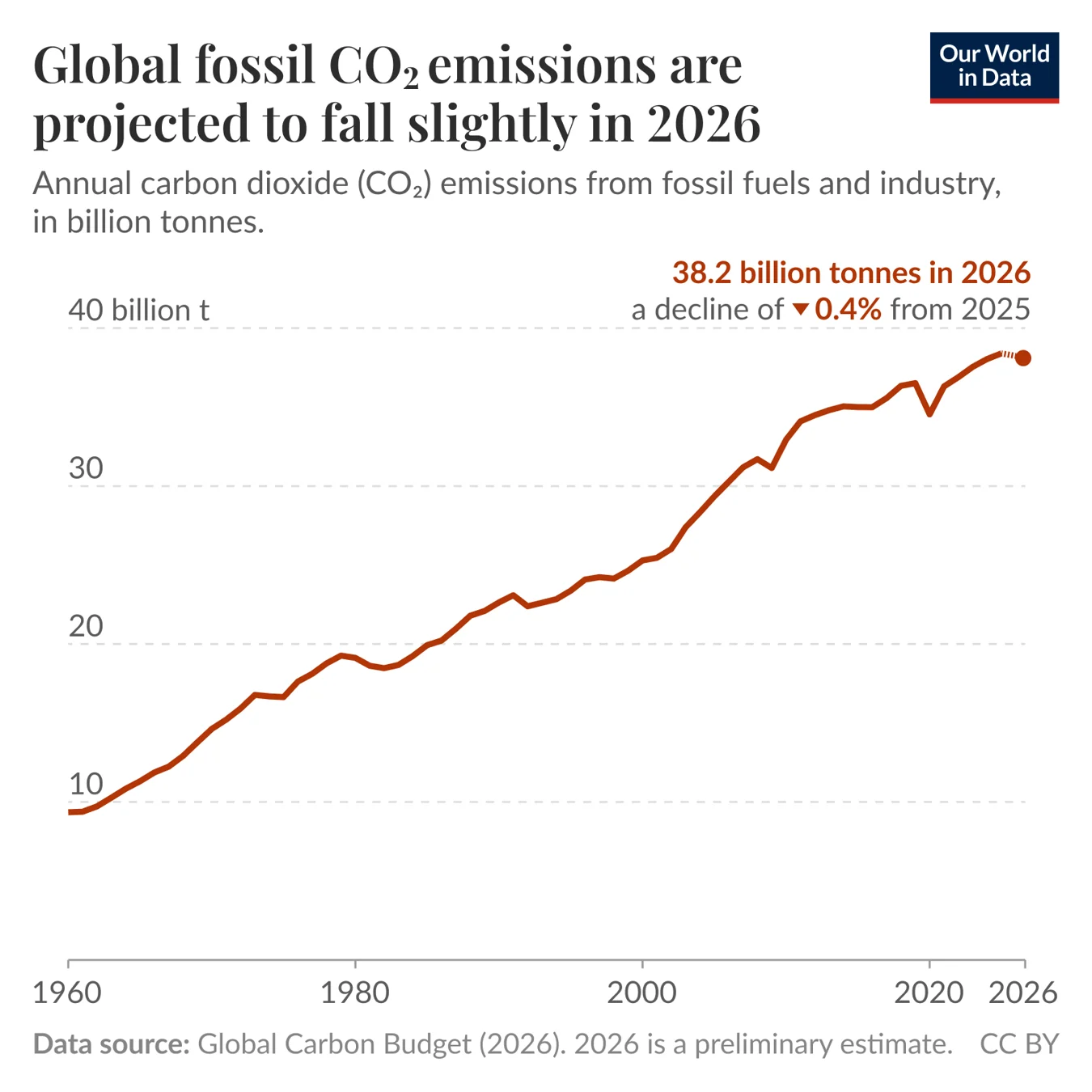
Global fossil CO2 emissions, 1960-2026, bn tonnes; 2026 is a preliminary estimate. Source: Global Carbon Budget (2026) via Our World in Data, CC BY
Clean energy is doing more of the work than before. Solar and wind power and electric vehicles are meeting two-thirds of the rise in global energy demand, according to the report. Emissions avoided by solar and wind rose from 0.28bn tonnes in 2010 to 4.1bn tonnes in 2025 and are projected at 4.6bn tonnes this year.
By fuel, gas emissions are expected to edge down 0.3%, while coal emissions are set to rise 0.6%, keeping coal the one fossil fuel still growing worldwide.
China, which produces 32% of global fossil emissions, cut its oil emissions sharply while its coal emissions rose 0.3%. It is also where half of the emissions avoided worldwide by renewables and electric vehicles are found, cementing its place as the world's green energy champion. US emissions are projected to fall mainly because coal use eased after spiking in 2025 on high gas prices and cold weather.
India runs the other way. Its 4.4% rise comes even as the International Energy Agency expects the country to become the biggest renewables growth market outside China through 2031, a sign that its new clean capacity is not yet keeping pace with demand growth.
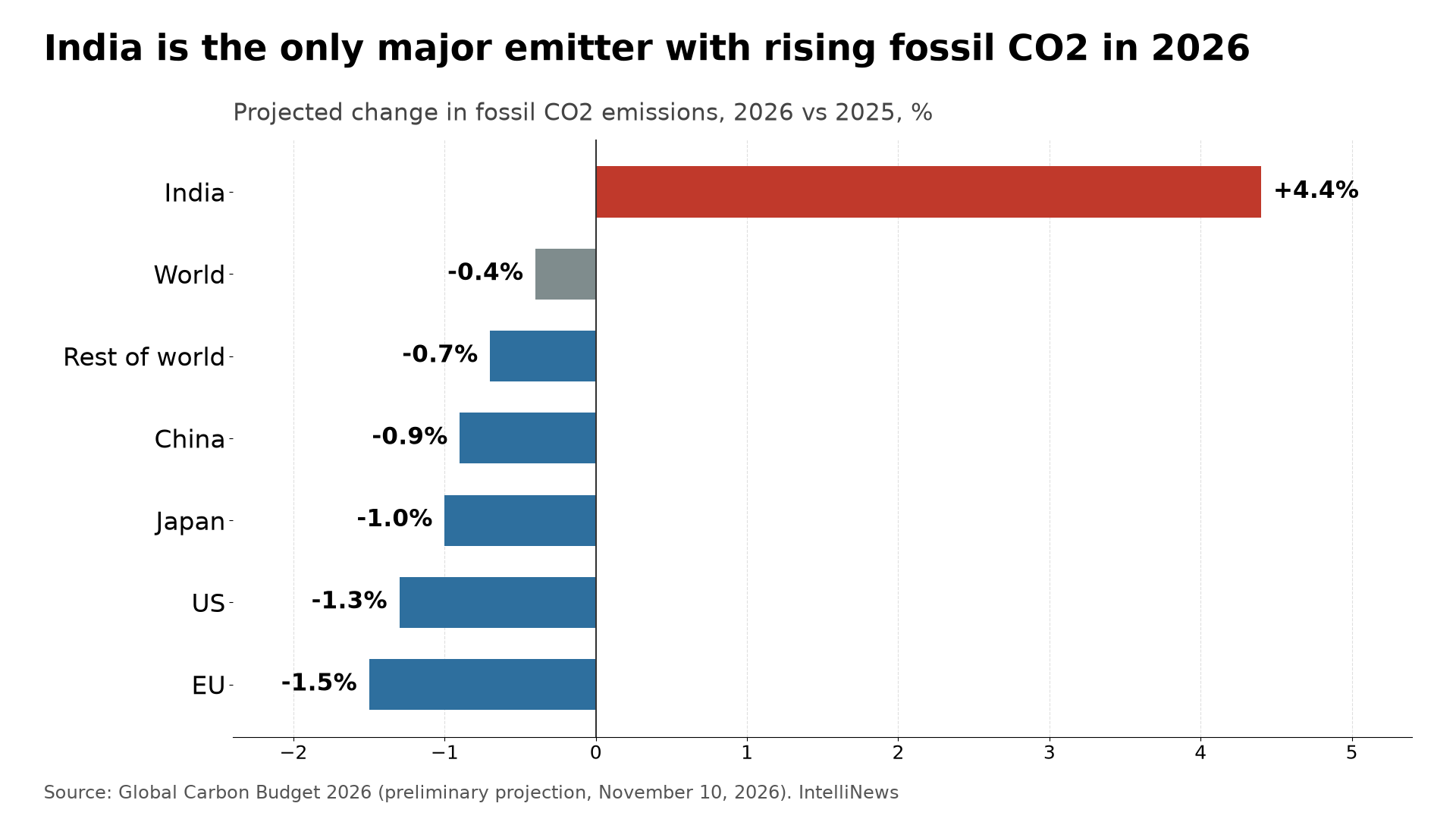
Projected change in fossil CO2 emissions in 2026, %. Source: Global Carbon Budget 2026. IntelliNews
Total CO2 emissions, including deforestation and other land-use change, are still set to reach a record 43.3bn tonnes, up from 42.8bn tonnes in 2025. Land-use emissions are projected to rise to 5.1bn tonnes, driven by peat fires and forest degradation in Southeast Asia as El Niño dries the region, where Indonesia's forest fires are already threatening its carbon credit market.
The remaining carbon budget to hold warming to 1.5C above pre-industrial levels has shrunk to 150bn tonnes, less than four years of emissions at the current rate. The concentration of CO2 in the atmosphere is set to reach 427.7 parts per million this year, 54% above pre-industrial levels.
The direction of travel is clearer than the single year. A companion paper in Nature Climate Change found that 59 countries emitted less in 2025 than in 2019 while their economies grew, though electric cars still made up only about 10% of the global car fleet in 2025. Data compiled by Carbon Brief had pointed to a fall of around 0.5% in global fossil emissions as early as September, on the back of the Hormuz closure.
"A drop in emissions in one year is not a peak unless it is driven by structural change," said Glen Peters, research professor at the CICERO Center for International Climate Research.
This article was produced with the help of the IntelliNews Lambda analytical tool
Follow us online