

Gas crisis: Only Belgium is still filling as EU gas stores sink below 70% full

Belgium was the only one of the EU's 18 gas storage countries still putting gas into the ground on November 17, the newest gas day published by Gas Infrastructure Europe. Fourteen were drawing down, against 11 on November 1, the opening day of the heating season, and EU stores have fallen below 70% full for the first time this winter.
The bloc's sites held 792.08 terawatt-hours (TWh) and were 69.95% full on November 17, against 844.27 TWh and 74.56% on November 1, according to GIE's AGSI platform. The net draw since the October 31 closing stock that opened the season is 53,153 gigawatt-hours (GWh), or 4.69% of working capacity. The draw on the day itself has widened from 1,348 GWh on November 1 to 2,253 GWh on November 17.
The opening-day picture has changed since it was reported on November 8. AGSI first put Germany down for an estimated 34 GWh injection on November 1; the confirmed figure is a net 272 GWh withdrawal. Europe's largest store was never filling on day one, and 11 countries were drawing on November 1, not the 10 the estimates then showed.
Germany remains in the most trouble and is the biggest hole in Europe's winter gas stores. It has by far the biggest tanks in the bloc, 247.4 TWh of working capacity, but went into the season the emptiest of the large markets at 61.0% full. It has been taking gas out since the first gas day of the season rather than topping it up, failing to get anywhere near the reduced 80% full by November 1 deadline.
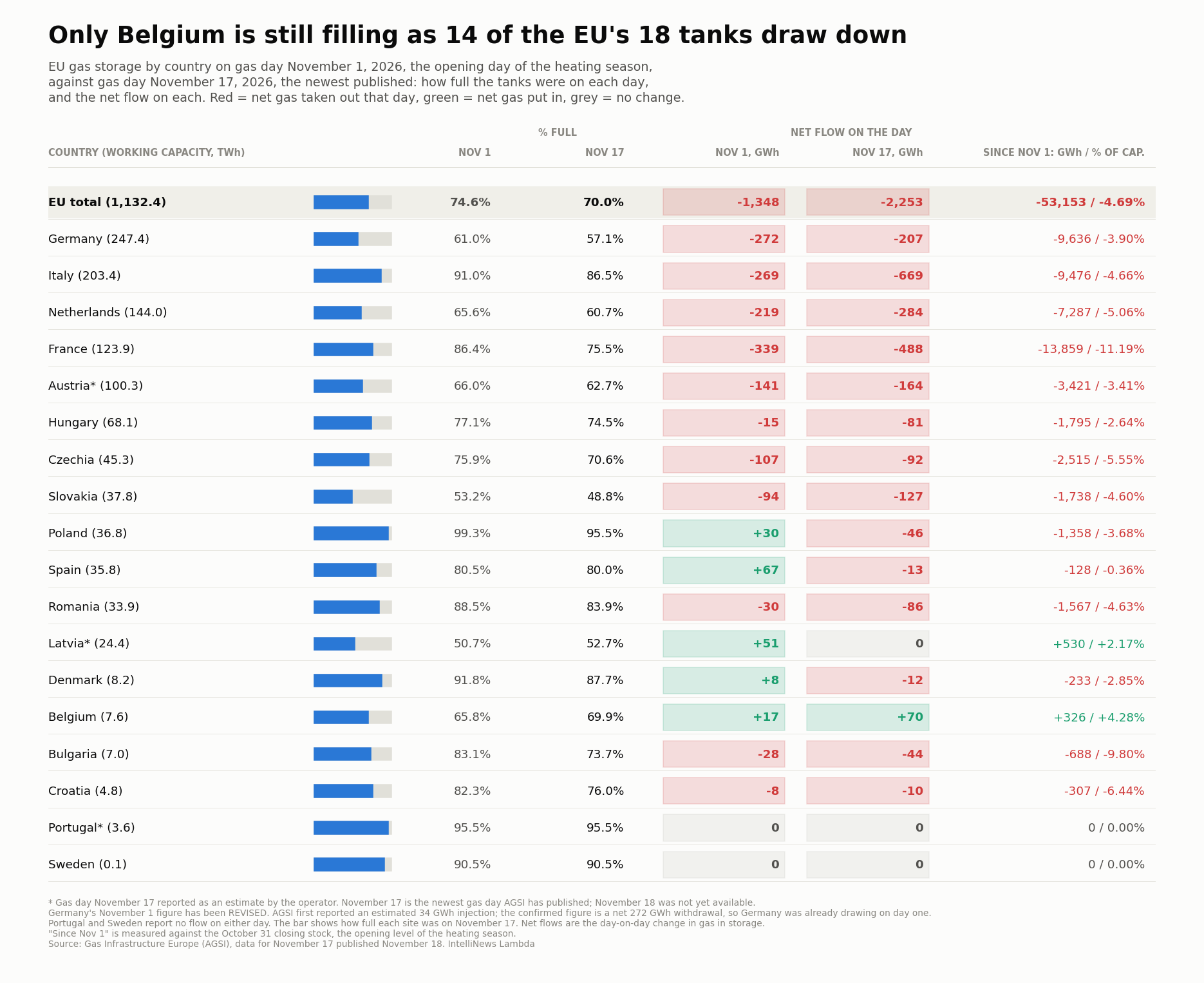
EU gas storage by country on gas day November 1, 2026, the opening day of the heating season, against gas day November 17, 2026, the newest published. Red is a net withdrawal on the day, green a net injection. Source: Gas Infrastructure Europe (AGSI). IntelliNews Lambda
Three countries flipped from injection to withdrawal between the two days: Denmark, Poland and Spain. Belgium went the other way, almost quadrupling its injection from 17 GWh to 70 GWh and lifting its sites from 65.81% to 69.86% full. Latvia stayed on the injecting side but barely, at 0.5 GWh on November 17 against 51 GWh on November 1. Portugal and Sweden, two of the smallest systems, reported no flow on either day.
France has drawn hardest against its own size, down 13,859 GWh since the start of the season, or 11.19% of capacity, falling from 86.4% full to 75.5%. In absolute terms Germany is the biggest draw at 9,636 GWh, just ahead of Italy's 9,476 GWh, though Italy went into the season nearly full at 91.0% and is still 86.5%. Slovakia is the emptiest country in the bloc at 48.8%, Poland the fullest at 95.5%, down from 99.3% on November 1.
Germany is the hole
German sites were 57.1% full on November 17, down from 61.0% on November 1. On November 9 they stood at 58.5%, against 74.8% on the same date a year earlier. Berlin missed the statutory fill target of roughly 70% for November 1 - most sites must reach 80%, six have a 45% threshold - with storage operators' association INES putting national stores at about 61.5% on the day.
The shortfall has already cost Berlin friends. Italy's energy ministry blamed Germany's late buying for pushing prices up, saying Rome had spent about €300mn subsidising injections only to pay more when Germany came to market late. The German economy ministry rejected that on October 30, arguing that the extra 8 TWh it had ordered state importer SEFE to buy would be sourced mostly from outside the EU, and setting it against the 92 TWh of injections Italy has subsidised since April.
What Berlin has done since is build a reserve, not a refill. The cabinet approved a draft law on November 11 for a 24 TWh strategic gas reserve, about 10% of German storage capacity, for use only in emergencies. It is sized to cover a 30-day shutdown of the country's gas import infrastructure, costs €1.26bn-1.81bn to buy and inject, is paid for by a levy of 0.03-0.05 cents per kilowatt-hour - €5.80-9.40 a year for a typical single-family household - and may take up to three years to fill. It does nothing for this winter.
It also replaces something. The statutory fill targets introduced in 2022 expire at the end of March 2027 and will not be extended, so summer 2027 will be Germany's first injection season in five years without a state-set storage floor. If market area manager Trading Hub Europe starts buying reserve gas in that same season, as much as 24 TWh of state purchases would land in a market that already has to refill from unusually low stocks. INES has warned that German storage could be empty by early February 2027 in a winter as cold as 2010.
The price has tripled
Europe's benchmark has roughly tripled since the new year. The Dutch TTF front-month contract peaked near €32 per megawatt-hour (MWh) in mid-January and had eased to about €29 by January 30, and was still trading in a €30-35 range in late February. It was €69 days after the strikes on Iran in early March, €85 by mid-October, and broke €100 on October 28 for the first time since December 2022. It has eased since the peak: about €90 on November 4, and €86.19 ($94.93) for the December contract on ICE Futures on November 17.
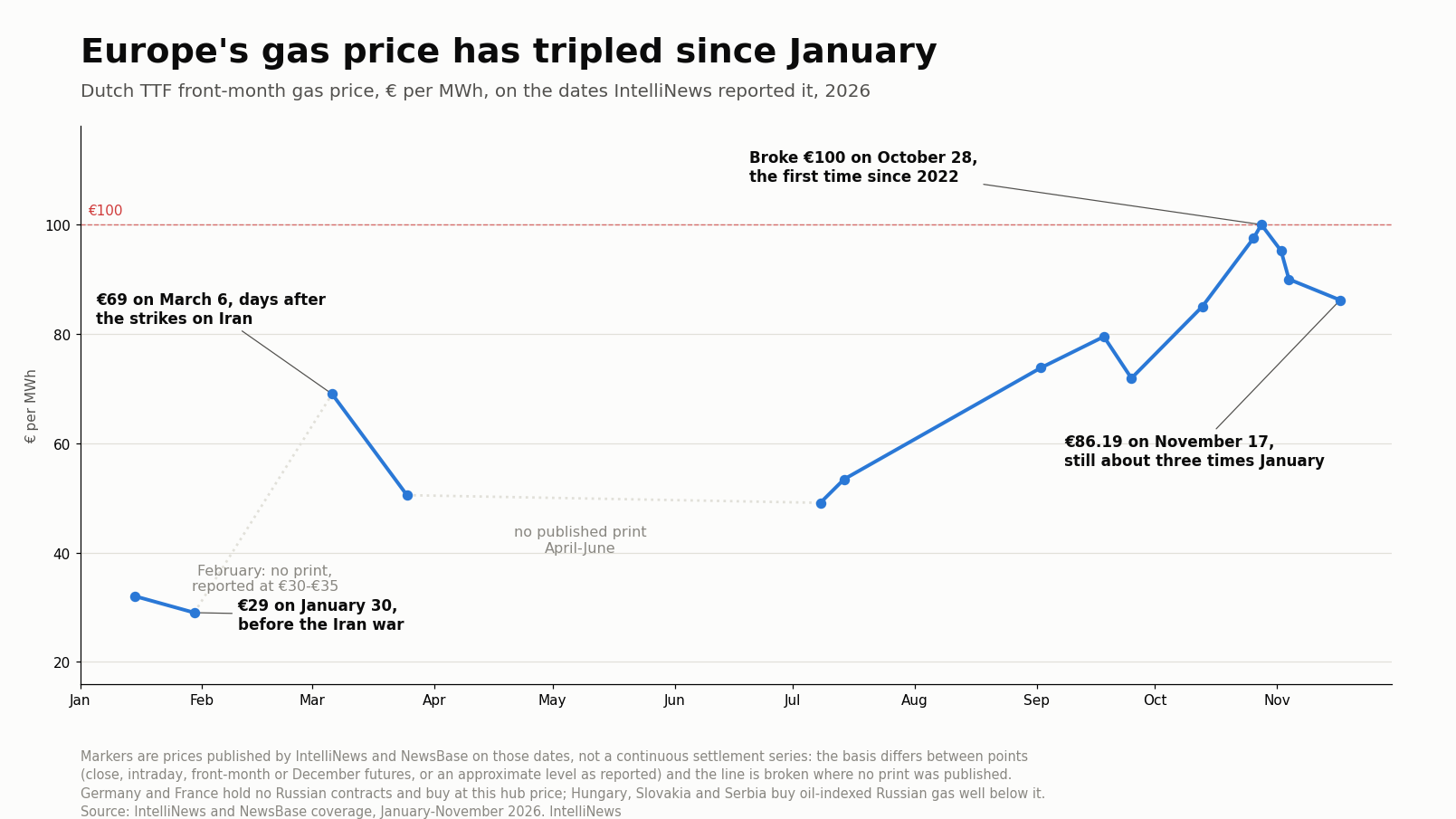
The Dutch TTF front-month gas price in euros per MWh, on the dates IntelliNews and NewsBase reported it through 2026. The line is broken where no price was published. Source: IntelliNews and NewsBase coverage. IntelliNews
The bill is visible at the top of the economy. Higher energy prices have cost the EU €127bn since the start of the year, up from €106bn in mid-October, European Commission President Ursula von der Leyen said. The EU Agency for the Cooperation of Energy Regulators put the upper-bound cost of refilling European storage this year at €27bn, with the average price of injected gas the second-highest in a decade.
Germany feels the hub price more directly than its neighbours to the east, because it holds no oil-indexed Russian contracts of the kind Hungary, Slovakia and Serbia still buy on. German energy inflation turned on the Iran strikes: energy prices in the consumer basket were falling 2.2% y/y in February and rose 6.3% in March, peaked at 13.6% in September and stood at 10.9% in October, on Eurostat data compiled by IntelliNews Lambda. Housing and utilities, where regulated retail gas tariffs sit and the pass-through is slower, moved from 0.5% to 1.6% over the same months.
Power prices tell the same story from another angle. German wholesale electricity averaged €90.80/MWh in March against €111.90 a year earlier, but German contracts for May were trading at €86.80/MWh on March 31 against €22.06 in France, a record multiple. France runs on nuclear; Germany closed its reactors in 2023 and has to fill the evening gap with gas or coal, which is why a gas price shock reaches German consumers twice.
Gazprom's Turkish surge, three weeks on
Gazprom's claim of a Turkish surge - that deliveries in the first five days of November were almost four times those of the same days in October - still carries no volumes. What is measurable is TurkStream, the only remaining route for Russian pipeline gas into the EU since Ukrainian transit ended on January 1, 2025. ENTSOG data for the Strandzha-2/Malkoclar entry point on the Turkish-Bulgarian border showed physical flows of 54.43mn cubic metres (mcm) on the November 16 gas day, with renominations pointing to 52.7 mcm on November 17, and deliveries through the route since the start of 2026 total 15.31 bcm, up 0.87% y/y. The surge, on the numbers available, is in Turkish offtake rather than in the pipe into Europe.
Ankara is buying more and complaining about the price at the same time. Energy Minister Alparslan Bayraktar said on November 5 that Russian gas is too expensive and that Turkey is buying more American LNG, eight weeks before two Gazprom contracts covering 22bn cubic metres a year expire. Hungary, Serbia and Turkey are each using Gazprom's narrowing options to push on price or contract length.
The arithmetic from here is less alarming than it looked a fortnight ago, because the draw has slowed as central Europe stayed above freezing. NewsBase Horizon, our intelligence and advisory division, notes that net withdrawals held at the 2.7 TWh a day averaged since stocks peaked on October 27 would leave EU stores about 37% full at the end of March. That period included mild weather, and the heaviest draws normally come in January and February: at the 4.0 TWh a day recorded in early November, the same arithmetic leaves about 22%. The International Energy Agency's worst case, a cold winter with no return of Hormuz LNG, puts stocks below 10% by the end of March, and warns that withdrawal rates themselves fall away once sites drop below 30% full.
Whatever the trough, the refill that follows starts from it. The EU's ban on Russian LNG under long-term contracts takes effect on January 1, 2027, so Europe will be competing harder for cargoes next summer from a lower base - and Germany will be doing it for the first time since 2022 without a storage target to hit.
Follow us online