

Germany revamps its energy laws, but risks locking itself into decades of costly gas import dependence
Germany risks locking itself into decades of costly gas import dependence unless policymakers give battery storage equal treatment in upcoming power market reforms, energy think-tank Ember has warned.
In a report published on May 13, Ember said Germany’s electricity system was at a “critical inflection point” as lawmakers debated reforms to the country’s renewables support scheme, grid legislation and the long-delayed Electricity Supply Security and Capacity Act, known as StromVKG. The legislation is expected to launch tenders for backup power capacity from September 2026 to secure electricity supplies during periods of low wind and solar generation, known in Germany as “Dunkelflaute”.
The think-tank warned that proposals favouring new gas-fired power plants in those auctions could slow the deployment of battery storage despite rapidly falling technology costs due to the battery revolution and a growing project pipeline.
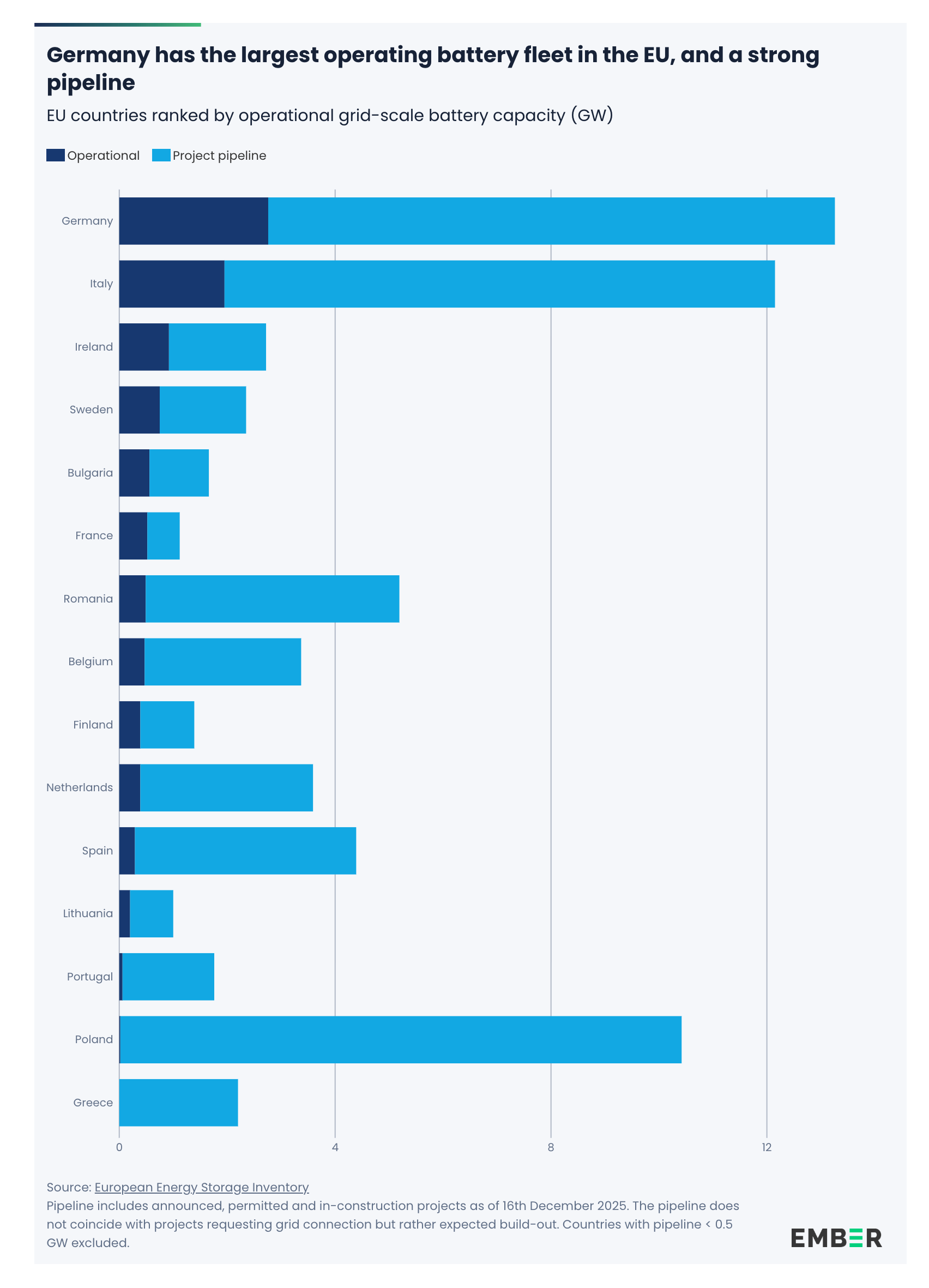
Germany currently hosts about 25% of the EU’s large-scale battery storage capacity, with more than 2.5GW operational by the end of 2025, according to Ember. That figure has more than doubled from 1.2GW two years earlier. The group said more than 10GW of additional battery projects were in development as of December 2025, including 1.5GW already under construction. However, as IntelliNews reported, due to a battery gap Europe as a whole and Germany in particular, only has 15 minutes of battery storage time at a grid level, not enough to impact peak period prices. It needs to scale up to at least 60 minutes and trails other European countries.
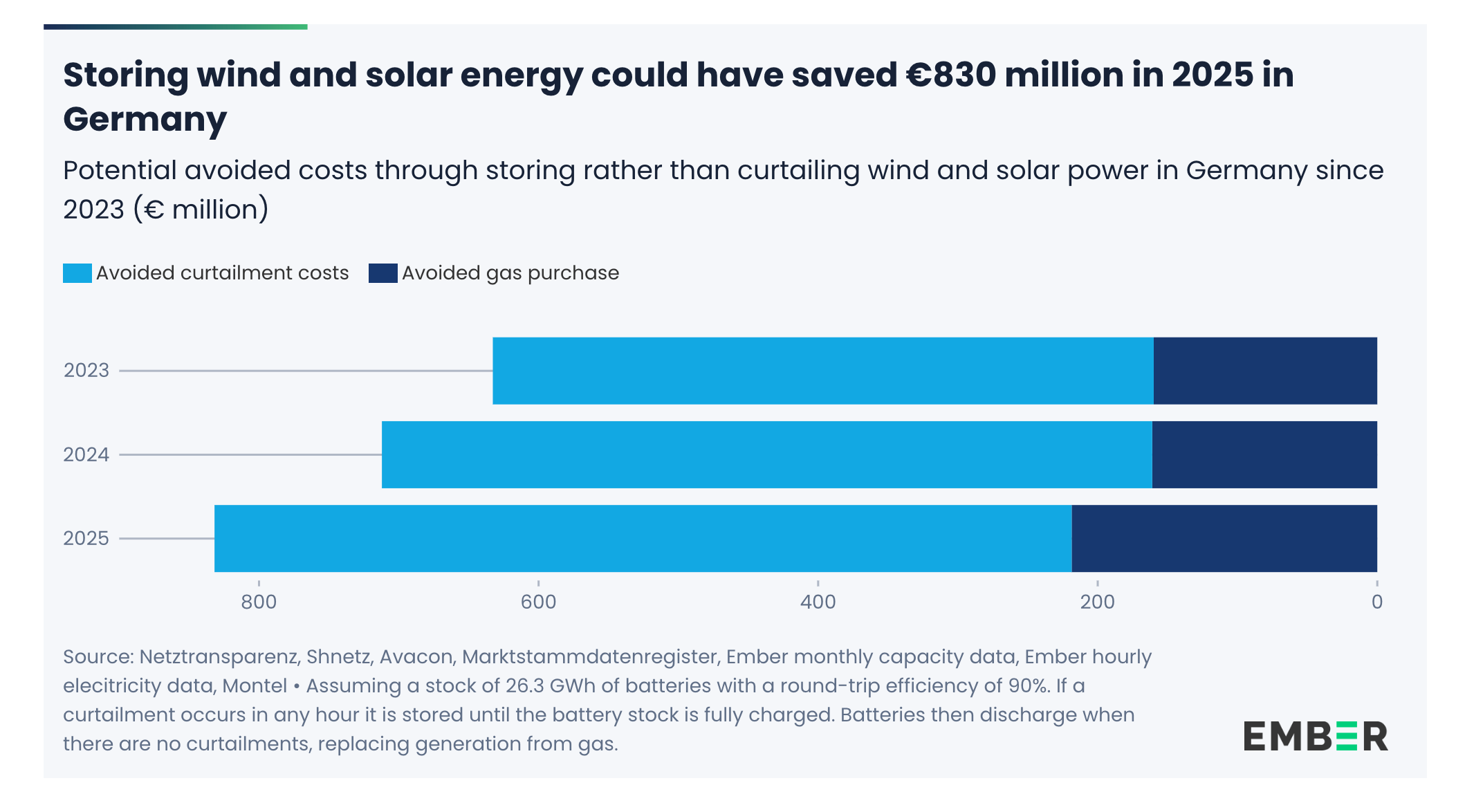
Ember estimated that if Germany’s planned battery pipeline of 10.5GW and 26.3GWh had been operational in 2025, it could have prevented roughly one-third of wind and solar curtailment. Germany curtailed 8TWh of renewable electricity last year, equivalent to 3.4% of total wind and solar output.
The avoided curtailment could have reduced redispatch costs and gas purchases by about €0.8bn, exceeding the estimated annual investment cost of €145mn ($163mn) required over the batteries’ lifetime, the report said.
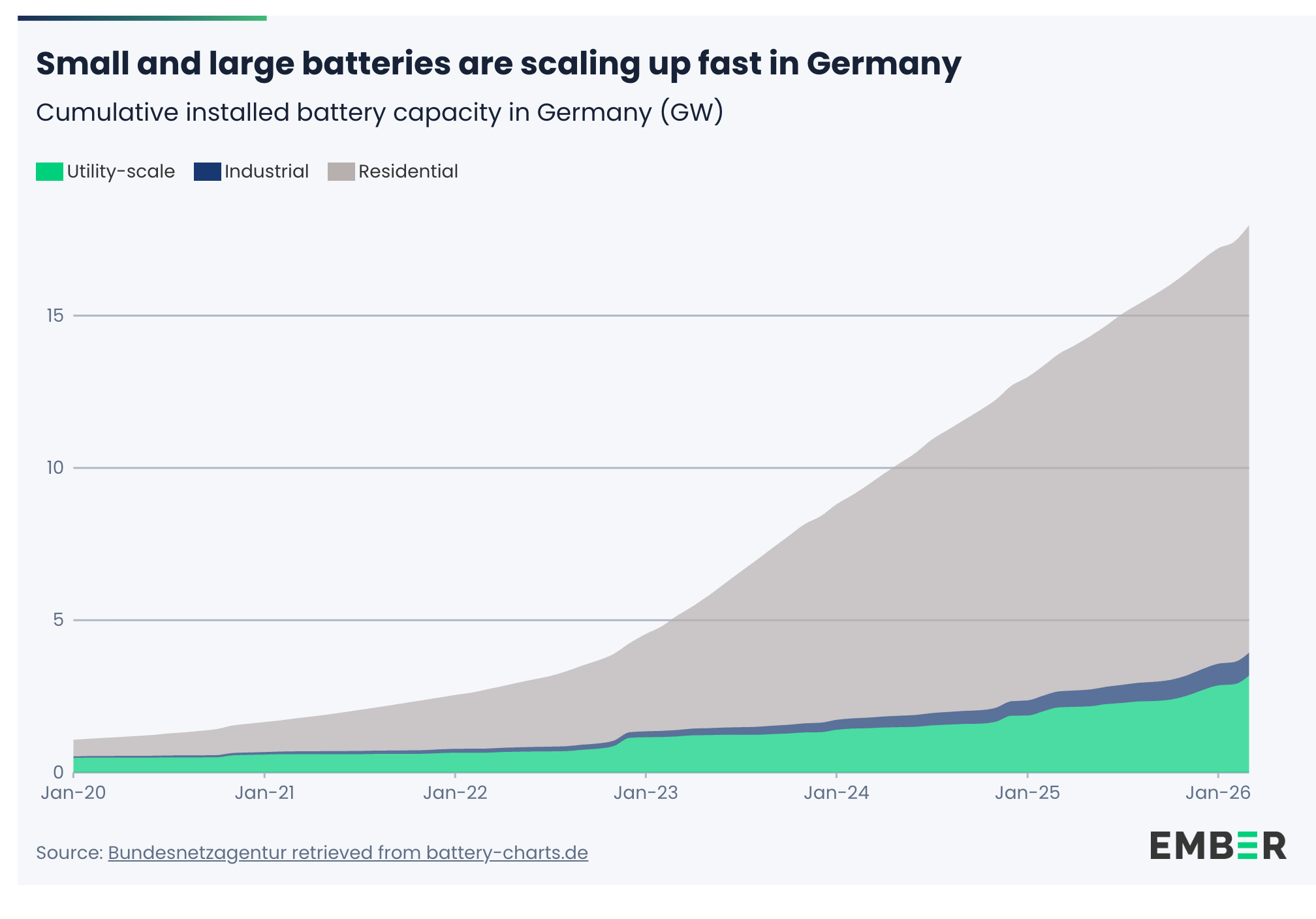
Germany’s residential battery market is also expanding rapidly. More than two million home battery systems have been installed, with roughly one in six homeowners already using the technology. A survey by the Institute for Demoscopy Allensbach found that 30% of homeowners were considering purchasing a battery within the next five years.
“What is missing is regulatory clarity. The upcoming Electricity Supply Security and Capacity Act and grid package should treat battery storage as a first-order solution for grid stabilization and flexibility – not an afterthought. Preferential pathways for gas in capacity auctions – as envisaged in the current draft bill – would delay the deployment of clean technologies that are already cost-competitive and shovel-ready. What Germany needs is a coherent clean flexibility strategy: a framework that gives equal standing to batteries at all scales, demand-side flexibility (including from electric vehicles and heat pumps) and smarter grid infrastructure, alongside concrete targets for non-fossil flexibility capacity,” Ember said.
Follow us online