
IEA releases details of historic oil reserves release member shares
The International Energy Agency released details of the contribution by members to the “largest release of oil reserves in history” that it announced on March 11 to calm the oil market and bring down prices.
The IEA said that members would release up to 400mn barrels, but according to a press release on March 15 the US, Asia, and Europe have so far committed to a total release of 271.7mn barrels of crude – two thirds of the originally announced 400mn barrels, not counting parallel releases of oil products from state-controlled reserves.
The US has the largest reserves in the world, with a total of 370mn in its Strategic Petroleum Reserves (SPR) in its tanks and has committed to release 172.2mn barrels.
Tokyo announced on March 16 that it would start releasing oil too from its reserves of 500mn barrels, if privately controlled reserves are included.
The government has asked Japan's refiners to use the released crude, which will reduce the national reserves by 17%, to secure domestic supplies. It is not known how much of the oil will go to a global release of 400mn barrels Reuters reports.
Any potential release from 12 million barrels jointly held in Japan by Saudi Arabia, United Arab Emirates and Kuwait would be in addition to the announced 80 million barrels, the Ministry of Economy, Trade and Industry says, Reuters reports.
Tokyo will start releasing 15 days' worth of private-sector oil on March 16 and then a month's worth of oil from the state reserves later this month, according to METI.
The US is self-sufficient, able to cover its entire domestic demand with its shale oil production. Japan is almost entirely dependent on oil imports, sourcing 90% from Gulf producers and another 4% from Russia.
The Straits of Hormuz are gradually reopening after Tehran introduced an informal permits-for-passage system that has seen exports rise to about 10mn b/d, almost all of which is going to Asia. However, Iran is only granting permits to tankers belonging to “friendly countries” including China, India and Bangladesh. The Western-aligned Japan does not belong to this group and has in effect been entirely cut off from Gulf supplies for the foreseeable future.
Fatih Birol, executive director of the IEA, said member states had now finalised their commitments under the collective action announced earlier this month.
“IEA countries have now confirmed their contributions to our largest ever oil stock release,” Birol said. The move “brings unprecedented additional volumes of oil to the market from March 16 onward,” he added, though he cautioned that “opening the Strait of Hormuz is vital for a return to stable flows.”
While the IEA’s announcement after “Wild Monday" that saw oil prices soar to over $120 a barrel last week initially calmed markets, after Iran hit three tankers with rockets prices rapidly rose again and are currently trading over $100 a barrel again. Russian Urals blend crude has been a big winner from the chaos and the discount on Russian Urals oil has fallen to zero from more than $20 only two weeks ago that is expected to bring the Kremlin a large windfall this year.
According to implementation plans submitted by IEA member countries, those in the Asia-Oceania region will begin releasing oil immediately, while stocks held by member countries in Europe and the Americas will start entering the market from the end of March.
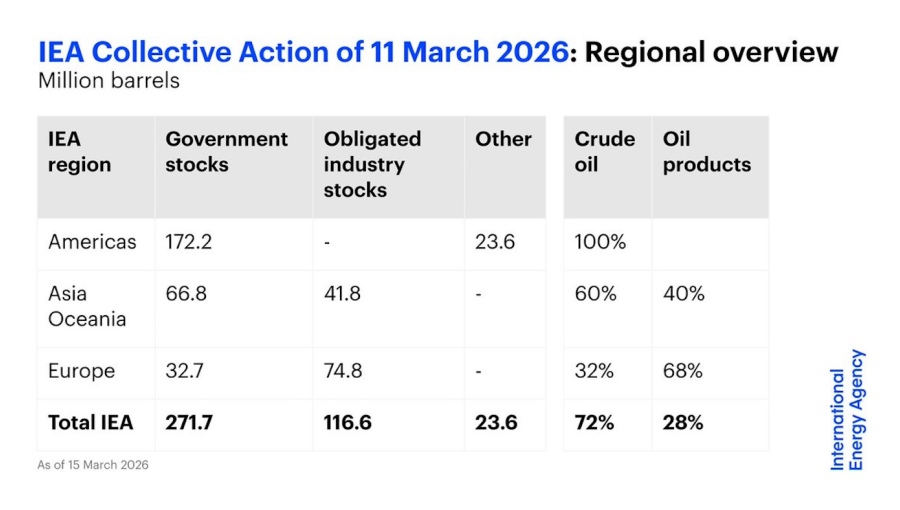
Data published by the IEA shows that the largest contribution will come from the Americas, which plan to release 172.2mn barrels of government-held crude and a further 23.6mn barrels from other reserves. Asia-Oceania countries will contribute 66.8mn barrels of crude alongside 41.8mn barrels of oil products, while European members will release 32.7mn barrels of crude and 74.8mn barrels of refined fuels.
In total, the release will consist of approximately 271.7mn barrels of crude oil and 116.6mn barrels of oil products, with around 72% coming from government-controlled reserves and the remainder from mandated industry stocks, according to the IEA.
The intervention marks the sixth time the IEA has coordinated a collective release of strategic reserves since its creation in 1974. Previous emergency actions were taken in 1991 during the Gulf War, in 2005 following Hurricane Katrina, in 2011 during the Libya crisis and twice in 2022 after Russia’s invasion of Ukraine.
The agency warned that the scale of disruption currently facing global oil markets is unprecedented. “The war in the Middle East is creating the largest supply disruption in the history of the global oil market,” the IEA said.
While the emergency release is intended to cushion markets from immediate shortages, the agency stressed that restoring shipping through one of the world’s most critical energy chokepoints remains essential. The purpose of strategic reserves is to cushion shocks, not to replace offline production, experts say.
“Adequate insurance mechanisms and physical protection for shipping are key to the resumption of flows,” the IEA said, adding that “the most important factor in ensuring a return to stable flows is the resumption of regular transit of shipping through the Strait of Hormuz.”
The Trump administration promised to reopen the Straits of Hormuz quickly, but has been caught out by the ferocity and effectiveness of Tehran’s resistance. The US Navy has been getting “daily requests” from commercial shipping companies for escorts through the Straits, but has turned them all down as the passage is “too dangerous to traverse.”
The Pentagon has ordered almost its entire fleet to converge on the Gulf, including 5,000 Marines, in what appears to be preparation for a land invasion in an effort to reopen the straits. Those ships are due to arrive sometime at the end of this month.
Follow us online