
Iran's grip on Hormuz slips as oil flows top 13.5mn b/d

Oil flows through the Strait of Hormuz have topped 13.5mn barrels a day, led by a surge in Saudi Gulf loadings, Commodity Context's tally of Kpler data showed on September 25.
The figure is a seven-day rolling average of tankers leaving the Gulf, and the latest days are usually revised up as more ship positions come in, Rory Johnston of Commodity Context wrote on X. "By far the biggest rise has come from Saudi Arabia's new Gulf loadings blitz," he said. The strait carried about 20mn b/d before the US and Israel attacked Iran on February 28, and outbound flows fell to around 2mn b/d in March.
The recovery weakens Tehran's main lever in the war. Iran has used its hold over one of the world's key chokepoints to push up oil prices and press Washington to lift its naval blockade, but with two-thirds of pre-war volumes moving again, the threat of a closure is worth less.
"Hormuz is no longer behaving like a chokepoint under effective Iranian control," energy analyst Art Berman wrote on X. "Iran can still attack ships, raise insurance costs and make the Strait dangerous. But danger is not the same as control."
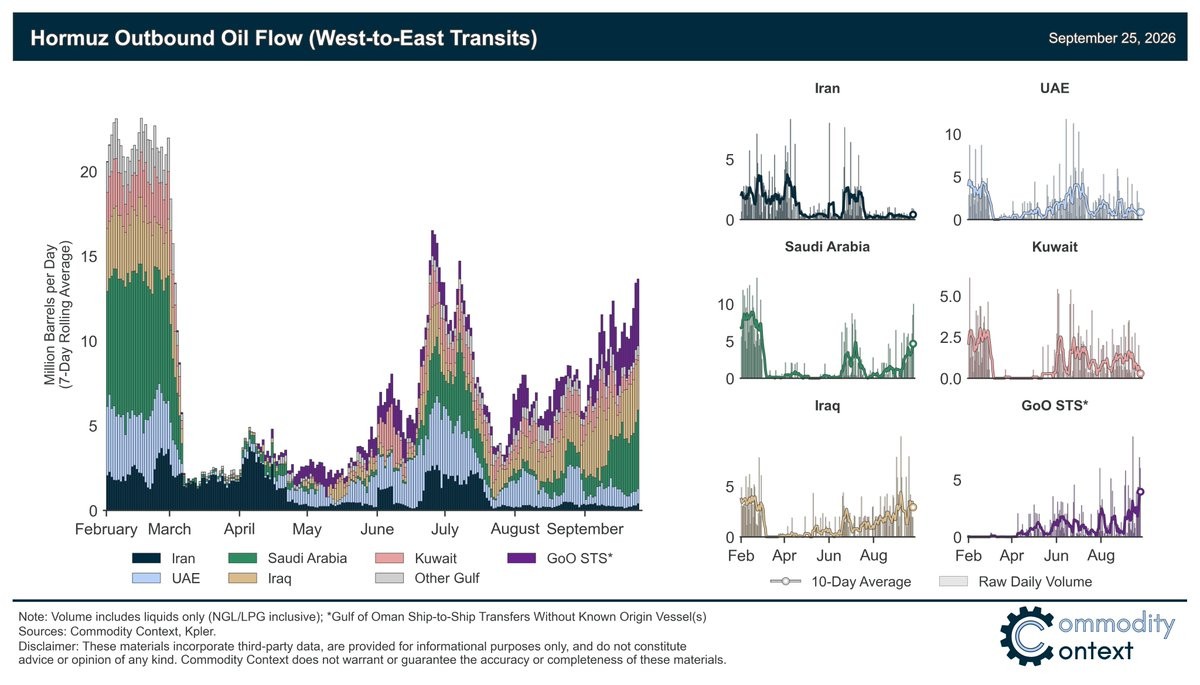
Oil leaving the Gulf through Hormuz by country of origin, seven-day rolling average, mn b/d. Source: Commodity Context, Kpler, via Rory Johnston (@Rory_Johnston).
Tehran is not giving ground in public. President Masoud Pezeshkian told the UN General Assembly on September 23 that Iran would not allow free passage through the strait while US sanctions and the naval blockade remain in place. A tanker hit by an unidentified projectile in the strait on September 21, injuring two crew, was the fourth attack on shipping there in 11 days, and the Islamic Revolutionary Guard Corps has warned that ships crossing without its permission face "destruction".
Saudi Arabia is sending ships through regardless. Its crude exports averaged 5.28mn b/d in the first 23 days of September, the highest since the war began, according to tanker-tracking data compiled by Bloomberg, which Bloomberg columnist Javier Blas picked as his chart of the day. About 3.4mn b/d of that loaded in the Gulf, against almost nothing in the spring, when the kingdom moved most of its exports to the Red Sea.
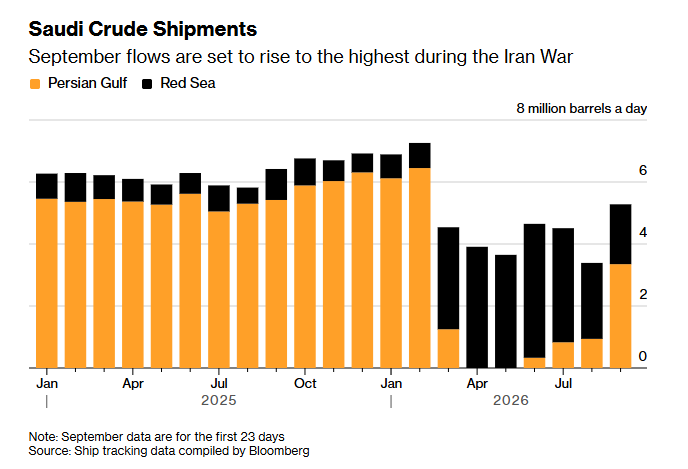
Saudi crude shipments from Persian Gulf and Red Sea ports, mn b/d. September covers the first 23 days of the month. Source: ship-tracking data compiled by Bloomberg, via Javier Blas (@JavierBlas).
The switch back to the Gulf followed drone attacks on September 11 that shut Saudi Arabia's East-West pipeline, the main route around Hormuz to the Red Sea port of Yanbu, for nine days. The line, which carried about 4mn b/d before the attack, restarted at a low rate on September 22.
Shipping through the strait remains expensive. Saudi Arabia's energy ministry blamed Iranian attacks and disruption at Hormuz for a jump in freight costs on September 22, after Iraq's oil minister told parliament the cost of moving Iraqi crude had risen to $37 a barrel from $26.
The recovery in crude has not reached refined products. Diesel supply from the Middle East was down by an average of about 773,000 b/d y/y in March-August, and Russian supply by about 348,000 b/d, a combined loss of some 1.1mn b/d, the newsletter The Kobeissi Letter calculated from estimates by Vortexa, Kpler and Energy Aspects first published by Bloomberg on September 18. Vortexa puts the Middle East loss at 835,000 b/d, Kpler at 750,000 b/d and Energy Aspects at 733,000 b/d; their Russian estimates range from 307,000 b/d to 377,000 b/d.
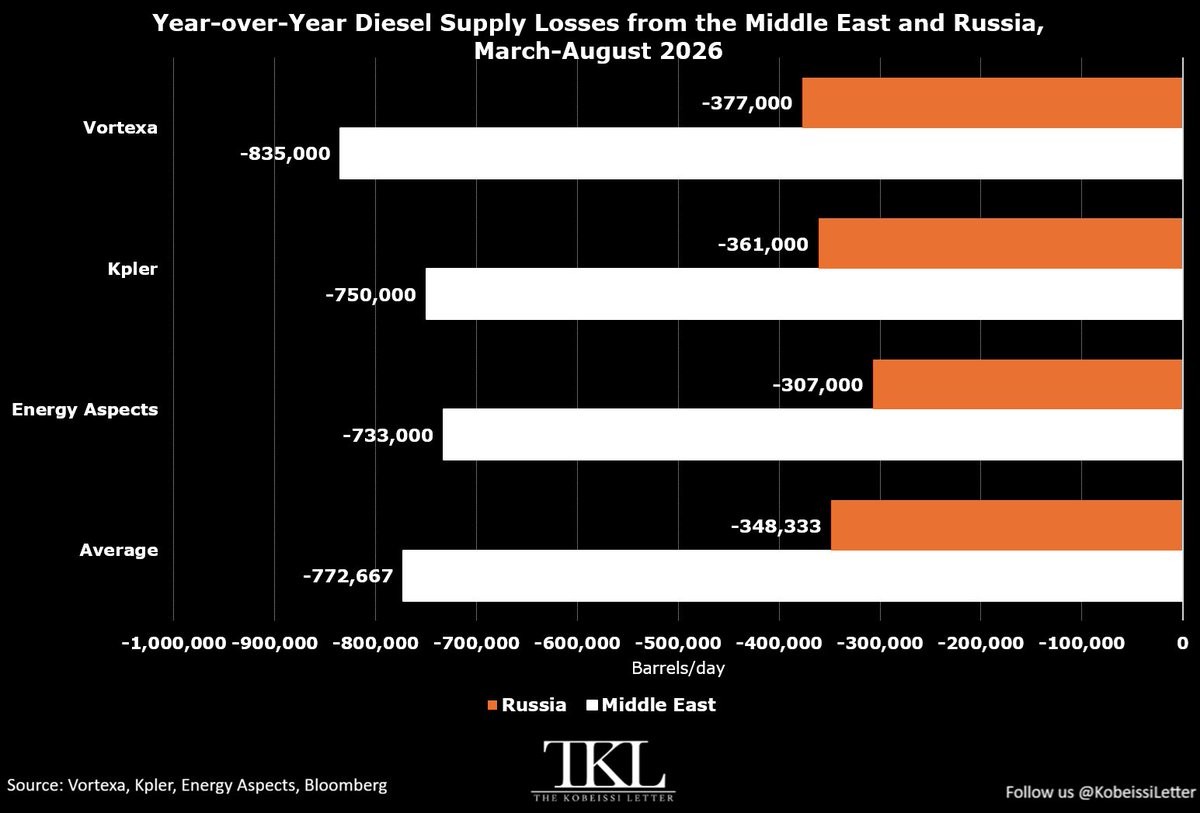
Estimated loss of diesel supply from the Middle East and Russia, March-August 2026 against the same period of 2025, b/d. Source: Vortexa, Kpler, Energy Aspects, Bloomberg, via The Kobeissi Letter.
Russia's diesel supply fell by 615,000 b/d y/y in July and August after Moscow banned exports, as Ukrainian drone strikes on refineries forced regions to reimpose fuel rationing. Crude can reach the Red Sea by pipeline, but Gulf refiners have no such bypass for their products, and diesel cracks hit a record in August. US President Donald Trump has backed a proposed ban on US diesel exports, which would cut off the market's main remaining source of spare supply.
"The more oil that clears Hormuz, the more Iran's leverage shifts from blocking flows to merely imposing costs," Berman wrote.
Follow us online