
Israel's Lebanon offensive threatens to unravel US-brokered gas deal and block Beirut's energy future
Israel's military occupation of southern Lebanon is threatening to upend a landmark 2022 US-brokered maritime border agreement and derail Lebanon's best remaining hope of tapping its offshore gas wealth.
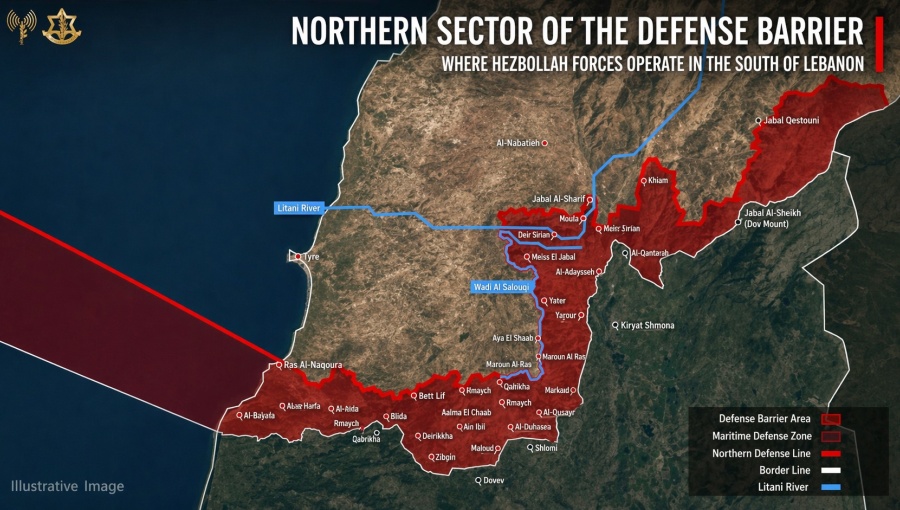
On April 19, the Israel Defence Forces published an official Arabic-language map explicitly delineating what it calls a "Forward Maritime Defence Zone" extending diagonally into the Mediterranean from the Lebanese coast.
The map, bearing the IDF emblem and distributed publicly, places the Qana Gas Prospect within the declared zone — making the maritime dimension of Israel's southern Lebanon operation a matter of stated military doctrine rather than analyst inference.
A separate map distributed by researcher Ahmad Baydoun, drawing on IDF, UN and US State Department sources, confirmed that the IDF's declared maritime exclusion boundary runs northwest into the Mediterranean, encompassing the Qana Prospect in Block 9.
The IDF's on-land zone also covers dozens of Lebanese villages named on the official map, including the Christian villages of Rmeish and Ain Ebel, which are clearly labelled within the declared occupation area.
Israel has been explicit that it wants to occupy all of southern Lebanon as part of its Greater Israel project to create a buffer zone on its northern border.
The dry well that isn't the point
The map has been taken by many to infer that Israel is also in annexing gas deposits in the Qana Prospect and not just security issues.
But the energy dimension of Israel's Lebanon occupation is a bit more complicated than that. The Qana Prospect, which sits within the IDF's declared maritime zone, is not a producing gas field. Test drilling some of the blocks has come up dry.
TotalEnergies (NYSE: TTE) drilled in 2023 and found no commercial reserves, abandoning Block 9 entirely.
"There's no gas in the Qana prospect," noted Elai Rettig, an assistant professor in Energy Politics at Bar-Ilan University. "In 2023, TotalEnergies announced it did not find commercial gas reserves in that field and abandoned Block 9 entirely."
However, the same may not be true of Block 8, which lies further northwest of the IDF's published maritime line.
"The more interesting issue is Block 8, which is beyond this map, which Total wants to explore," Rettig added.
In January 2026, TotalEnergies announced it was redirecting its Lebanon exploration efforts to that block.
"Although the drilling of the well Qana 31/1 on Block 9 did not give positive results, we remained committed to pursue our exploration activities in Lebanon," TotalEnergies chief executive Patrick Pouyanné said earlier this year. "We will now focus our efforts on Block 8."
A consortium of TotalEnergies, Eni (BIT: ENI) and QatarEnergy — holding stakes of 35%, 35% and 30% respectively — signed the Block 8 exploration agreement with Lebanon in January 2026 and planned to begin 3D seismic surveys across 1,200 square kilometres.
If Israel moves to formally revise its maritime coordinates back to what is known as Israeli Line 1, a large part of Lebanese Block 8 could fall within disputed territory, effectively sending a warning to the consortium that exploration in parts of the block is untenable.
Lebanese Petroleum Administration president Gaby Daaboul had said Lebanon aimed to "step up exploration and achieve a commercial discovery to boost the economy and support sustainable development."
Energy Minister Joseph Saddi said Lebanon was working on its fourth exploration licensing round before the war started at the end of February. Both statements now look premature.
The 2022 deal under threat
The 2022 US-brokered maritime border agreement was hailed as a diplomatic breakthrough for a region long locked in dispute. Under its terms, Israel obtained full control of the Karish field, while Lebanon received rights to the disputed area including the Qana Prospect — along with recognition that Israel was entitled to royalties on portions of the Qana field that overlapped with Israeli maritime claims.
Now Israel is moving the lines on the maps. The occupation zone now extends into Lebanese territorial waters, cutting approximately nine kilometres into Lebanon's exclusive economic zone according to researchers tracking the boundary.
If Israel formally revises its maritime boundary, Lebanon would retain legal options. Analysts note that in such a scenario Lebanon could demand adoption of Line 29 — the line it had abandoned in 2022 — which would give it the entire Qana area and approximately half of the Karish field. That outcome would represent a significant economic blow to Israel's existing energy infrastructure.
Israel's energy minister Eli Cohen has already signalled interest in revisiting the 2022 agreement, which was signed by the outgoing government of Yair Lapid and has long been contested by the Netanyahu coalition. During the 2022 election campaign, Netanyahu had threatened to "neutralise" the maritime border deal if elected. Now he has boots on the ground in Lebanon, the change in territorial ownership may be simply delivered as a fait accompli as part of the current military operation.
The Gaza precedent
The energy dimension of Israel's Lebanon operations has prompted comparisons to Gaza Marine, the gas field discovered approximately 36 kilometres west of Gaza City in 2000.
Containing an estimated 28.3 to 39.6bn cubic metres of natural gas, it has been stalled for decades. The field is owned by the Palestine Investment Fund and Consolidated Contractors Company. Although Israel approved its development in June 2023, ongoing conflict has rendered any near-term exploitation impossible, and Palestinian access to the resource remains effectively blocked by Israeli security control over the maritime area.
Israel and Cyprus have made major offshore gas discoveries in the eastern Mediterranean — including the Leviathan and Aphrodite fields — highlighting the region's geological potential and the enormous value of controlling maritime territory in these waters. The question now being asked in Beirut, Paris and Doha is whether Lebanon will ever be permitted to join them.
Follow us online