

Kazakhstan pushes for regional cooperation on climate as threats increase
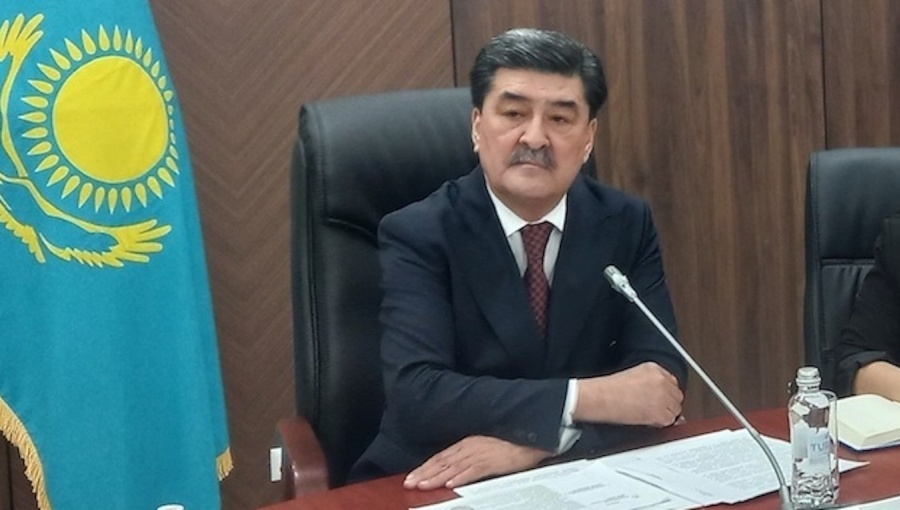
Kazakhstan’s ecology minister has called for deeper cooperation across Central Asia to tackle shared environmental issues, as the region faces increasing threats from climate change. Speaking on April 21, Minister of Ecology and Natural Resources Yerlan Nyssanbayev said the Regional Ecological Summit 2026 that opens on April 22 would serve as a platform to forge practical solutions to cross-border challenges ranging from water scarcity to climate change.
“Today ecological agenda is not only about conserving the nature,” Nyssanbayev told a briefing with journalists in Astana. “The water resources, glaciers, soil degradation, air quality, sustainable agriculture, preserving biodiversity and the future of the Caspian Sea are directly related to economy, health, food security and sustainability of the countries.”
He stressed that environmental risks in Central Asia are inherently transnational. “These ecological challenges know no borders. Desertification, climate change, cross-border rivers and ecosystem condition impact several countries at once,” he said. “That is why the solutions should be developed in collaboration.”
The summit, he said, reflects a broader shift in regional thinking. “The main value of this summit is it transfers all these issues from discussion level to practical coordination level,” Nyssanbayev said. “It’s not only about political statements but about practical decisions, new technologies, partnerships, investments between countries, business and international organisations.”
Kazakhstan, he added, is positioning itself as a facilitator rather than simply a host. “For Kazakhstan, conducting this summit is … about showing readiness to promote the joint agenda, to provide a platform for joint decisions and strengthen regional cooperation based on trust and mutual benefit.”
The minister said Central Asia in particular requires collaborative approaches in several key areas. “This region needs coordinated approaches to water safety, to climate adaptation, to ecosystem protection and modernising economy,” he said. “The summit creates a platform where ecology will be a basis for trust, partnership and longstanding cooperation.”
He added that the event would extend engagement beyond Central Asia. “From a broader dimension it also opens opportunity for dialogue with other countries including Trans-Caucasian countries,” he said.
Among the most pressing concerns is the future of the Caspian Sea, which Nyssanbayev said is already being affected by rising temperatures. “The Caspian is affected by global warming. Because of the increase in temperature the evaporation levels are increasing,” he told journalists.
He pointed to existing frameworks for cooperation, including regional agreements among littoral states. “Jointly all the Caspian Sea countries are monitoring the condition and we exchange data,” he said. “We need to jointly work on developing some proposals, suggestions to stop these problems.”
Kazakhstan has set out its own long-term climate strategy, targeting carbon neutrality by 2060. Nyssanbayev said this includes sector-specific measures across energy, industry, agriculture and waste management, as well as mechanisms such as green finance and a just transition.
“We updated and approved our indices with the aim to reduce emissions by 17% by 2035 in comparison with 1990,” he said.
However, the scale of the challenge remains significant, particularly in the energy sector. “Nowadays the energy sector is responsible for up to 80% of all emissions in Kazakhstan,” Nyssanbayev said. “That’s why our main goal right now is to modernise the energy sector to stabilise the situation in our ecology.”
He added that tackling methane emissions is also a priority. “Global warming is affecting all countries and we need to work on our methane emissions too,” he said.
Financing remains a major constraint. “All these actions need financing, and we made preliminary estimation in order to achieve our goal on carbon neutrality by 2060 we need about $600bn,” Nyssanbayev said. “The government is investing in this and the private sector is also investing in modernising the energy sector, but still this issue is very important.”
Kazakhstan has already implemented market-based mechanisms to curb emissions. “There is an emission trading system which has worked since 2013 and it covers almost half of the national emissions in the energy, chemicals and mining and metallurgy sectors,” he said.
The country is now seeking closer alignment with international systems. “We are working on integrating our system with the European system and developing projects on deforestation and carbon land management,” he said. “We are also implementing measures in accordance with Article 6 of the Paris Agreement to enter into the international carbon market.”
Nyssanbayev said such steps would help Kazakhstan meet its climate targets while contributing to broader global efforts. “All these steps will help us achieve ambitious climate objectives and promote global sustainability,” he said.
Looking ahead to the summit, he stressed the need for a shift in mindset among regional partners. “The main position of the summit is that countries of the region should not only talk about challenges we face in this area but about joint solutions we can come up with,” he said.
Follow us online