
Libya’s diplomatic thaw masks dinar slide and central bank fight

Libya is gathering the outward signs of normalisation. The UN’s aviation agency has lifted its safety warnings on Libyan airspace after more than a decade, its three North African neighbours have rallied behind a UN-led settlement, and its rival administrations agreed in April on the country’s first unified budget since 2013.
Domestic indicators point the other way. Inflation has reached its highest level this year and the dinar is under pressure. The state oil company and the central bank are disputing how much oil money has reached the central bank, a contested change in central bank leadership has exposed fresh institutional divisions, an armed group has cut crude supplies to the country’s main western refinery, and the eastern parliament’s approval of a maritime deal with Turkey has drawn Egyptian condemnation.
That matters because the Central Bank of Libya (CBL) handles oil revenue that accounts for roughly 90% of state income. Control over those dollar flows affects the state’s ability to pay salaries, fund fuel imports and defend the currency. The IMF warned in April that Libya’s fiscal deficit had reached about 30% of GDP in 2025 and that public debt had nearly doubled in two years to 146% of GDP, with fiscal imbalances straining the exchange rate and reserves.
Prices and the dinar
Annual consumer price inflation rose to 16.6% in September from 14.3% in August, the highest rate of the year, according to the Bureau of Statistics and Census. Food and beverage inflation reached 21.2% year on year, up from 16.9% in August; with a weight of 40.39% in the index, the category accounted for about half of headline inflation.
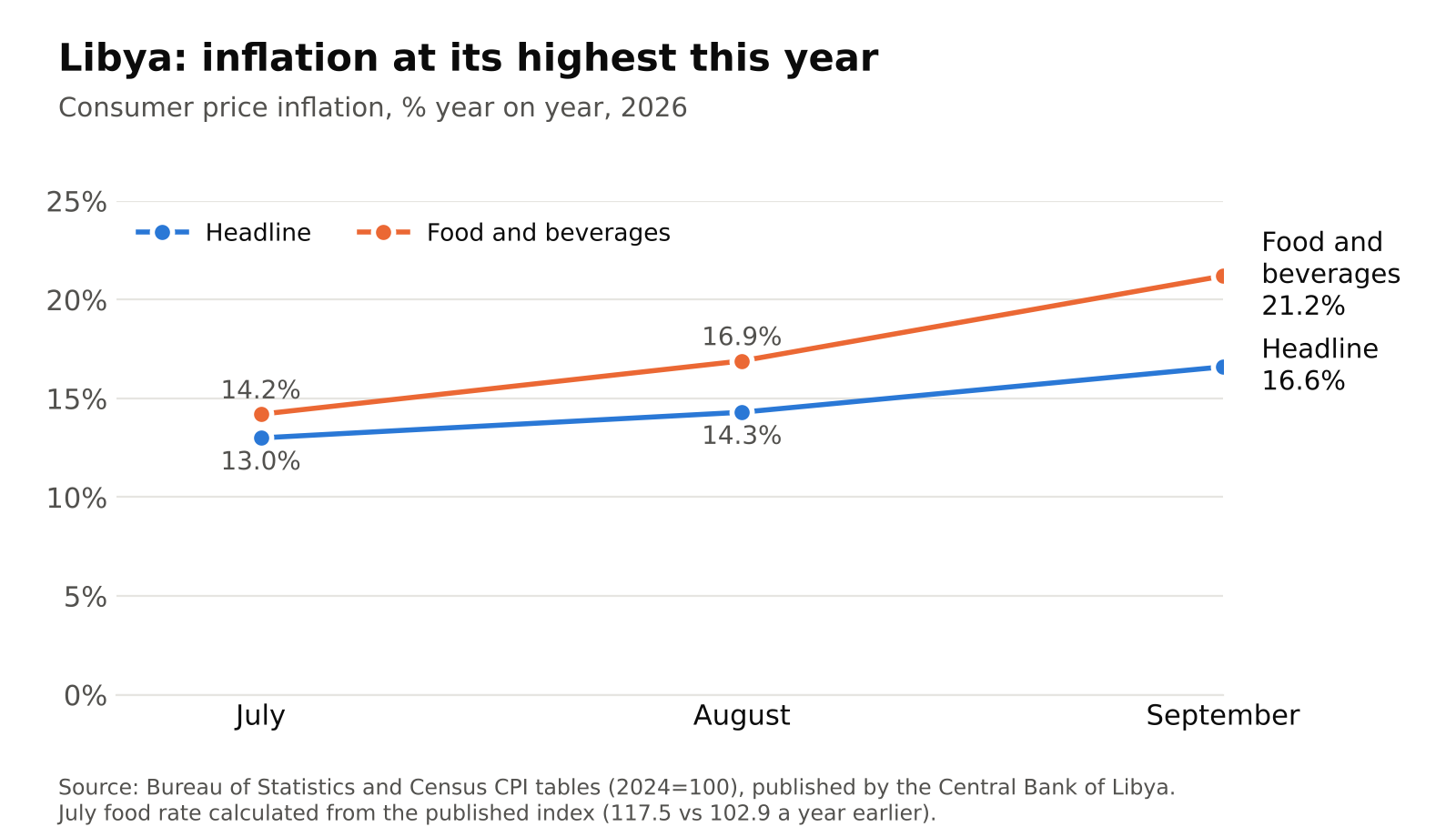
Inflation has accelerated in the months after the CBL cut the dinar’s official value by 14.7% in January, its second devaluation in less than a year. The official rate stood at about LYD6.42 to the dollar on November 3, while the parallel-market rate rose from LYD9.62 on September 19 to LYD10.30 on October 15 and was near LYD10 in late October, implying a premium of about 55% over the official rate. The World Bank estimated that the premium averaged 42% in the first half of 2026.
Libya imports more than 75% of its food, leaving household prices exposed to exchange-rate movements and the availability of foreign currency. A September 30 ban on commercial imports outside official banking channels has since been eased: the Economy Ministry announced on November 3 that Decree No. 555 of 2026 temporarily allows imports paid for with parallel-market currency until March 31, 2027, with certain essential goods and medicines excluded, Libya Herald reported.
See IntelliNews: DATAWATCH: Libya inflation climbs to 16.6% in September as food costs surge
See IntelliNews: Libyan dinar remains under pressure as inflation reaches 16.6% in September
Whose oil money?
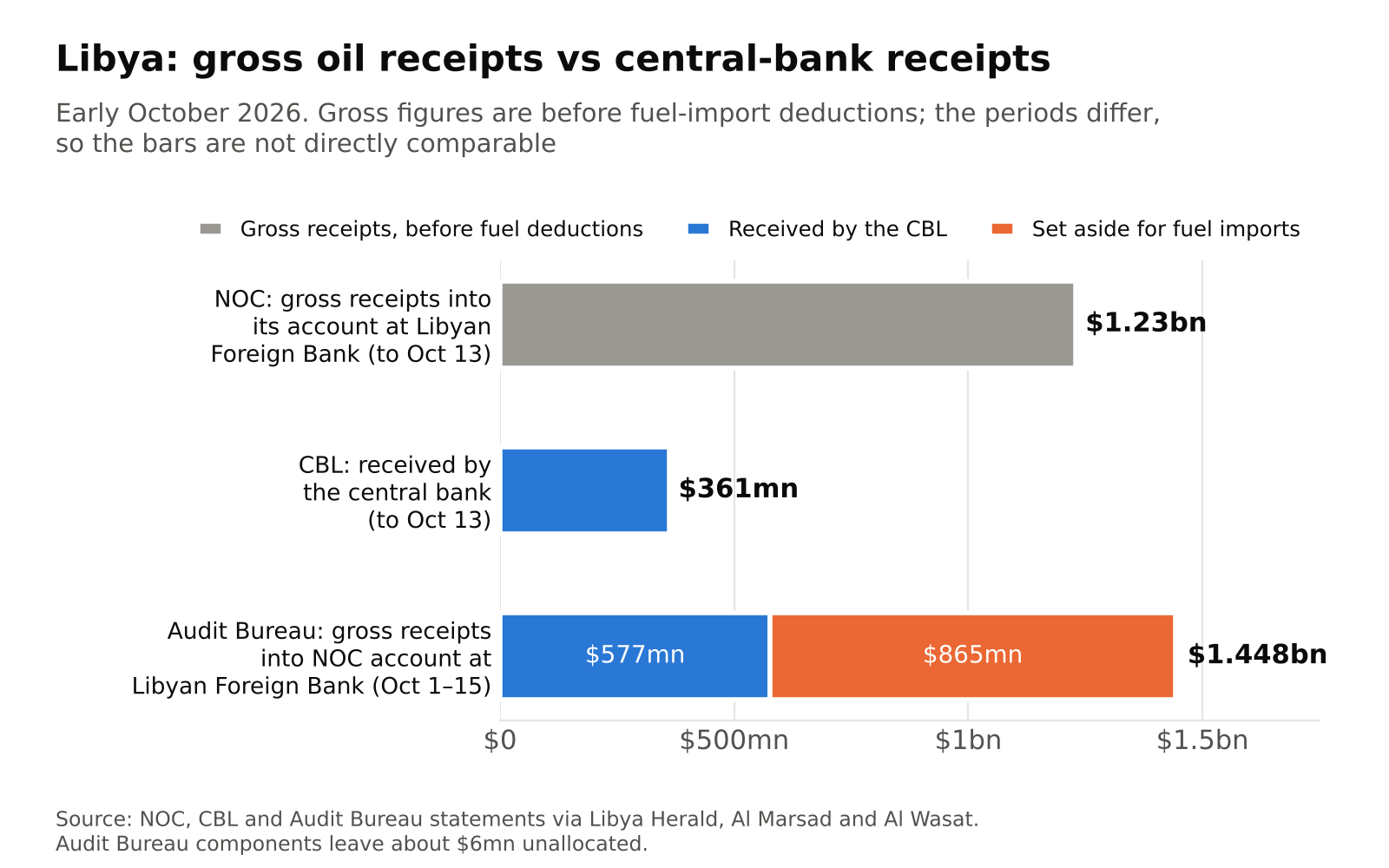
The unified budget has not settled the argument over oil revenue. In mid-October, the National Oil Corporation (NOC) said gross oil receipts of about $1.23bn had been paid into its sovereign account at the Libyan Foreign Bank by October 13, before deductions for fuel imports, while the CBL said it had received about $361mn over the same period, Libya Herald reported.
The NOC said the difference reflected deductions to settle letters of credit for fuel imports before the remaining funds were transferred to the central bank. It accused the CBL of withholding approved budgets and asked the Prosecutor General to open an independent investigation. The NOC’s figure is a gross transfer into its account at the Libyan Foreign Bank, while the CBL’s is what the central bank received after those deductions, so the gap does not by itself show that funds are missing.
The Audit Bureau stepped in with its own figures. It said gross receipts of $1.448bn had reached the NOC’s accounts at the Libyan Foreign Bank between October 1 and 15, of which about $865mn was set aside for fuel imports and $577mn was passed to the CBL. It set up a joint committee with the CBL, the Finance Ministry, the NOC and the Libyan Foreign Bank to reconcile figures and standardise reporting, warning that conflicting disclosures risked disrupting the parallel currency market, Libya Herald reported. The bureau’s figures run to October 15, two days beyond the NOC and CBL figures, so the three sets cannot be compared directly.
On November 5, the NOC said about $3.12bn in gross revenue from September oil exports had been collected and transferred to the sovereign account during October as a whole, a different period from the mid-October figures. Under the mechanism the NOC has described, fuel-import costs are deducted from that account before the remainder passes to the CBL.
On October 21, masked men in military uniform stormed the headquarters of the Audit Bureau – the body leading the reconciliation – in what the UN Support Mission in Libya (UNSMIL) called an “unacceptable” attempt to install a disputed deputy head by force, Enterprise reported.
A contested central bank
The revenue dispute has run into a fight over the central bank itself. Issa tendered his resignation in August without publicly explaining his reasons, and both the House of Representatives’ finance committee and High Council of State head Mohamed Takala rejected it at the time.
On October 22, the presidency of the eastern-based House of Representatives reversed course, accepting the resignation and naming CBL board member Fawzi Abu Khazam as interim governor. The same day, the CBL reported an unauthorised entry into its Tripoli headquarters; in a separate statement, it said Abu Khazam had taken over at a handover attended by members of both chambers. Jalel Harchaoui of the Royal United Services Institute described Abu Khazam as “100% pro-Saddam Haftar”, Enterprise reported on October 26.
UNSMIL said on October 23 that the CBL’s operational independence and integrity were essential and that “any changes to the leadership must be driven by a commitment to improved governance and oversight”. It warned that “continued pressure on the CBL to finance escalating public expenditure” could “further intensify pressures on the exchange rate, fuel inflation, and accelerate the depletion of reserves”, Libya Herald reported.
The appointment was then put to a full vote. The eastern parliament confirmed Abu Khazam as governor on November 2, with 78 of the 90 members present voting in favour, and he took the oath in Benghazi on November 4.
The Tripoli-based High Council of State has not formally endorsed the November 2 appointment, and its position has been mixed. Its first deputy chairman, Naji Mukhtar, rejected the eastern parliament’s “unilateral action” in October, although Abu Khazam met Takala on October 27, according to the CBL.
The dispute raises questions over the durability of the UN-brokered 2024 agreement under which both legislatures approved Issa’s appointment. During the 2024 crisis, then-governor Sadiq al-Kabir said more than 30 international banks had suspended transactions with the institution.
Washington has also weighed in. Massad Boulos, President Donald Trump’s senior adviser, voiced concern over developments at the central bank on November 4 and warned that those obstructing Libya’s political transition could face sanctions.
Africa Intelligence reported on November 5 that the US Treasury had suspended dollar transactions with the CBL. Neither the Treasury, the Federal Reserve nor the central bank has publicly confirmed the report.
See IntelliNews: Africa Intelligence reports US Treasury suspended dollar dealings with Libya
Output holds, security does not
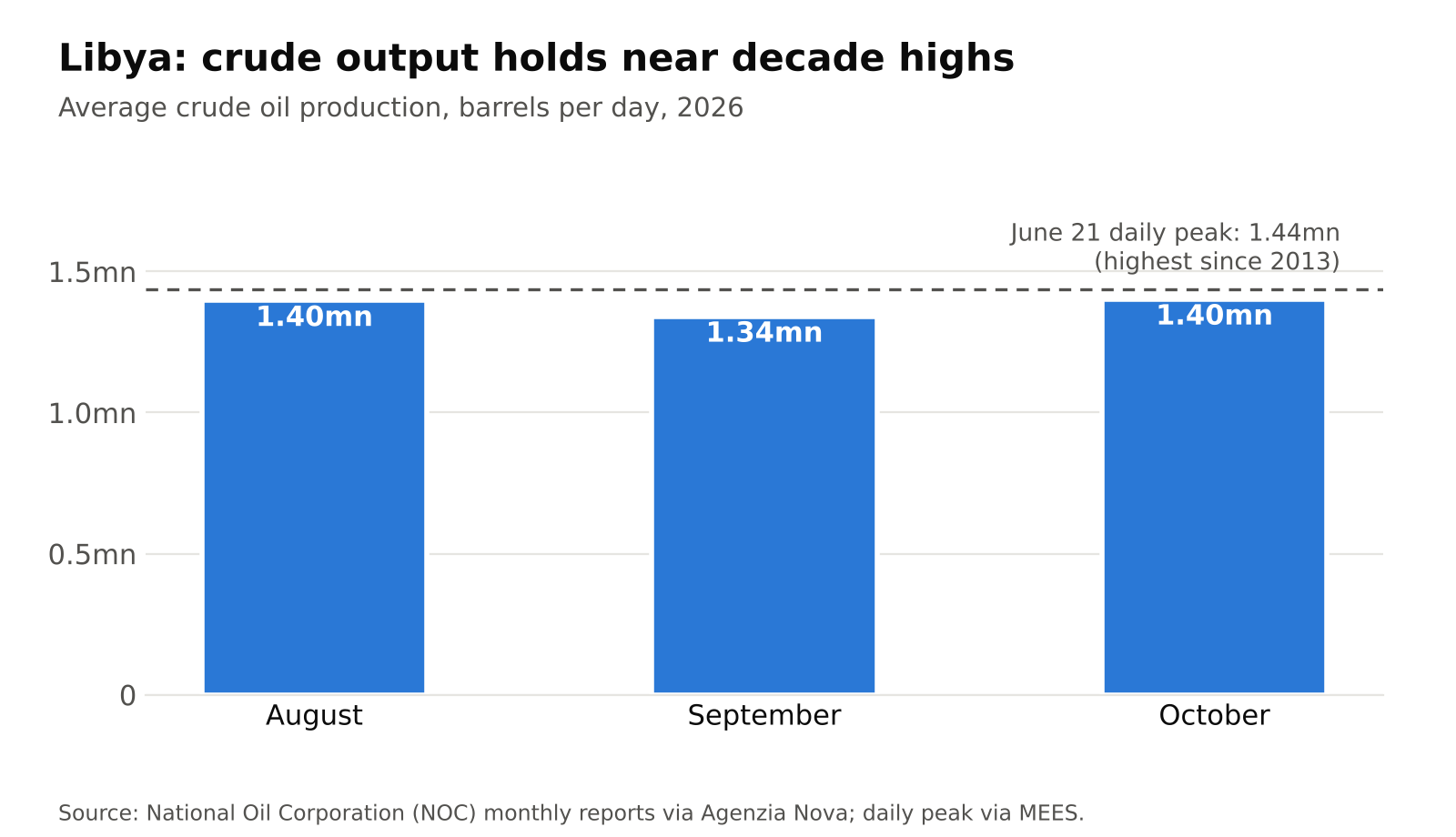
Crude output has so far held up. The NOC reported crude production of 1.44mn barrels per day (bpd) on June 21, the highest daily level since 2013, according to Libya Herald. Agenzia Nova reported on November 5 that Libya produced 43.47mn barrels in October, an average of about 1.4mn bpd.
Security inside the oil system is less assured. An armed group shut the main valve on the pipeline linking the Hamada field to the 120,000-bpd Zawiya refinery on October 30, the second time in October that flows to the refinery had been halted, the NOC said. It warned that a prolonged closure would cost about 15,000 bpd of crude destined for the refinery and asked the Petroleum Facilities Guard to help reopen the valve, Reuters reported.
Rival deals offshore
The House of Representatives approved the 2019 maritime boundary memorandum with Turkey on October 20, reversing its previous opposition to a deal originally signed by the Tripoli government. The shift has unsettled Libya’s neighbours.
Egypt’s Foreign Ministry declared the memorandum “null and void” and said the ratification “entails no legal consequences whatsoever for Egypt”, while Turkish Foreign Minister Hakan Fidan called it “an entirely legitimate deal”, Middle East Eye reported. Egypt, Greece and Cyprus dispute the boundaries it sets, and the eastern parliament’s approval does not resolve those competing claims.
The diplomatic track
The International Civil Aviation Organization lifted aviation safety warnings on Libyan airspace that had been in place since 2013 and 2015, Transport Minister Mohamed Al-Shahoubi announced on October 26, Libya Herald reported, although not all restrictions on Libyan airlines have been lifted. The European Union Aviation Safety Agency’s own conflict-zone bulletin on Libya, renewed in July until January 31, 2027, still advises operators not to use Libyan airspace below about 32,000 feet, except for sea approaches to coastal airports, Libya Observer reported. A day earlier, the foreign ministers of Egypt, Algeria and Tunisia met in Algiers and backed an “inclusive political solution to the Libyan crisis, agreed upon by Libyans themselves”, leading to legislative and presidential elections and unified institutions, Daily News Egypt reported.
What to watch
The next tests are institutional rather than diplomatic: whether the High Council of State and the House of Representatives can agree on the central bank’s leadership, whether the joint committee reconciles oil revenue figures, and whether the CBL publishes sufficiently detailed revenue and spending data to show how much of Libya’s oil income reaches the budget.
The suspension of dollar transactions reported by Africa Intelligence, if confirmed, would add a further test of the bank’s access to international markets.
Follow us online