

Nigeria reviews oil block screening after years of stalled development

Nigeria's upstream regulator is reviewing how it qualifies bidders after its CEO said some domestic operators had lacked the financial or technical capacity to develop awarded assets while disputes had stalled others.
Nigeria's Independent Corrupt Practices and Other Related Offences Commission (ICPC) said on September 11 that Oritsemeyiwa Eyesan, chief executive of the Nigerian Upstream Petroleum Regulatory Commission (NUPRC), disclosed the review during a visit to the anti-corruption agency.
The timing is significant. Eyesan told S&P Global in a September 4 interview that the regulator expected to launch the 2026 licensing round by early October, with the 13 blocks that attracted no bids in the previous exercise among the acreage expected to return to the market.
The problem identified by the regulator reaches beyond the design of another bidding process. For more than two decades, Nigeria has repeatedly sought to move dormant petroleum acreage into the hands of new investors, particularly domestic operators, on the premise that smaller companies could develop discoveries that ranked below the investment priorities of larger producers.
Some have done so. Others have spent years raising finance, resolving ownership disputes or negotiating access to infrastructure, while some awarded fields have never reached production.
The gap between discovered petroleum and production therefore depends not only on allocating acreage but on whether winners can finance drilling and development, secure evacuation routes and meet their work obligations.
A two-decade problem
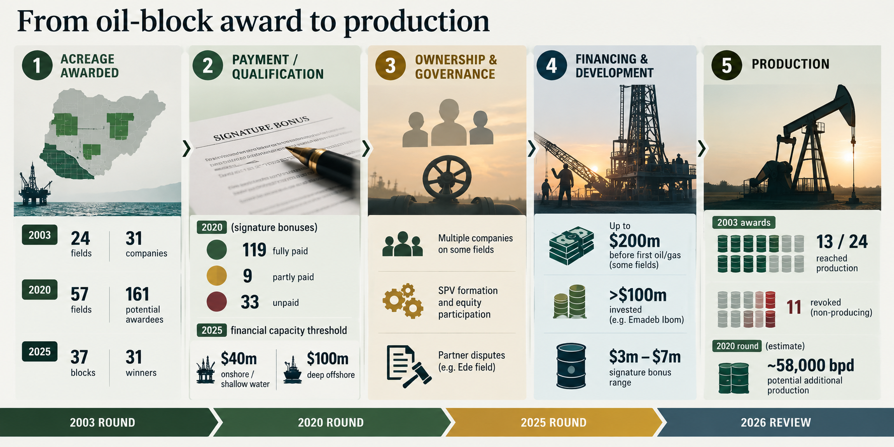
Nigeria's first major marginal-field round resulted in 24 fields being awarded to 31 domestic companies in 2003, with farm-out agreements following in 2004, under a policy intended to broaden Nigerian participation in an upstream industry then dominated by international oil companies.
Several awards became successful producing assets. Platform Petroleum, operator and majority holder of the Egbaoma field, reached first oil in 2007. Waltersmith's Ibigwe field followed in 2008, and the company later commissioned a 5,000 barrels per day (bpd) modular refinery. Midwestern Oil & Gas also brought the Umusadege field into production.
Across the wider portfolio, progress was much slower. The then Department of Petroleum Resources (DPR), NUPRC's predecessor, said in 2013 that only eight of the 24 awarded fields were producing. Sarki Auwalu, then DPR director, said in 2021 that 13 had eventually reached first oil, while the 11 non-producing awards had been revoked.
Corporate competence was only part of the explanation. Under Nigeria's pre-Petroleum Industry Act regime, marginal fields were generally discoveries left undeveloped by their original licence holders. Their economics could be constrained by scale, location and infrastructure access. Smaller operators could face the cost of financing wells and processing equipment while negotiating access to pipelines, terminals and other facilities they did not control.
Regulators and industry reporting have also cited security problems, crude theft in parts of the Niger Delta, financing constraints and disputes with technical or financial partners.
Problems extended beyond marginal fields. At a 2013 DPR review, then-director George Osahon reportedly said that only one of 77 blocks awarded in Nigeria's 2005-07 licensing exercises had entered production and fewer than 30% were being actively worked.
Osahon cited financing and technical constraints, partnership disputes and insecurity. He also said some production-sharing contracts remained unsigned, required bank guarantees had not been provided, and work obligations had not been met.
He put the government's missed revenue from the stalled blocks at about $40bn. No public methodology sufficient to reconstruct that estimate was located, so the figure is best treated as a DPR estimate rather than a definitive calculation of revenue Nigeria would otherwise have received.
The 2020 experiment
By the time another marginal-field round opened in 2020, DPR officials said they had learnt from the earlier exercise. Auwalu said the regulator was conducting due diligence and looking for bidders with both financial strength and technical capacity.
Demand was substantial. NUPRC later said 665 entities expressed interest in 57 fields and 161 emerged as potential awardees.
By January 2022, NUPRC said signature bonuses had been fully paid for 119 potential awards and partly paid for nine, while 33 remained unpaid. Interests for which the required payment was not made by the deadline expired and reverted to the bid basket.
The missed payments showed that some potential awardees had failed to meet the round's immediate financial requirement on time. They did not, by themselves, establish why the companies failed to pay or how much longer-term development finance they might have been able to raise.
A separate difficulty arose from the structure of some awards. Reuters reported in March 2021, citing participants and industry sources, that DPR was placing more than one company on certain fields, including companies that had entered the competition separately.
Participants told Reuters that such pairings could hinder development. NUPRC later acknowledged that special-purpose vehicle formation, equity allocation and disputes among co-awardees had complicated completion of some awards and offered dispute-resolution support.
The Ede marginal field illustrates the governance problem. In January 2025, the Court of Appeal struck out Gab & Nuella Concept and Brinitup Hydrocarbons' challenge as statute-barred, leaving NorthWest Petroleum's 69.6% interest undisturbed. The court also addressed aspects of the underlying equity reallocation.
In March 2025, the Court of Appeal granted the two companies leave to appeal to the Supreme Court. NUPRC's June 2026 concession register continued to list NorthWest Petroleum & Gas with a 69.6% interest in PPL 229.
The dispute does not establish that award structure was responsible for every stalled development. It does show that governance and ownership conflicts could arise before development was under way.
Development capital is the harder constraint
Even comparatively small petroleum discoveries can require substantial capital before they produce a barrel.
Ahead of the 2020 round, energy consultancy Wood Mackenzie estimated that the 25 largest oilfields on offer could unlock about $9.4bn of investment during their first five years. It identified 22 fields with estimated returns above 20% that could nevertheless require as much as $200mn of capital before first oil or gas.
The figures illustrate why passing a bid evaluation and paying a signature bonus are not equivalent to financing development. An upfront payment tests whether a bidder can meet an immediate obligation. Bringing a field into production may require access to much larger sums over several years.
Emadeb Petroleum Exploration & Production, a Nigerian independent, provides a contrasting example. The company said in November 2025 that it had achieved first oil from the Ibom field the previous month after investing more than $100mn in its development. Emadeb also said NUPRC had approved the field development plan in November 2024. The field was discovered in 1979.
The case shows that domestic operators can bring previously undeveloped discoveries into production, but also that doing so can require substantial capital and time.
Measuring delayed production
Putting a single number on the cost of stalled development would be misleading. Oil that never entered production is a counterfactual, and there is no reliable way to establish how much acreage awarded over the past two decades would have been commercially viable, fully financed and brought on stream on schedule.
Some blocks may have contained less commercially recoverable petroleum than expected. Others were delayed by security problems, infrastructure constraints or legal disputes rather than operator capacity.
A more defensible measure is the regulator's estimate of additional production potential. NUPRC estimated in 2023 that petroleum prospecting licences arising from the 2020 marginal-field round could add approximately 58,000 bpd of oil and 87mn standard cubic feet per day of gas.
If sustained for a full year, 58,000 bpd would amount to about 21.2mn barrels. That should not be described as oil Nigeria has “lost”: it is NUPRC's estimate of potential incremental production from the portfolio and assumes projects can be developed successfully.
For scale, NUPRC said Nigeria produced an average 1,500,190 bpd of crude oil in August 2026, while crude and condensate combined averaged 1,677,777 bpd. The 58,000 bpd estimate for the 2020-round portfolio is equivalent to about 3.9% of August crude production.
Oil also remains central to Nigeria's external accounts. National Bureau of Statistics data for the second quarter of 2026 show crude oil and other oil products accounting for about 86.2% of goods exports.
For an otherwise commercial project, years of delay can therefore defer royalties and taxes, export volumes and foreign-exchange receipts.
A tougher screening framework
NUPRC had already tightened screening before the latest review was disclosed.
The 2025 Licensing Round rules required verifiable evidence of financial capacity. Applicants for onshore and shallow-water acreage had to demonstrate at least $40mn through qualifying turnover, cash or a bank guarantee, while the deep-offshore threshold was $100mn. Newly incorporated applicants could rely on a qualifying parent-company guarantee.
The wider evaluation also covered work programmes, technical and professional capacity, balance-sheet strength, guarantee support, turnover and corporate governance. At the commercial-bid conference, Eyesan said bids would be assessed using the signature bonus, work-programme commitment and performance security.
Signature bonuses were set in a $3mn-$7mn range. NUPRC said the bounded bonuses were intended to reduce entry barriers while placing greater weight on financial strength, technical capability and credible work programmes.
The new review therefore raises a broader question: whether the main weakness lies in headline thresholds or in verifying that funding is genuinely deployable, structuring partnerships and enforcing post-award obligations.
Nigeria also has statutory mechanisms for dealing with stalled acreage, although no single provision governs every category.
Section 79 of the Petroleum Industry Act requires a petroleum prospecting licence holder that has declared a commercial discovery to submit a field development plan and work commitment within two years. If it does not, the Act provides for relinquishment of the area containing the discovery. Section 94 contains separate transitional development and relinquishment provisions for legacy marginal fields.
NUPRC describes its broader approach as “drill or drop”. Eyesan told bidders at the July commercial-bid conference that “an award is not a trophy to be held”.
The 2025 awards
The new framework is already being tested. Thirty-one companies emerged as winners for 37 blocks in the 2025 Licensing Round in July, but that announcement did not itself make them final licence holders.
NUPRC said successful bidders still had to provide required guarantees, pay the signature bonus and first-year rent, and complete contractual documentation before the commission could make the necessary recommendation for ministerial approval.
The published guidelines require payment of the signature bonus within 60 days of receipt of an offer letter and the broader package of guarantees, rent and other pre-licence documentation within 90 days.
Those requirements give NUPRC an early means of identifying bidders unable to complete the immediate award process. The harder question comes afterwards: whether the financial capacity demonstrated during bidding translates into deployable development capital, whether guarantees are enforceable, whether jointly held assets can be governed effectively and whether acreage is recycled when obligations are missed.
The September ICPC statement said NUPRC also planned an onboarding programme for successful awardees in October, with the anti-corruption agency expected to participate on governance, compliance and integrity.
At the same time, the regulator is seeking to replace Nigeria's historically irregular acreage awards with more frequent licensing exercises. Eyesan told S&P Global that the next round was expected by early October.
More regular bidding may make acreage easier for investors to access. Its success will ultimately depend on whether successful bidders can finance and develop their blocks — and whether NUPRC acts when they cannot.
Follow us online