

Operating carbon capture capacity equals under 0.2% of global CO2 emissions

The world's 132 commercial carbon capture and storage (CCS) projects have capacity to capture about 68mn tonnes of CO2 a year, less than 0.2% of global emissions, Global CCS Institute data compiled by Statista show.
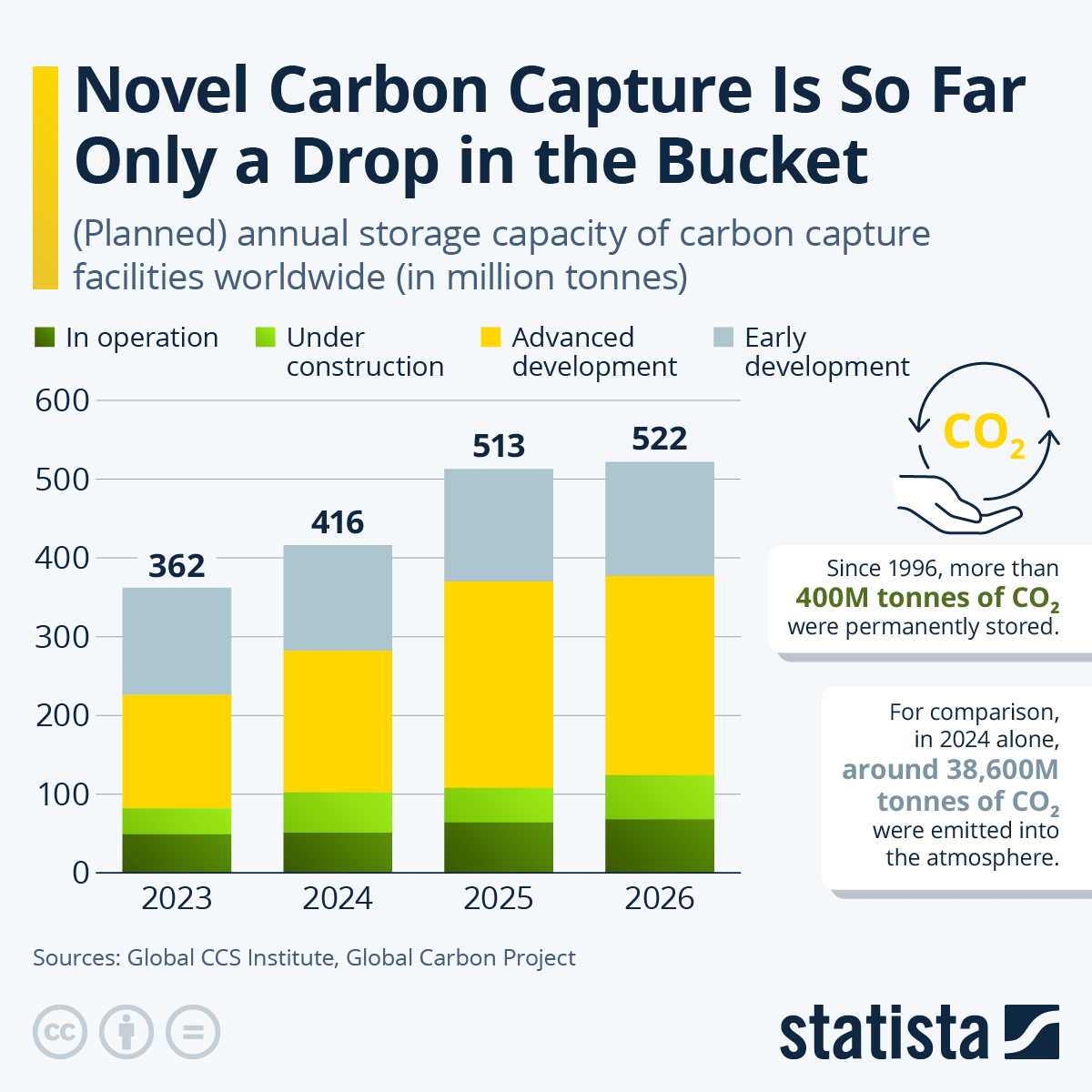
Annual storage capacity of carbon capture facilities worldwide by development stage, mn tonnes. Source: Global CCS Institute, Global Carbon Project, via Statista (CC BY-ND).
Around 38.6bn tonnes of CO2 were emitted in 2024 alone, according to the Global Carbon Project, while all the CCS facilities built since 1996 have permanently stored a little over 400mn tonnes between them, roughly four days' worth of current emissions.
Planned annual storage capacity, including projects under construction and in advanced and early development, has risen to 522mn tonnes in 2026 from 362mn tonnes in 2023. Most of it remains on paper, and even if every project were completed, the total would equal less than 1.5% of 2024 emissions.
The US has 50 operating facilities, China 27 and Canada 12. Europe has 15, five of them in Norway. Most projects capture CO2 from biomass and ethanol production, power and heat generation, gas processing and hydrogen, ammonia and fertiliser plants.
Planting and managing forests remains by far the cheapest carbon removal credits, at a weighted average of $17 per tonne of CO2 equivalent in 2025, followed by peatland and coastal wetland restoration at $29, according to The State of Carbon Dioxide Removal 2026 report, also charted by Statista.
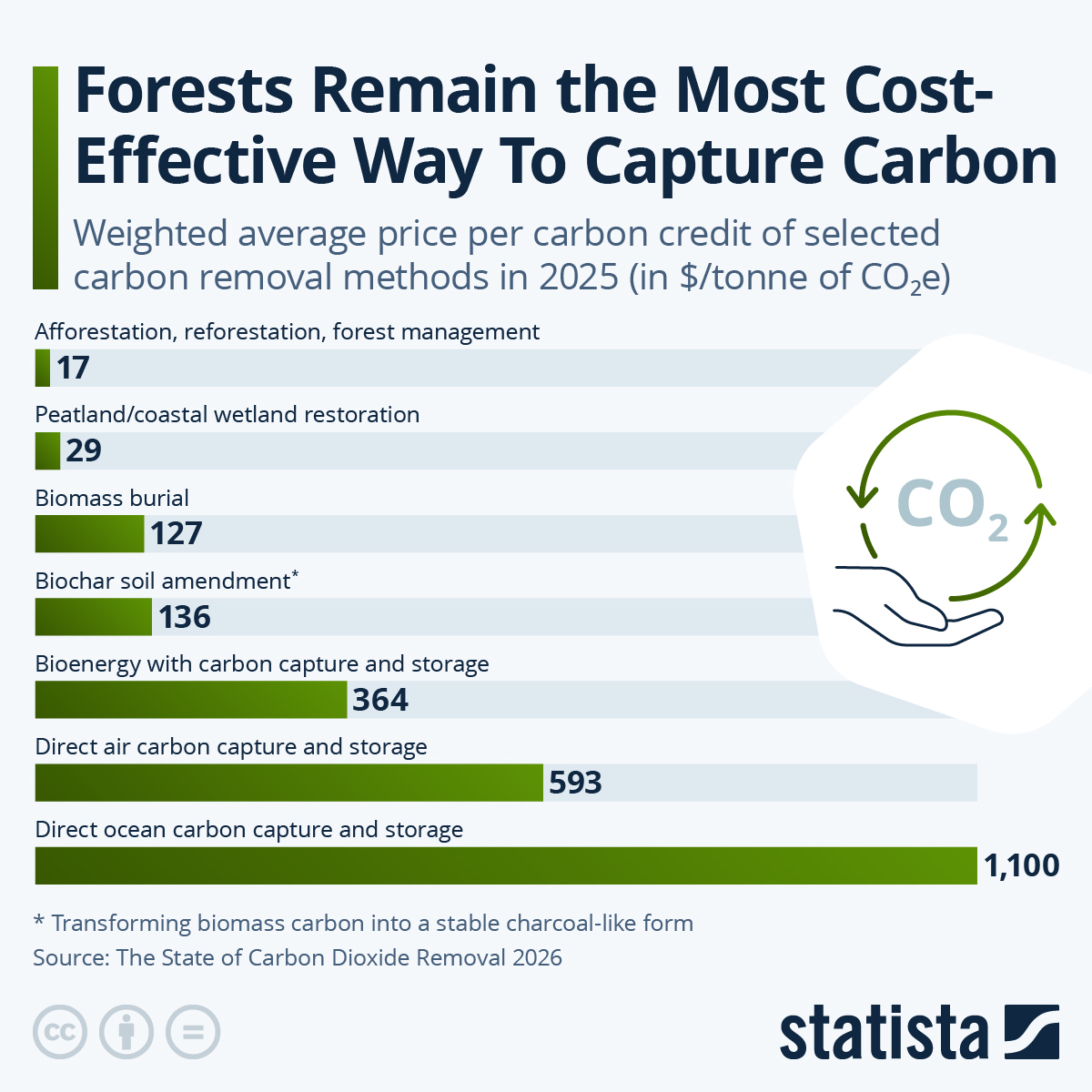
Weighted average price per carbon credit of selected carbon removal methods in 2025, $ per tonne of CO2 equivalent. Source: The State of Carbon Dioxide Removal 2026, via Statista (CC BY-ND).
Engineered carbon removal credits are much more expensive. Biomass burial averaged $127 a tonne and biochar, which turns biomass into a stable charcoal-like form, $136. Bioenergy with carbon capture and storage were priced at $364, direct air capture $593 and direct ocean capture $1,100, about 65 times the price of forestry credits. High energy use and cost remain the main hurdles for air and ocean capture, although natural solutions face their own limits from land constraints, wildfires and illegal logging.
Follow us online