
Poland Europe’s largest methane super-emitter from coal mines

Poland has been identified as Europe’s largest “super-emitter” of methane from coal mining operations, according to a new report by energy think-tank Ember, which warns that vast quantities of the potent greenhouse gas continue to be vented illegally across the EU.
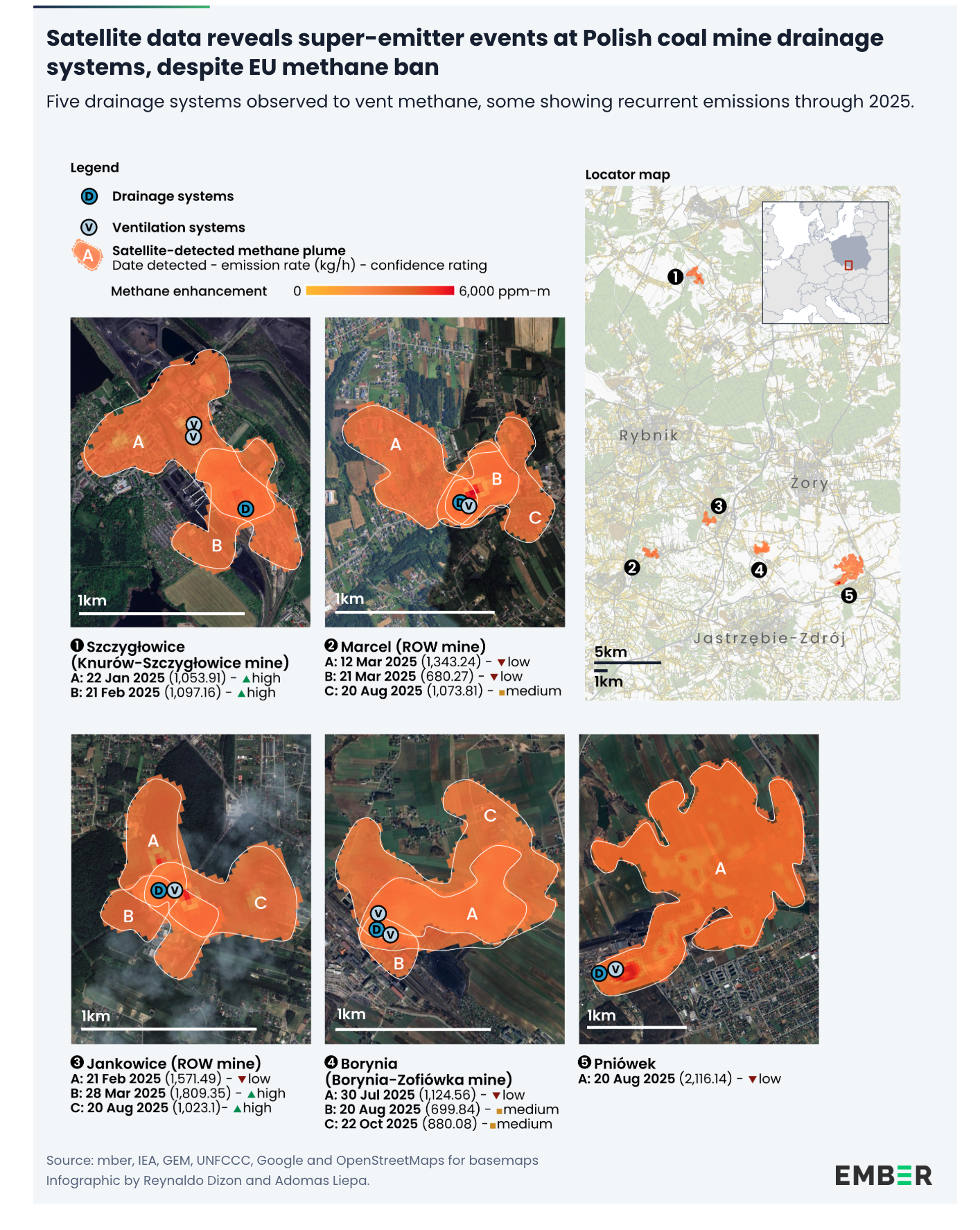
“In 2025, Polish coal mines were identified as the most frequent methane super-emitter observed in the EU energy sector. Despite the EU Methane Regulation prohibiting the venting of methane from drainage systems, new satellite evidence shows that methane venting continues across several sites in Poland,” the report said.
The study examined methane releases from EU coal mines using satellite data,. Ember reported on February 13 that Poland accounts for the largest share of so-called super-emitting sites — facilities that release exceptionally high levels of methane into the atmosphere. The effect on global warming of methane is more than 80 times more powerful than carbon dioxide over a 20-year period, making it a critical target for short-term Climate Crisis mitigation.
The report found that despite the EU’s tightening climate framework and commitments to cut greenhouse gas emissions by at least 55% by 2030, methane from coal mining remains one of Europe’s biggest climate problems. Poland, the bloc’s largest coal producer, is highlighted in the report and a standout emitter due to the scale and intensity of emissions linked to its underground mining operations.
"These direct observations of potential non-compliance underscore a critical gap between policy and practice. They demonstrate that, without independent verification and dissuasive penalties, the Regulation will fail to deliver the significant emission cuts that are technically feasible and urgently needed for climate goals," EMber found.
Ember said that many coal mines across the EU continue to vent methane directly into the atmosphere rather than capturing or flaring it. Venting is often used for safety reasons in gassy underground mines, but the practice results in significant climate impacts when mitigation technologies are not deployed. Since January 2025, routine methane venting has been banned in the EU but at least five Polish coal mines have ignored the order and continue to vent methane illegally, Ember reports. Ember analysis finds that coking coal mines accounted for 90 out of 109 of the observed methane releases in 2025, despite representing only 25% of total hard coal production in Poland.
In 2025, 96% of methane plumes (109 out of 114 plumes analysed) over onshore European energy infrastructure were traced to Polish coal mines, making Poland the most frequent fossil fuel methane super-emitter in the EU. 5 out of 22 drainage systems in Polish coal mines were observed venting methane in 2025, despite the EU ban. "This is especially alarming given that no systems for verification or penalties are in place," says Ember.
“Since the EU Methane Regulation entered into force, its provisions are directly applicable across all EU Member States, and all operators covered by the regulation are legally required to comply. However, practical enforcement remains uncertain until each Member State adopts its own penalty framework, the deadline for which was 5 August 2025. To date, several Member States have submitted their penalty or draft penalty frameworks, including coal methane emitters such as Czechia and Romania. Poland – the EU’s largest coal mine methane emitter – has not,” the report says.
Methane reportedly vented from drainage systems – if captured – could keep 14.5mn Polish houses warm for a week. In 2024, Polish coal mines used 70% of captured drainage methane, emitting 57,000 unutilised tonnes to the atmosphere. This drainage gas, rich in methane, could instead be used as an energy source, the report says.
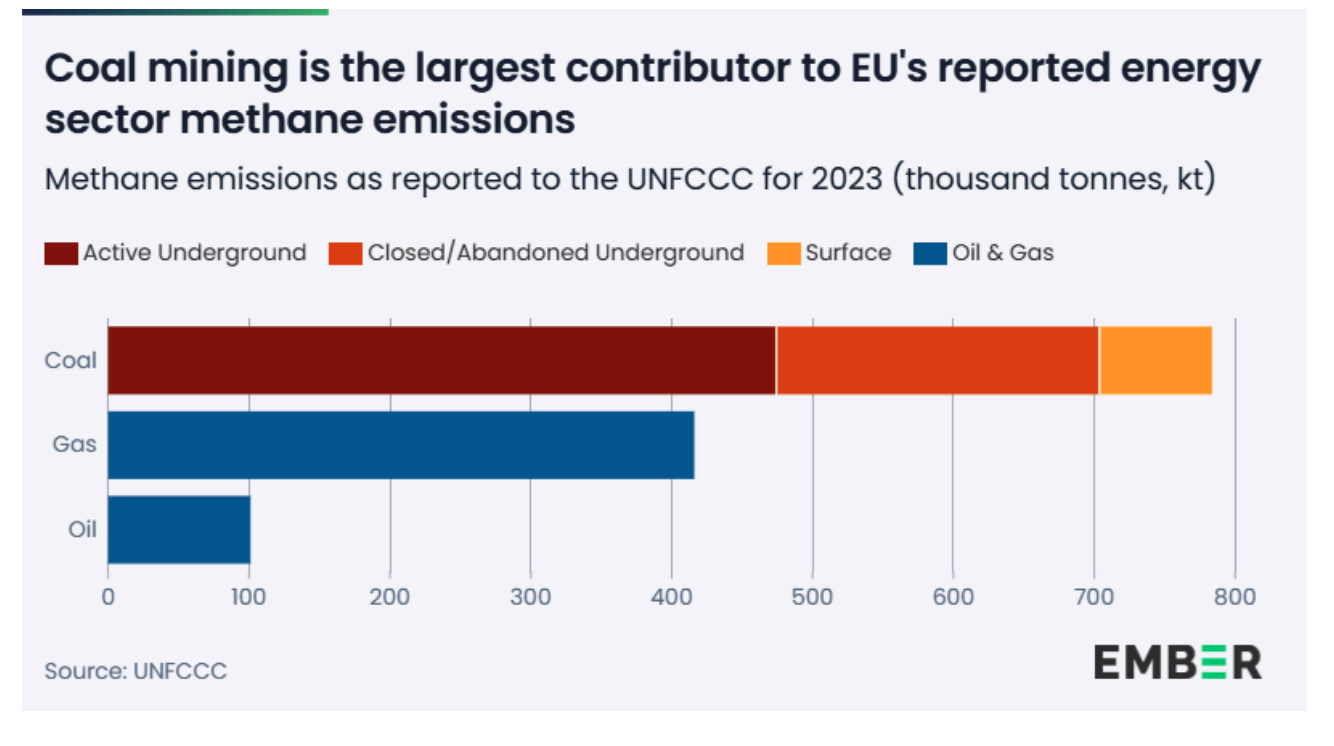
The findings come as the EU prepares to implement new methane regulations, which require operators in the fossil fuel sector to measure, report and verify emissions, and introduces restrictions on routine venting and flaring. Coal mines will face new monitoring obligations under the legislation, with stricter standards expected to apply in the coming years.
Poland has defended the continued role of coal in its energy mix on grounds of energy security and affordability, particularly following supply disruptions after Russia’s invasion of Ukraine. However, the scale of methane emissions identified in the report is likely to intensify scrutiny of the country’s transition strategy.
Ember said tackling methane from coal mines represents one of the fastest and most cost-effective ways for the EU to curb near-term warming while accelerating the shift away from fossil fuels.
The Climate Crisis is accelerating. The United Nations’ Intergovernmental Panel on Climate Change (IPCC) says that the Paris Agreement goal of keeping temperature increases to less than 1.5°C-2°C above the pre-industrial benchmark has already been missed and temperature increase are on course to reach a catastrophic 2.7C-3.1C by 2050. At that point extreme temperature events will become routine and large parts of the world will become uninhabitable. Despite the urgency of the emergency, countries continue to put economic considerations head of the need to fight global warming.
Follow us online