

Poland slashes coal to half its power in four years as solar and wind double
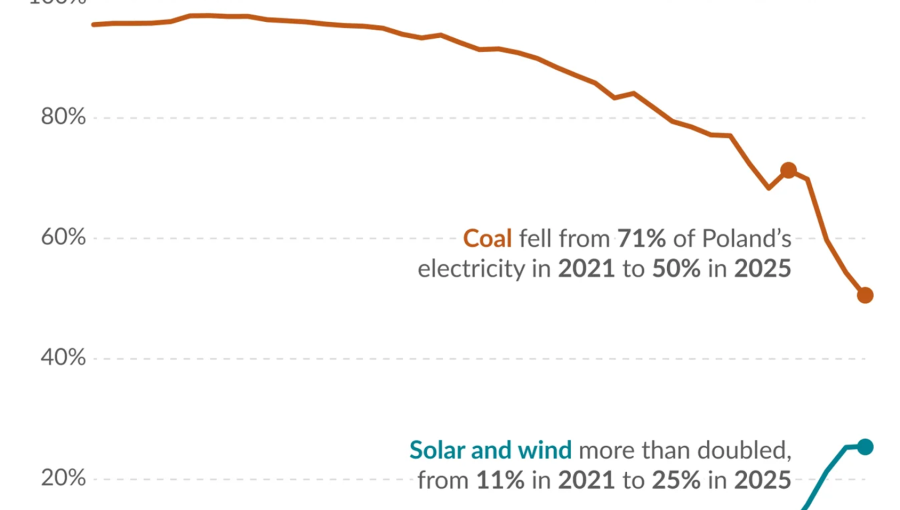
Coal's share of Poland's electricity fell from 71% to 50% in four years, nearly as much as in the previous three decades, Our World in Data reported on November 3.
Solar and wind went the other way, more than doubling from 11% of generation in 2021 to 25% in 2025, on figures from the energy think tank Ember and the Energy Institute. The two were close to zero until about 2010, while coal supplied over 95% of Polish power through the 1980s and 1990s. The start date flatters the fall a little, as coal had rebounded in 2021 from about 68% a year earlier.
The switch reaches well beyond Poland, which with Germany generated more than 74% of the EU's coal power in 2025, according to Ember's European Electricity Review 2026. Coal supplied just 9.2% of EU electricity that year, so Poland still leans on it more than five times as heavily as the bloc as a whole. The cheap and quick part of the change now looks finished: coal output is rising again this year, and the official plan sets no date for shutting the last coal-fired plant.
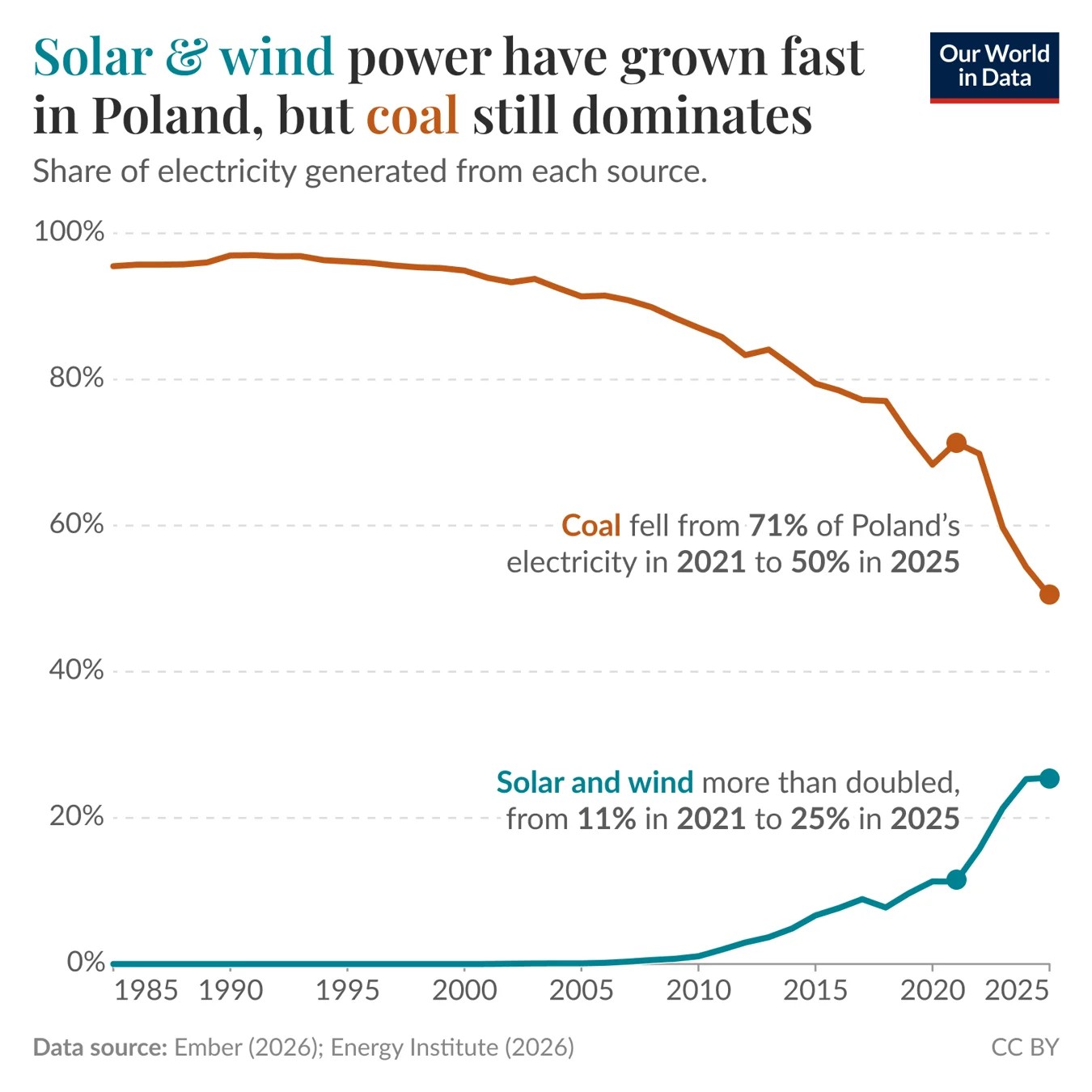
Solar and wind power have grown fast in Poland, but coal still dominates. Share of electricity generated from each source. Data source: Ember (2026); Energy Institute (2026), via Our World in Data, CC BY.
"Poland still has one of the most coal-intensive electricity mixes in Europe," wrote Hannah Ritchie of Our World in Data, adding that growth in solar and wind "will play a key role" in moving away from coal over the next few decades.
That growth has already slowed. Solar and wind together produced 41.1 TWh in 2025, the same as in 2024, on Ember's monthly figures: solar added 1.9 TWh and weak wind took away 1.9 TWh. Gas did more of the work, with its output up 4.3 TWh as coal's fell 6.2 TWh. Forum Energii, a Warsaw think tank, put the rise in the renewables share at 0.7 percentage points in 2025, against 2.3 points a year earlier. Counts of coal's 2025 share differ slightly by source, with Ember's own Poland page giving 51% and Forum Energii 52.2%.
Coal comes back
Coal-fired output rose 7.6% y/y to 64.2 TWh in the first nine months of 2026, and its share edged up to 52% from 51.2%, Ember's monthly data show. Solar grew 18.1% to 20.2 TWh, but that 3.1 TWh gain covered less than half of the 7.1 TWh rise in total generation, and wind fell 4.3%. Coal's lowest monthly share this year was 46.8% in July, still above the 42.9% it touched in June 2025.
| Poland, first nine months | 2025 (TWh) | 2026 (TWh) | Change y/y | 2025 share | 2026 share |
| Coal | 59.6 | 64.2 | +7.6% | 51.2% | 52.0% |
| Gas | 14.3 | 14.9 | +4.1% | 12.3% | 12.0% |
| Solar | 17.1 | 20.2 | +18.1% | 14.7% | 16.3% |
| Wind | 15.7 | 15.1 | -4.3% | 13.5% | 12.2% |
| Solar and wind | 32.8 | 35.2 | +7.4% | 28.2% | 28.5% |
| Total generation | 116.4 | 123.5 | +6.1% | 100% | 100% |
Source: Ember monthly electricity data. Shares and changes calculated from the TWh figures; the monthly series runs slightly below Ember's annual totals.
Weak wind and rising power use both played a part. Wind output in June was half its level of a year earlier, according to the Warsaw think tank Instrat. Grid operator PSE put domestic consumption up 3.79% y/y in January-September, while output grew 6.4%, which implies more Polish power going abroad. Solar also fades just as evening demand peaks: during the August heatwave, when drought cut output at coal plants, PSE said the gap made coal and gas more important.
No end date
Warsaw's National Energy and Climate Plan, adopted on June 8, sets a deadline for the mines but not for the power plants: domestic thermal coal mining ends by 2049 at the latest. It describes its timetable for cutting coal use as a "flexible approach", dependent on progress in low-emission generation and on the geopolitical situation, and allows selected coal units to stay on as a system reserve.
The plan's two scenarios show the size of the job. In the reference case, hard coal and lignite plants together generate 56.5 TWh in 2030, and hard coal still 12.3 TWh in 2040. In the accelerated case the 2030 figure is 44.9 TWh, with lignite gone by 2035 and hard coal by 2040. Set against the 87 TWh Ember recorded for 2025, the reference case needs a fall of about 8% a year, and the plan's assumption of 51.6%-53.2% renewables in generation by 2030 needs the wind and solar build-out to pick up again.
The International Energy Agency was more bullish in February, forecasting that renewables will overtake coal as Poland's main power source in 2028, with coal output falling 11% a year. It also noted that Brussels has let high-emission plants stay in Poland's capacity market until the end of 2028, which keeps coal units paid for standing by until then.
The replacements are arriving, though unevenly. Solar capacity reached 28,231 MW on September 1, up 15.4% y/y, against 11,794 MW of wind on October 1, and the government wants 5.9 GW of offshore wind by 2030. State-controlled PGE plans PLN210bn (€47.5bn) of investment by 2035, with about PLN80bn (€18.1bn) for wind and storage. The grid is the bottleneck: Forum Energii estimates 1.4 TWh of renewable output was curtailed in 2025, and batteries stood at just 1.3 GW on October 1.
Nuclear will not help this decade. The first reactor at Lubiatowo-Kopalino is now due to start commercial operation in 2036, with the plant at full capacity by 2038, and until then pushing coal down from half the mix falls to wind, solar, gas and batteries.
This article was produced with the help of the IntelliNews Lambda analytical tool
Follow us online