
Post Assad Syria sill dependent on Russian oil
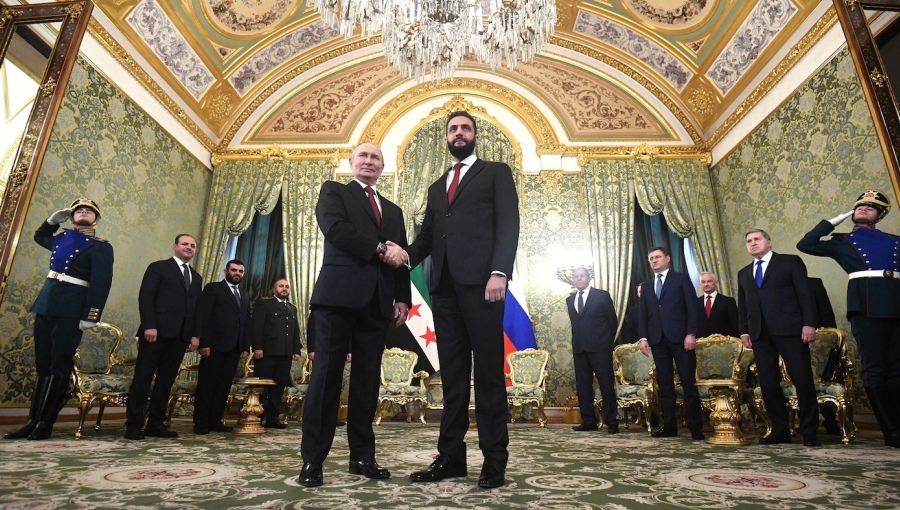
When Ahmad al-Sharaa's forces swept into Damascus in December 2024 and ended the rule of Russian-backed Bashar al-Assad's half-century dynasty, the fall of Russian President Vladimir Putin’s ally in the Middle East was seen as a big blow for the Kremlin. Syria's new government turned toward the West. It threatened to close down Russia’s key naval base on the Mediterranean. The new leader toured European capitals and made a landmark trip to Washington. And sanctions were lifted that had isolated the country for decades.
But Moscow has a tenacious hold on Syria and Al-Sharaa is enough of a pragmatist to realise that he continues to need Russian inputs as he strives to rebuild an economy smashed by years of war and mismanagement.
Russia has emerged as the main supplier of oil to Syria, Reuters reports show, despite the new government's reaching out to the West and uncomfortable relations with Moscow over its military support for the fallen Assad regime.
Oil shipments from Russia jumped 75% y/y to about 60,000 barrels per day this year, based on Reuters calculations of official announcements and ship tracking data from LSEG, MarineTraffic and Shipnext.
Russia was first to send a tanker to Syria after Assad fell, supplying 16.8mn barrels in 2025 — about 46,000 barrels per day — through 19 cargoes shipped between February 28 and December 31, 2025, according to Kpler data. That has risen to an estimated 60,000 barrels per day this year. Reuters tracked the names of 21 vessels that arrive at Syrian ports from Russia on an almost weekly basis. All the vessels are currently under Western sanctions.
The volumes are modest in global terms — a rounding error for Russia's overall export programme – but for Syria, the imports are a vital lifeline.
The supply gap
Syria's total demand for oil and fuel is estimated at 120,000 to 150,000 barrels per day, according to the Syrian Petroleum Company and energy ministry officials. Domestic production remains at roughly 35,000 barrels per day in 2025 — a fraction of pre-war levels of 350,000 barrels per day. The country's largest producing field, Al-Omar in Deir Ezzor, yields only about 5,000 barrels per day despite the government having regained control of eastern Syria's oil fields from the occupying US-backed Kurdish forces.
After years of occupation, the US entirely withdrew its forces from the occupied western Syria, where the main oil fields are located, just two weeks ago.
US Central Command confirmed that "US forces have completed turning over all of our major bases in Syria as part of a deliberate and conditions-based transition." The final convoy of US soldiers and equipment departed Qasrak air base in Hasakah province on April 16, ending a military presence that began in 2014.
The US withdrawal is directly relevant to the oil dependency story in two ways. US Republican congressman Joe Wilson said: "Syria should do the right thing and kick them out" referring to Russia's bases — now looks somewhat hollow: the US itself has just completed its own exit from Syria, eliminating whatever leverage Washington had to press Damascus on the question of Russian bases at Tartus naval port and Khmeimim airbase.
With no US military presence remaining on Syrian soil, Russia's bases are now the only foreign military infrastructure in the country — reinforcing Moscow's structural leverage over Damascus at precisely the moment the new government is trying to pivot toward the West.
The gap between what Syria produces and what it needs is filled, overwhelmingly, by Russia. The switch from Iran to Russia as Syria's primary external supplier happened rapidly and completely. Until 2025, Iran was Syria's dominant crude supplier, while Russia's role was limited to occasional diesel shipments. Kpler data shows that all crude imports in 2024 — about 22.2mn barrels — came from Iran, which halted supplies after Assad's fall. Russia moved into the vacuum within weeks.
A Syrian energy ministry official said Syria's reliance on Russian oil reflected the country's limited market size and weak purchasing power, which made it hard to secure long-term contracts with other major producers such as Gulf states. The Central Bank of Syria only reactivated its account at the Federal Reserve Bank of New York in March 2026, opening opportunities for wider banking communications with the global financial system for the first time since 2011, TASS reports.
At Syria's Mediterranean terminals, the trade is handled by a rotating fleet tied to Russia's network of sanctioned shadow fleet tankers, operating under multiple flags including Panama, Liberia, Marshall Islands, Comoros, Madagascar, Oman and Russia, according to LSEG data. The mechanics of trading oil with Russia are well worn by now: complex maritime routing, ship-to-ship transfers in open water, flag-hopping and shell company intermediaries that obscure the origin and ownership of both the cargo and the vessel.
Syrian authorities have said when oil shipments arrive they do not disclose their origin as Russia remains deeply unpopular domestically because of its military support for the Assad government. The only delivery the government has publicly identified was from Saudi Arabia in November 2025, which it described as a grant.
The bases problem
Energy dependence is not the only thread tying Damascus to Moscow. Russia retains its naval base at Tartus that has allowed Russia to reestablish itself as a naval power on the Mediterranean, as well as the key Khmeimim air base near Latakia that is Russia’s stepping stone to support its military activities in Africa.
Both were also central to Russian military operations in support of Assad throughout the civil war. Both remain operational under the new government, albeit in reduced scope. Over the past six months, Al-Sharaa has visited Moscow twice as this new relationship unfolds and both sides have shown a pragmatism in the new relationship. Agreements reached during those visits include maintaining the Russian military bases in Tartus and Khmeimim in exchange for trade.
The bases are a constant undercurrent in Syria's diplomacy with the West. Syrian officials acknowledge that the fate of the Russian installations regularly features in discussions with Western capitals.
Kicking Russia out of Syria completely would require Syria to simultaneously find an alternative oil supplier, restructure its energy import logistics, withstand potential Russian retaliation through supply disruption, and do all of this while its financial system is only beginning to reconnect with global markets after fifteen years of isolation.
The irony of the US position was sharpened on April 16, when the final convoy of American soldiers departed Qasrak air base in Hasakah — completing a full US military withdrawal from Syria that Trump had ordered in February. The US, which had maintained up to 2,000 troops in Syria at its peak, now has no military presence in the country, while Russia is still there.
Damascus's diversification attempts
Syria has unsuccessfully sought to reach an oil supply deal with Turkey, an official at the state Syrian Petroleum Company told Reuters. While relying on Russian imports, Damascus is simultaneously courting Western companies to develop its oil and gas sector, which was left in disarray during the civil war. Syria expects to award oil and gas exploration licences to major international oil firms to tap what it describes as significant reserves, the chief executive of the Syrian Petroleum Company told the Financial Times in February.
The contradiction at the heart of Syrian energy policy — buying sanctioned Russian oil through a shadow fleet while soliciting Western majors to develop domestic production — is not lost on Damascus. Syrian economist Karam Shaar told Reuters that the purchase of Russian oil could lead to new Western sanctions, and that Damascus is trying to diversify supplies, including through negotiations with Turkey that have so far yielded no results, Interfax reports.
Syria has limited options as Al-Sharaa tries to stick together a viable recovery plan. Russian oil, delivered weekly by a rotation of sanctioned tankers to Baniyas and Latakia, covers the gap between what Syria produces and what it needs. But until the recently recovered domestic production can be ramped up to a level that reduces that gap materially — a process that will take years and requires the massive foreign investment Syria is simultaneously trying to attract — the dependency on Russian supplies will persist giving the Kremlin considerable leverage over Damascus.
Follow us online