
Russia, China lead new nuclear age as Rosatom closes the fuel cycle
IntelliNews summary:
- Russia plans about 30 GW of new nuclear capacity, with the BREST-OD-300 fast reactor due in 2029 and the BN-1200M in 2035.
- Rooppur 1 in Bangladesh and Tianwan 7 in China are already on the grid, and Akkuyu in Turkey is due to deliver power from 2027.
- China's nuclear capacity has overtaken France's at 63.98 GW, and it builds at about a third of the French cost.
- Chinese labs have unveiled a thorium molten salt reactor, a pebble-bed reactor and the Linglong One SMR.
____________________
Russia's Rosatom has run a commercial reactor on fuel made from plutonium bred in that same reactor, a first step towards nuclear power that makes its own fuel and needs far less mined uranium.
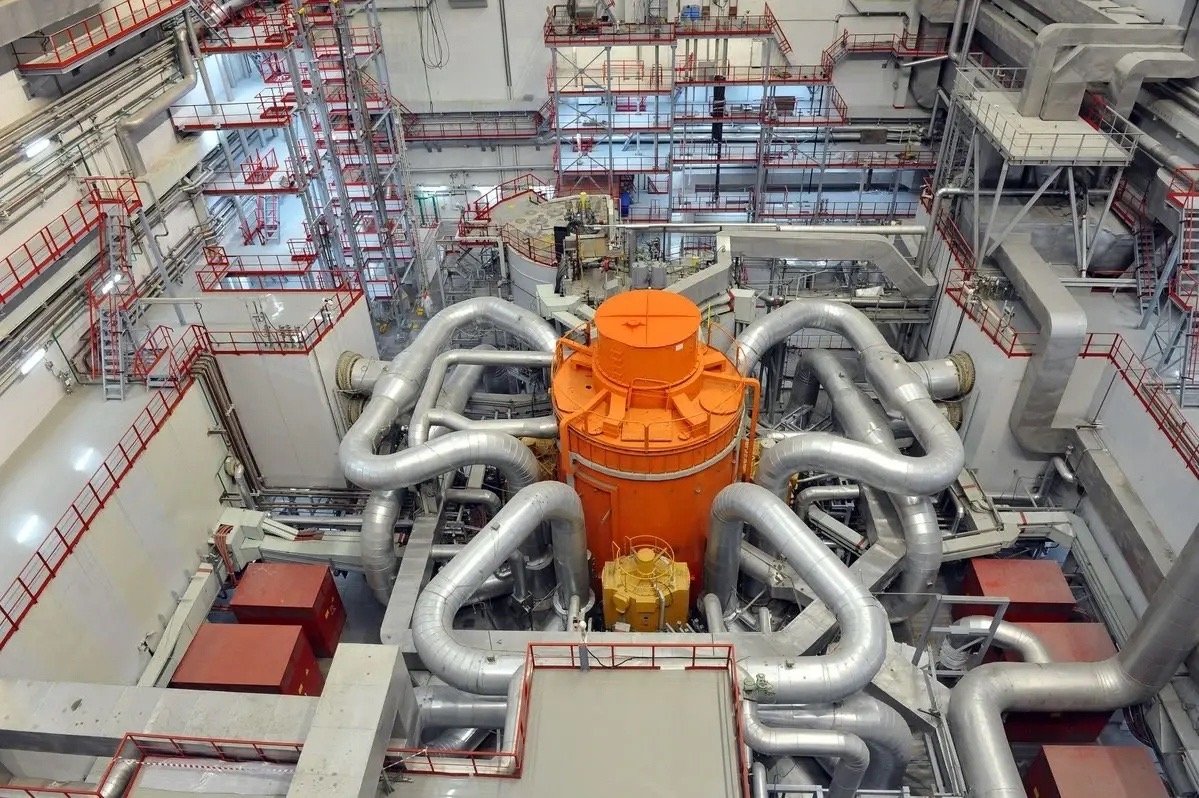
The BN-800 fast-neutron reactor at unit 4 of the Beloyarsk nuclear power plant in the Urals. Source: Rosatom
Engineers at unit 4 of the Beloyarsk nuclear power plant in the Urals have loaded an experimental assembly of twice-recycled mixed-oxide (MOX) fuel into the 880 MW BN-800 sodium-cooled fast-neutron reactor, the state nuclear corporation said on November 27. The plutonium in it was extracted from a MOX assembly that had already completed a full cycle inside the BN-800 itself. Until now the reactor ran on MOX made with plutonium recovered from the spent fuel of conventional thermal reactors, Nuclear Engineering International reported.
"Today, we have moved from theory to practice in closing the nuclear fuel cycle at fast reactors," said Rosatom Director General Alexei Likhachev. "Having overcome another technological milestone, we are proving the viability of the very model of 'renewable' nuclear energy. It will provide for the growing demand for electricity without proportionally increasing the burden on natural resources and increasing the volume of radioactive waste."
Today's light-water reactors burn less than 1% of the energy in the uranium they are fed, and the rest ends up as waste. A fast reactor that breeds plutonium and gets it back as fresh fuel can keep recycling the same material, which in theory frees nuclear power from the limits of the world's uranium reserves and cuts the volume and life of its most dangerous waste. Scientists have chased the closed fuel cycle since the dawn of the nuclear age; Rosatom says this is the first time it has been shown on a large commercial reactor rather than a prototype, a claim no independent body has yet confirmed.
Russia and China pioneers
Russia is not alone at the frontier. China has spent the last two years unveiling one new reactor technology after another, from a thorium molten salt reactor that breeds its own uranium to the world's first commercial fourth-generation pebble-bed reactor. Between them the two countries now hold most of the cutting-edge nuclear technology in commercial use, while the West's builders struggle to finish conventional plants on time and on budget.
The Beloyarsk assembly is a single test unit, not a full core, and the work is being done under licence from the regulator Rostechnadzor. Its real job is to feed operating data into the next generation of Russian fast reactors: the BN-1200M planned as Beloyarsk unit 5, which Likhachev says will be operating in the next decade, and the lead-cooled BREST-OD-300 being built at Seversk in Siberia's Tomsk region.
A domestic build programme
BREST is the centrepiece of Rosatom's Proryv (Breakthrough) programme and the reason Moscow talks of a revolutionary closed fuel cycle reactor. The 300 MW unit sits on the same site as its own fuel plant: a fabrication and refabrication module that began working in December 2024, and a reprocessing module that will take spent fuel straight back out of the reactor and recycle it. BREST is due to start in 2029. Beloyarsk received a siting licence for the BN-1200M in April 2025, and first concrete is expected around 2027 with commissioning in 2035, according to the World Nuclear Association.
Russia plans to commission about 30 GW of new nuclear capacity over the long term, mostly conventional reactors but including small modular ones, President Vladimir Putin said in August, enough to replace the ageing Soviet-era units and add net capacity. Nuclear already supplies roughly a fifth of Russia's electricity.
The first VVER-TOI unit at Kursk II was connected to the grid in December 2025 and two more are under construction there, while units 3 and 4 at Leningrad II, both VVER-1200s, started construction in March 2024 and March 2025. Preparations for first concrete at Smolensk II, which will replace the RBMK reactors of the Chernobyl type still running there, are scheduled for 2027. Much of the new capacity is aimed at Siberia and the Far East, where mining, data centres and the China trade are outrunning the grid.
The export order book
The domestic programme is also the shop window for Rosatom's exports, which have kept booming through four years of sanctions. No Western government has sanctioned Rosatom outright, because too many of their own reactors run on its fuel, and each VVER sold abroad comes with a fuel contract that can last 60 years, the lock-in that has made uranium the new gas in Moscow's dealings with the Global South.
Several of the big projects are now close to producing power:
- Bangladesh: Rooppur 1 sent its first electricity to the grid on November 17, on a trial basis at 350 MWe; fuel for the second 1,200 MWe unit is being flown in. The two-unit plant is being built under a $12.65bn contract.
- China: the Russian-designed VVER-1200 at Tianwan 7 was connected in October, with its twin, unit 8, due in 2027.
- Turkey: Ankara aimed to load the first fuel at Akkuyu within weeks of late October and to use its power from 2027.
- Egypt: El Dabaa's four VVER-1200 units are under construction, with grid connection of unit 1 targeted for 2028, although Egypt's nuclear authority has accused Rosatom of defects in the foundation slabs.
- Iran: unit 2 at Bushehr is more than 60% complete and targeted for 2029, with unit 3 also under way.
- Uzbekistan: two small modular reactors are already under construction in Jizzakh, where two larger units are due to start in 2027.
- Hungary: Paks II, Rosatom's only live project in the EU, is a €12.5bn build now under audit by Prime Minister Peter Magyar's new government.
Behind those sits a longer list of deals that have been announced but not started:
- Iran: Rosatom has signed for eight more units and for small reactors, on top of a 2025 deal for a plant at Sirik near the Strait of Hormuz that state news agency IRNA valued at $25bn.
- Kazakhstan: the main contract for two VVER-1200s at Balkhash was signed on September 3, at a preliminary $16.4bn, with the first reactor due in 2034.
- Egypt: talks on two more El Dabaa units that would lift the plant to 7.2 GW, and a proposed 110 MW floating plant at Port Said.
- Indonesia: two floating FPU-100 units with 200 MW between them for Halmahera island, signed in October as the first export deal for power from a floating plant.
- Myanmar: a 110 MW plant built around two small reactors, with construction due to start in 2027.
- Ghana, Armenia, Turkmenistan and Brunei: early-stage talks or pitches, from Ghana's first plant to a 1,000 MW unit offered to Yerevan.
China's atomic electrostate
China is building more reactors, faster and more cheaply, than any other country. Its installed nuclear capacity reached 63.98 GW this summer, overtaking France's 63 GW for the first time and leaving only the US ahead, according to World Nuclear Association figures, after the State Council approved eight more reactors at the end of July. State-owned CNNC counts 10 of its home-grown Hualong One reactors in commercial operation and another 37 approved; a fourth unit at San'ao in Zhejiang, the first Chinese nuclear project with private capital, broke ground on November 10. China accounts for roughly half of the new nuclear capacity coming online worldwide and builds it at around $63 per megawatt-hour, against $190 in France, nearly triple the Chinese cost, according to the McKinsey Global Institute.
Nuclear is one leg of Beijing's plan to become the first electrostate, an economy run on electricity rather than oil. It is growing alongside renewables, not instead of them. China is already the world's green energy champion, building two-thirds of the world's new wind and solar plants, and the fossil-fuel share is falling.
In October nuclear generation rose 17.4% year on year, solar 33.3% and wind 11.4%, while coal-fired power fell 8.9%, its steepest drop since the 2022 lockdowns and the fourth monthly fall in a row, according to the Centre for Research on Energy and Clean Air (CREA).
Beyond the production line, Chinese labs have unveiled a string of new nuclear technologies:
- Thorium molten salt reactor: the 2 MW thermal TMSR-LF1 at Wuwei in the Gobi converted thorium into usable uranium fuel for the first time in 2025. Its fuel is dissolved in liquid salt, so it can be refuelled without shutting down; a 100 MW demonstration plant is planned by 2035.
- Pebble-bed reactor: the HTR-PM at Shidao Bay in Shandong, the first fourth-generation reactor in commercial operation, uses fuel particles sealed in ceramic and graphite that withstand more than 1,600°C, and cooled itself in tests with no pumps or human intervention.
- Small modular reactor: the 125 MWe ACP100 Linglong One on Hainan, the first SMR design to clear an IAEA safety review, started hot functional tests in October with fuel loading targeted before the end of the year.
- Standardised large reactors: the Hualong One, now moving to an upgraded Hualong One 2.0, and the CAP1400-based Guohe One, approved for the new Laiyang plant.
- Thorium at sea: the design of KUN, a container ship powered by a thorium molten salt reactor.
- Fusion: the HL-3 tokamak in Chengdu reached ion temperatures of 120mn°C and electron temperatures of 160mn°C in 2025, and the BEST burning-plasma tokamak in Hefei is due to be finished by end-2027, with a deuterium-tritium power demonstration around 2030. Beijing aims to commercialise fusion by 2050.
Russia still leads on fast reactors and on selling plants abroad; China leads on volume, cost and the breadth of its experiments. They are partners as well as rivals: China's newest units at Tianwan are Russian VVERs, and Kazakhstan has given Rosatom its first nuclear plant and CNNC its second.
Follow us online