

Russia tops Saudi Arabia, Australia in historical fossil-fuel export emissions - Carbon Brief

IntelliNews summary:
- The US and China still carry the largest historical responsibility under extraction accounting; Russia stays third and Saudi Arabia climbs to fifth;
- Japan drops from sixth on a territorial basis to 34th on an extraction basis;
- Russia's fossil-fuel output carried 3.63bn tonnes of CO2 in 2025, about 9% of the world total, and Kazakhstan's extraction hit a record 561mn tonnes;
- The Czech Republic is the only country in the per-capita top 10 that is not a major oil or gas producer.
____________________
Russia has exported more carbon dioxide than any other country in history, selling 69bn tonnes of CO2 abroad in the form of oil, gas and coal since 1850.
Saudi Arabia comes second and Australia third, according to an analysis by the London-based climate news site Carbon Brief published on November 17. Australia co-presided over the COP31 climate summit in Antalya in November with host Turkey.
The ranking is built on a draft dataset of extraction-based emissions compiled by Robbie Andrew, a senior researcher at the Norwegian climate institute CICERO. It assigns the CO2 released by burning fossil fuels to the country that dug them out of the ground, wherever in the world they were eventually burned.
Climate diplomacy counts emissions where fuel is burned, which puts the weight of blame on big importers such as Japan and Germany. Counting at the wellhead hands a much larger share of today's warming to the petrostates, and to Russia above all, whose budget still depends on selling hydrocarbons abroad.
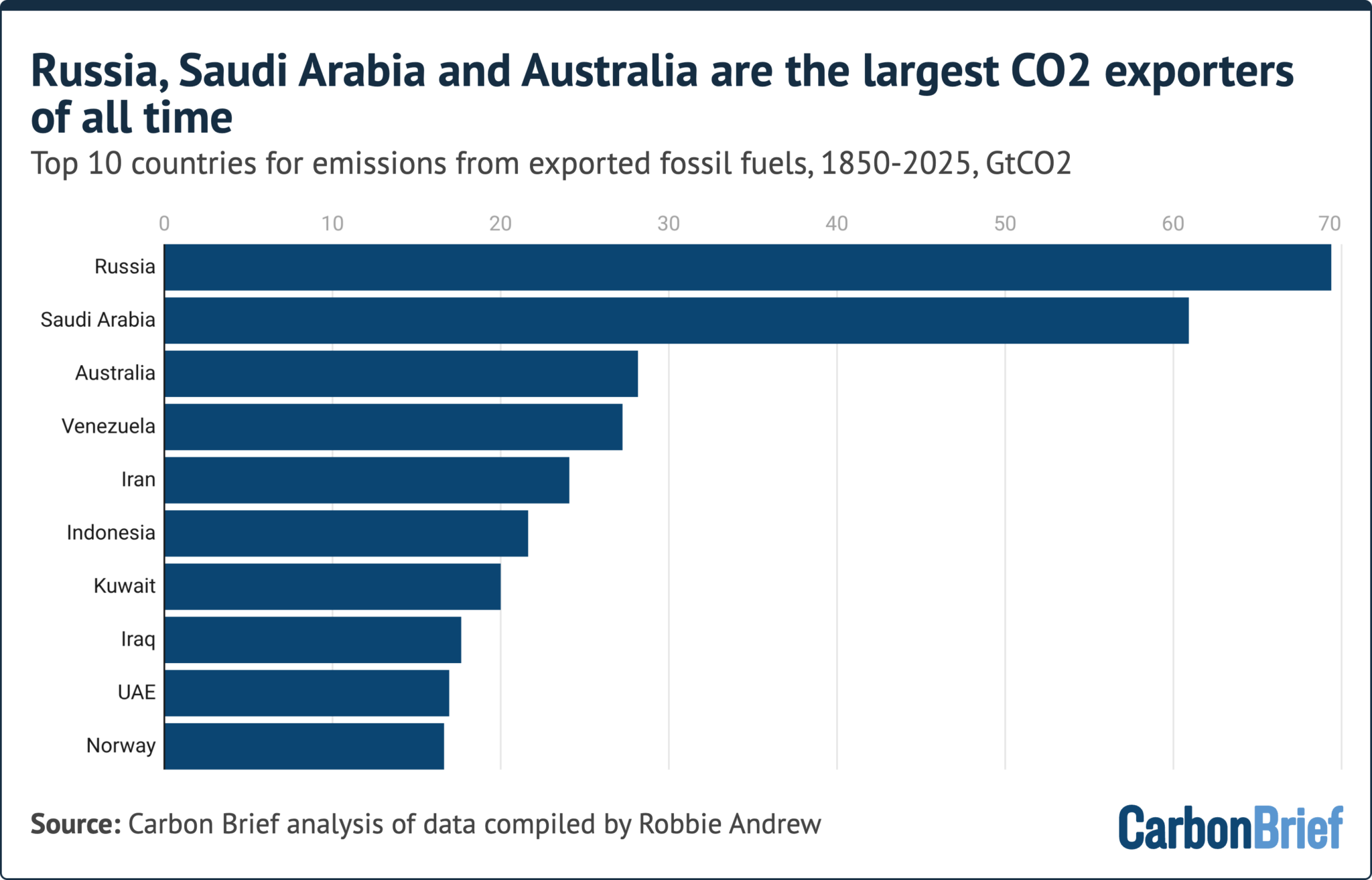
Top 10 countries for emissions from exported fossil fuels, 1850-2025, in billions of tonnes of CO2. Source: Carbon Brief analysis of data compiled by Robbie Andrew
Venezuela, Iran, Indonesia, Kuwait, Iraq, the UAE and Norway make up the rest of the top 10 all-time exporters. Between them, these coal, oil and gas producers have shipped hundreds of billions of tonnes of CO2 abroad over 175 years, Carbon Brief calculated.
Emissions under the Soviet Union, Czechoslovakia and Yugoslavia are shared out among today's successor states in proportion to their shares of emissions when those states broke up, so Russia's total carries most of the Soviet Union's oil and gas output.
The US and China still bear the largest responsibility for historical warming under extraction-based accounting, even though both have been net importers of CO2 since 1850. The US was a big oil importer until the shale revolution of the early 2000s, and China describes itself as "rich in coal, lacking oil and gas".
Russia stays in third place, its cumulative total swollen by the 69bn tonnes it exported. The UK moves up to fourth, overtaking Germany, which relies on imported fuel.
Saudi Arabia jumps to fifth, as its exports more than quadruple its cumulative emissions. Australia enters the top 10, its share of historical emissions more than doubling.
Japan, almost wholly dependent on imported fuel, falls furthest: it is the sixth-largest emitter on a territorial basis and only the 34th on an extraction basis. Germany, India, France and Turkey, the COP31 host, also slide down the table.
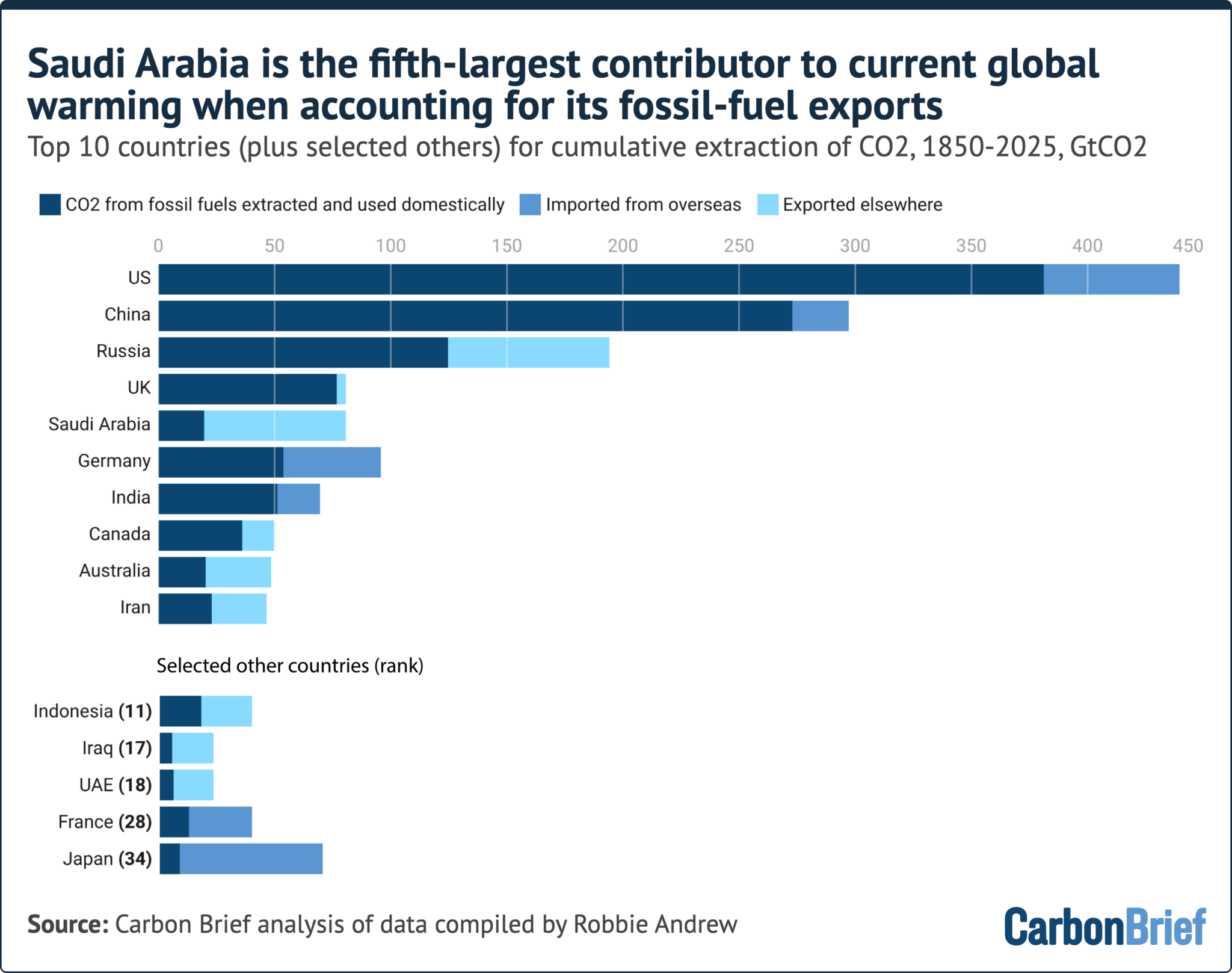
Top 10 countries (plus selected others) for cumulative extraction of CO2, 1850-2025, split between fuel used at home, fuel imported and fuel exported, in billions of tonnes. Source: Carbon Brief analysis of data compiled by Robbie Andrew
Russia's fossil-fuel output carried 3.63bn tonnes of CO2 in 2025, according to Andrew's dataset, about 9% of the world total of 40.3bn tonnes and third only to China and the US. Russia's extraction-based emissions peaked at 3.90bn tonnes in 2019.
Saudi Arabia was fifth in 2025 with 1.81bn tonnes, behind India. Kazakhstan's extraction rose 11% to 561mn tonnes, the highest in the series, while Australia's fell 6% to 1.36bn tonnes.
At COP31, the Arab Group and Russia rejected the summit's draft cover decision outright, objecting to language that singled out specific energy sources. OPEC Secretary General Haitham Al Ghais told the plenary in Antalya that electrification depends on oil.
The talks ended on November 22 with at least 32 countries, led by the EU, rejecting the final cover decision because it did not mention fossil fuels. Russia's petrochemicals major Sibur used the summit to pitch Russian carbon credits to foreign buyers, and Venezuela, fourth on the exporters' list, has lifted crude output to 1.2mn barrels per day (bpd) from about 900,000 bpd in 2025.
Norway, the 10th-biggest exporter of all time, has started to count the emissions it ships abroad. Its Supreme Court on November 13 voided government approvals for three North Sea developments because their impact assessments ignored the CO2 released when their oil and gas is burned.
Measured per head of today's population, small oil and gas exporters lead: Brunei, Kuwait, Qatar, Norway and Trinidad and Tobago. Saudi Arabia, the UAE, Libya and Australia follow, and the Czech Republic, heir to Czechoslovakia's coal mines, is 10th, the only country in the top 10 that is not a major oil or gas producer. Czech extraction has fallen to 34mn tonnes of CO2 a year in 2025 from 144mn tonnes in 1990, Andrew's data show.
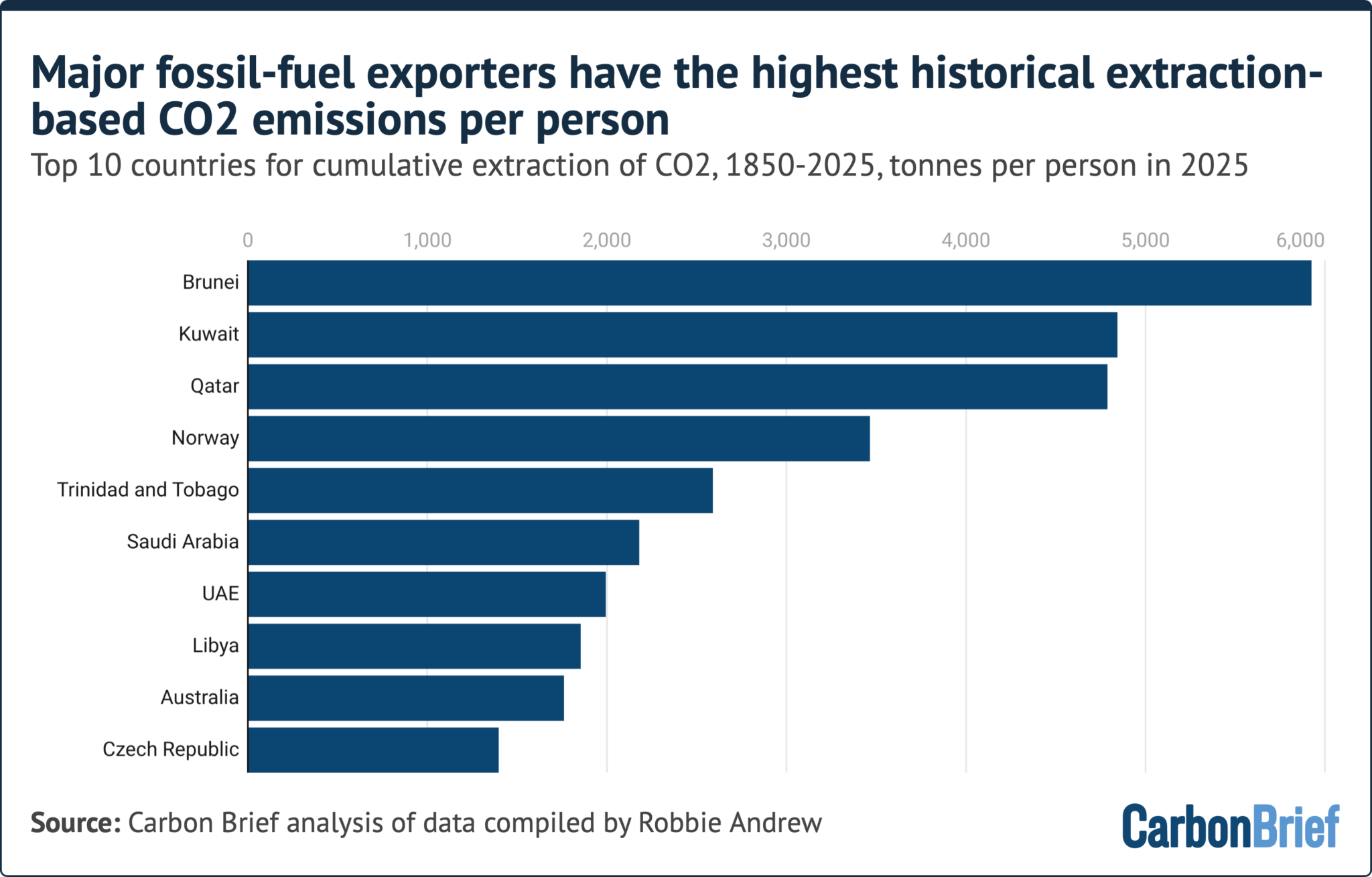
Top 10 countries for cumulative extraction of CO2, 1850-2025, in tonnes per person in 2025. Source: Carbon Brief analysis of data compiled by Robbie Andrew
Andrew told Carbon Brief that extraction-based accounting offers another way of looking at responsibility for warming, but raises complex questions of its own.
"At the end of the day, it's not solely the responsibility of extracting countries that fuels are combusted; it's joint responsibility between extractors, producers and consumers," he said, adding that oil production in the Middle East was historically "developed by and for western powers".
Follow us online