

Russian construction of Uzbekistan's first nuclear plant launched as leaders meet at St Petersburg International Economic Forum

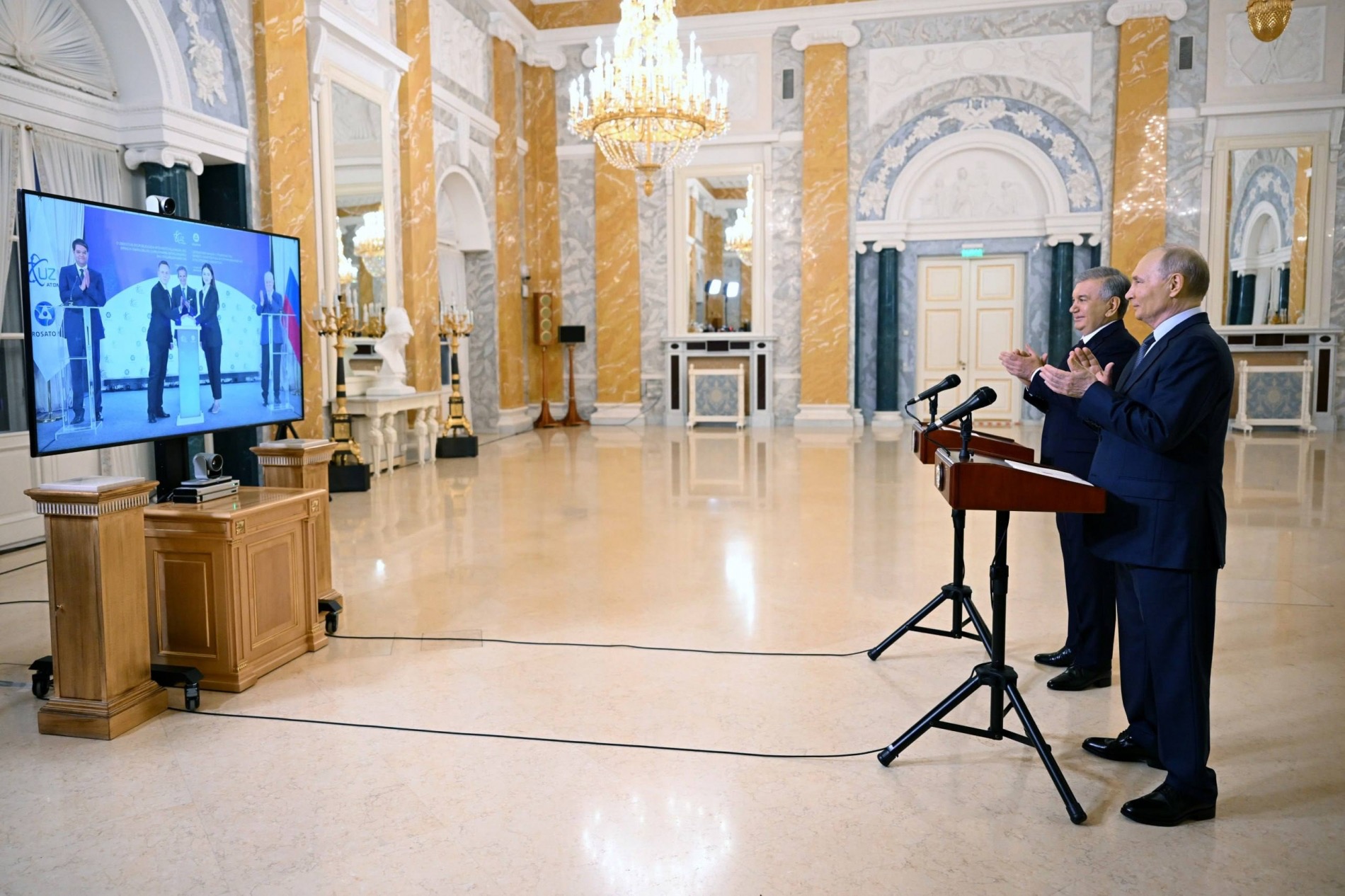
Uzbekistan’s president Shavkat Mirziyoyev joined Russian leader Vladimir Putin in St Petersburg on June 4 to watch via video link the launch of construction of the first power unit of what will be the Central Asian country’s first nuclear power plant (NPP).
Rafael Mariano Grossi, director-general of the International Atomic Energy Agency (IAEA), also watched the ceremony.
The project, led by Russian state nuclear corporation Rosatom, is a first in that it combines small modular reactor (SMR) technology with the large-scale baseload generation typical of standard NPPs
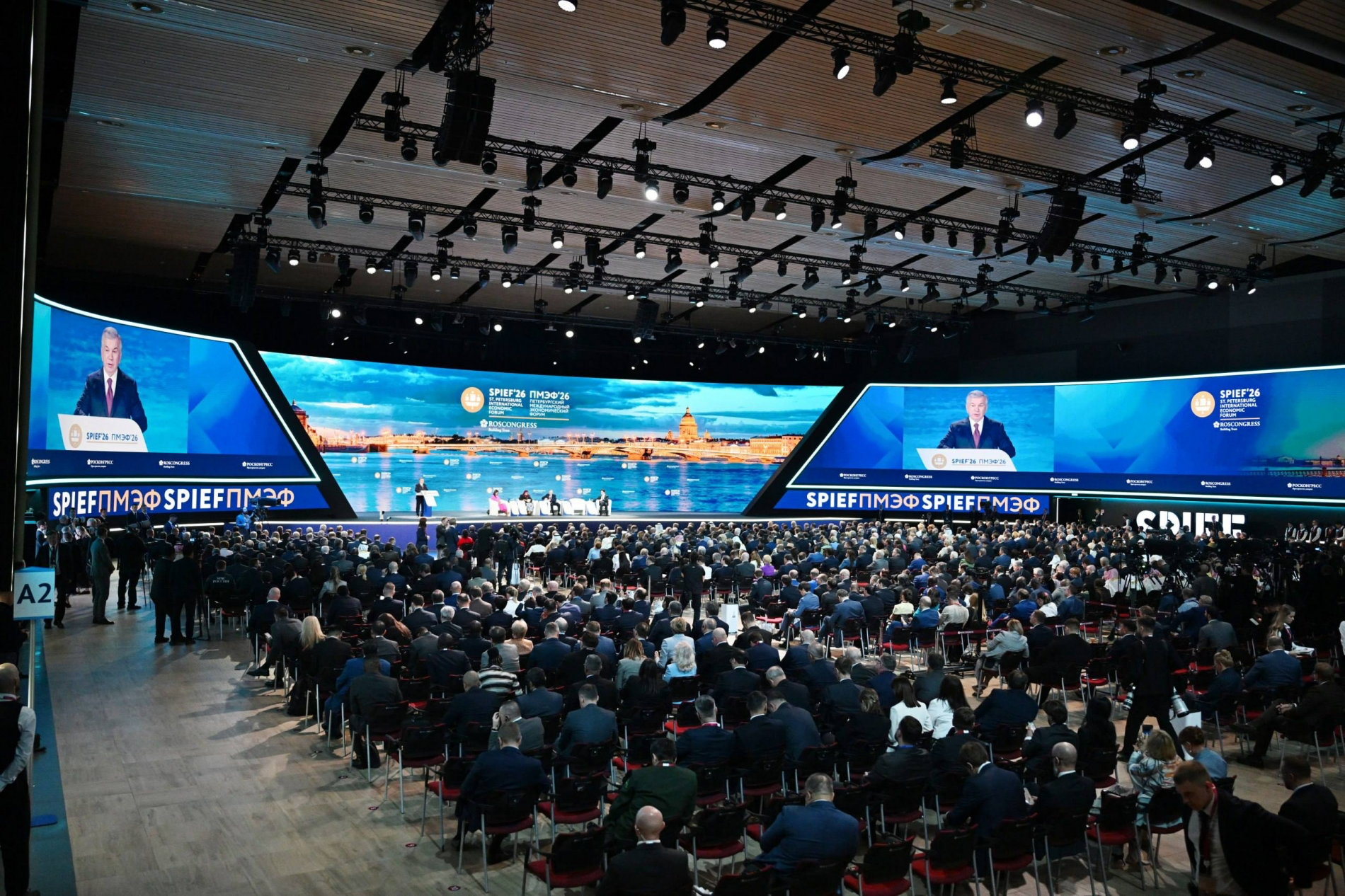
The launch formed part of the agenda of the St Petersburg International Economic Forum (SPIEF).
Mirziyoyev told delegates at SPIEF that the hybrid NPP would emerge from “a long-term development project that will allow for the establishment of a new school of engineering and the adoption of advanced technologies."
With regard to safety, the Uzbek leader said that the project would be implemented under IAEA supervision and according to international standards.
Aside from the nuclear launch, Mirziyoyev and Putin held talks aimed at strengthening what both sides described as a comprehensive strategic partnership.
According to Uzbek officials, Uzbekistan-Russia trade turnover has grown by 20% since the beginning of 2026, while cooperation continues across energy, metallurgy, transport, chemicals and manufacturing. Uzbekistan’s trade and investment rates with China are, however, growing at faster rates.
Uzbekistan runs a multi-vector foreign policy under which it attempts to maintain amicable and productive ties with all the major powers.
In his address to SPIEF, Mirziyoyev observed that trade between the two countries had more than tripled over the past decade, rising from $4bn to $13bn, while the value of joint projects was in excess of $50bn.
"For Uzbekistan, Russia is more than just a regional neighbour. It is our time-tested strategic partner and ally," Mirziyoyev said. "Today, our relations have entered a new era. Our cooperation has become multi-level and multifaceted."
Uzbekistan and Russia’s cooperation also extends into deep regional industrial integration, involving Russian regions including Moscow, Saint Petersburg, Tatarstan, Bashkortostan, Krasnoyarsk and Perm.
Interregional projects are valued at around $5bn, with an additional $5bn investment pipeline under preparation. Cooperation spans the energy, petrochemicals, mechanical engineering, logistics, agriculture, textiles and food industries, including industrial parks in multiple Uzbek regions and a railcar manufacturing cluster in Tashkent.
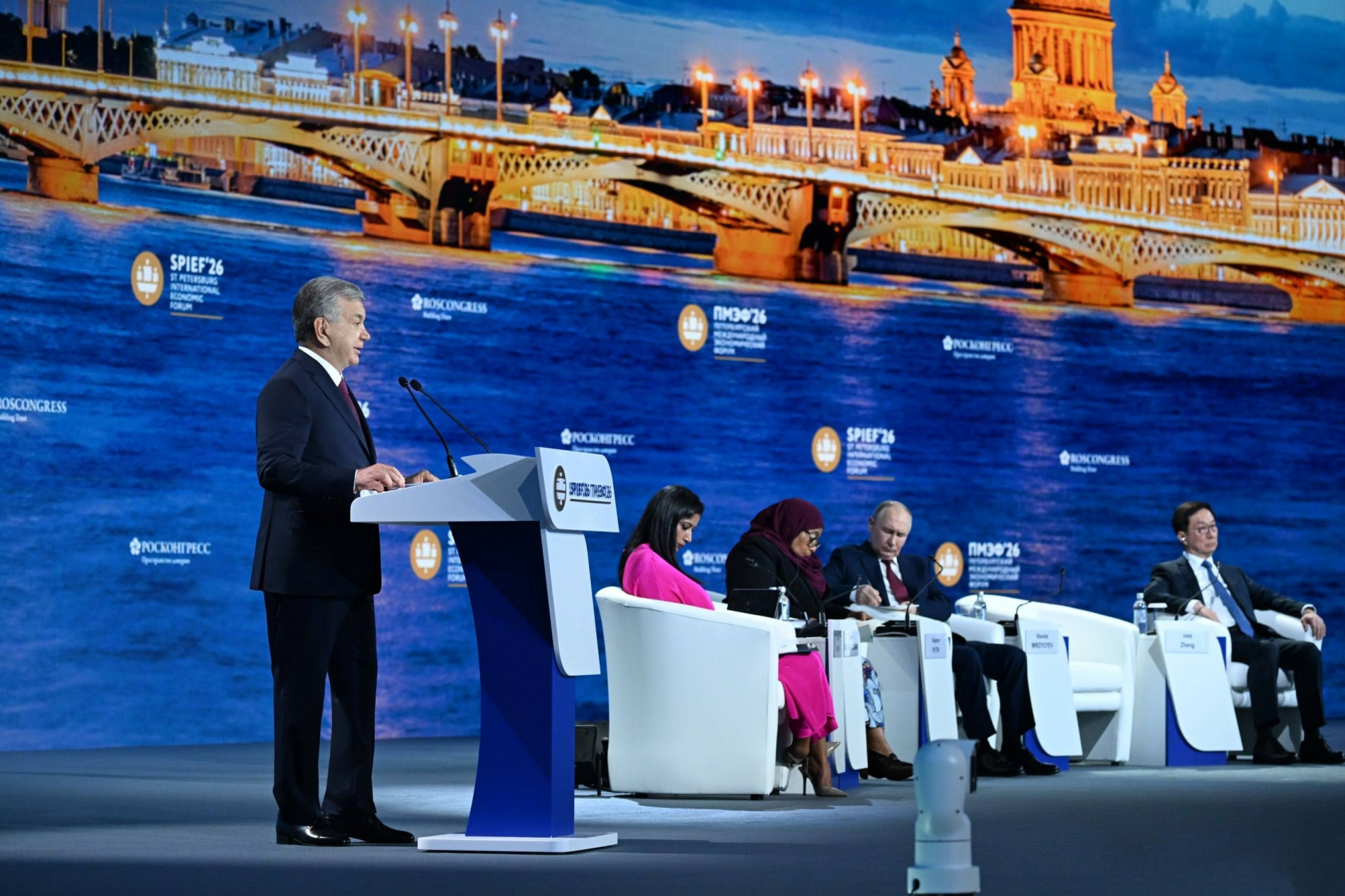
Addressing business leaders and policymakers at SPIEF, Mirziyoyev argued that Central Asia was emerging as a new centre of economic growth amid shifts in global trade patterns and supply chains.
The president noted that the world is undergoing a profound transformation, with shifting transport routes, the emergence of new supply chains and technological platforms and the widespread adoption of artificial intelligence (AI) across industries.
"Competition is increasingly evident not only in the struggle for markets and natural resources, it is also shifting into the realm of technology, algorithms, logistics and infrastructure," the head of the state added.
Uzbekistan’s electricity generation has increased from 58bn kilowatt-hours to 87bn kilowatt-hours in recent years, with plans to reach 120bn kilowatt-hours by 2030. The president noted that 54% of future generation will come from renewable energy sources, alongside nuclear development as part of a broader energy diversification strategy.
Mirziyoyev also pointed out how Uzbekistan's location placed it at the centre of new economic corridors linking Asia, Europe and the Middle East.
"For millennia, Uzbekistan has been at the heart of the Great Silk Road. It was not merely goods that passed through Samarkand, Bukhara and Tashkent; ideas and knowledge, cultural and religious traditions also intermingled," he voiced. "Therefore, for us, openness has never been a choice, but a vital necessity and a civilisational code."
He also highlighted Uzbekistan’s human capital development agenda, noting the presence of 32 foreign university branches in the country, including 15 Russian institutions, forming the largest network of Russian universities abroad. Mirziyoyev pointed to joint engineering schools in Almalyk and Tashkent and proposed a new online platform linking education, vocational training and employment to better connect young people with labour market needs.
Seeking to expand industrial cooperation beyond bilateral projects, the president proposed the creation of a "Eurasian Technological Industrialisation Belt", which he described as a network of interconnected industrial and technological clusters linked through a common digital platform.
"We are talking about creating full-cycle chains, from technology development and personnel training to the localisation of industrial production and entry into foreign markets," the president stated.
Digital integration featured prominently in Mirziyoyev's vision for future cooperation. He proposed the establishment of a joint digital ecosystem covering e-commerce regulation, employment services, artificial intelligence and digital trade.
"Digitalisation is undoubtedly a promising area of cooperation, as it is becoming the new language of the economy," he said. "While infrastructure used to mean roads, pipelines and power lines, today it primarily entails digital platforms."
Mirziyoyev at the forum also outlined a proposal to launch the “From Samarkand to St Petersburg” creative and tourism corridor, which would include joint film and art festivals, museum exhibitions, culinary weeks and music events.
Much of the president's address focused on Uzbekistan's domestic reform programme, launched nearly a decade ago under his administration.
"A decade ago, we embarked on the construction of a New Uzbekistan based on openness, inclusivity and pragmatism," he said.
According to Mirziyoyev, the country's economy has expanded from $50bn to $147bn during the reform period, attracting more than $150bn in foreign investment and nearly tripling exports.
Over the reform period, Uzbekistan’s population income has increased 2.5 times and the government is implementing the “Uzbekistan-2030” strategy, which aims to grow the economy to over $240bn while ensuring sustainable and inclusive development.
Mirziyoyev also highlighted Uzbekistan's youthful population as one of its greatest competitive advantages.
"Today, Uzbekistan is one of the youngest countries in the world, with more than half of its population being young people," he said. "This is not just a statistics. It is a source for development. It sparks new demand. It is our future."
"Uzbekistan is a reliable and predictable country for the global business community," he added.
The president concluded by inviting international investors to attend the Tashkent International Investment Forum later this month, arguing that cooperation and dialogue remain essential in an increasingly fragmented world.
"The theme of this year's forum, 'Pragmatic Dialogue – The Path to a Stable Future,' is symbolic. Open and respectful dialogue has become the main prerequisite for sustainable development today. New opportunities arise where there is trust, a willingness to cooperate and a commitment to finding solutions together," Mirziyoyev concluded.
Follow us online