
Russian shadow ship becomes first LNG carrier ever lost at sea, with Moscow blaming Ukrainian drone strike
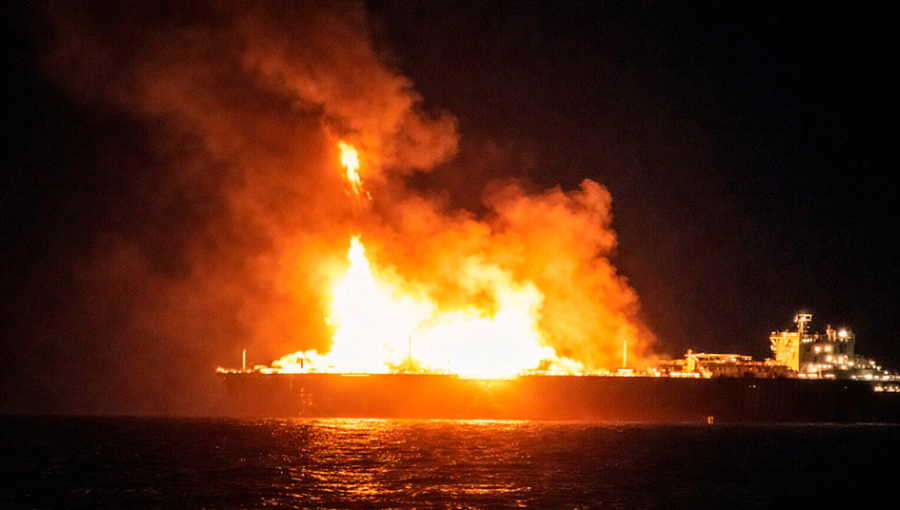
A Russian-flagged LNG carrier suffered explosions and sank in the Mediterranean Sea off the coast of Libya on March 4, becoming the first vessel of its type to be lost at sea following a major onboard fire. Moscow claims the ship was attacked by Ukrainian naval drones.
The Arctic Metagaz tanker, under both UK and US sanctions as part of a so-called shadow fleet of vessels servicing Russia’s Arctic LNG-2 project, was carrying a cargo loaded from the northern Russian port of Murmansk and was believed to be en route towards Port Said in Egypt when the incident occurred.
Libyan authorities said the vessel sank after “sudden explosions followed by a massive fire,” with the wreck occurring roughly 130 nautical miles north of the port of Sirte in the maritime area between Libya and Malta, within the Libyan search-and-rescue zone, according to the Libyan port authority. The tanker had issued several distress calls late on March 3, while Malta’s armed forces said they had received a distress message and were able to geolocate the ship.
All 30 crew members escaped via lifeboats and were later rescued through joint efforts by Maltese and Russian rescue services, Russia’s Ministry of Transport said, adding that all those on board were Russian nationals. Images circulating on social media appeared to show the vessel engulfed in flames at night, although their authenticity could not immediately be verified.
Russia’s transport ministry accused Ukrainian naval drones launched from the Libyan coast of carrying out the attack near Malta’s territorial waters, calling the incident “an act of international terrorism and maritime piracy” and “a gross violation of the fundamental norms of international maritime law.” Ukraine’s military and security services have not publicly commented on the allegation.
If confirmed, the strike would mark the first time Ukraine has attacked a Russian LNG carrier, expanding Kyiv’s campaign of strikes on Russia’s energy infrastructure and shipping. Ukrainian forces have previously targeted Russian oil tankers with naval drones near the Black Sea and, in December, reportedly struck an oil tanker in the Mediterranean.
The Arctic Metagaz — previously known as Everest Energy and currently sailing under the name Arctic Metagaz — has been one of the most closely tracked vessels involved in shipments from the sanctioned Arctic LNG-2 project, which is majority-owned by Novatek. The ship first loaded LNG from the project’s Utrenniy terminal in August 2024 and subsequently returned for additional cargoes in September and October during the project’s first export season, according to shipping data cited by gCaptain.
The vessel played a key role in Russia’s efforts to sustain LNG exports despite Western sanctions that have limited access to specialised ice-class carriers, insurance and buyers. In September 2024 it became the first conventional, non-ice-class LNG carrier to transit the Northern Sea Route, a high-risk Arctic passage typically reserved for specialised Arc7 vessels.
The risks of such operations became clear in August 2025 when the ship attempted another Northern Sea Route transit but became stuck near the ice edge, forcing it to halt and reverse course in heavy sea ice. The episode highlighted the logistical challenges facing Arctic LNG-2, which lacks sufficient purpose-built LNG carriers.
During the 2024 export season the vessel offloaded cargoes at floating storage units including the Saam FSU and the Koryak FSU before spending much of the winter and spring of 2024-25 circulating in the eastern Mediterranean while laden with LNG, reflecting the difficulties Russia has faced in placing sanctioned cargoes with stable buyers.
The tanker later delivered cargo to China’s Beihai terminal on several occasions, including an Arctic LNG-2 shipment discharged there in October 2025 and another cargo unloaded on January 3, 2026 after transiting the Suez Canal. The vessel had most recently loaded LNG during a rare triple ship-to-ship transfer near Murmansk on February 18, according to shipping data cited by gCaptain.
That operation marked the first known simultaneous LNG transfers from both the Yamal LNG and Arctic LNG-2 projects onto separate conventional carriers, illustrating the increasingly complex maritime logistics Russia has adopted to sustain LNG exports despite sanctions.
The loss of the tanker could deal a further blow to the project’s export capacity. Novatek currently has only around 11 vessels in its shadow LNG fleet, according to shipping data cited by gCaptain, already insufficient to transport the project’s full nameplate capacity. Arctic LNG-2 is currently exporting less than 1mn tonnes per year, constrained largely by shipping limitations.
The incident could also prompt Russia to reconsider shipping routes through the Mediterranean, the Suez Canal and the Red Sea, which several Arctic LNG-2 vessels have continued to use despite heightened regional security risks. One such vessel, Arctic Pioneer, was recently reported holding outside Port Said after a northbound Suez transit, potentially signalling a reassessment of routing decisions.
Beyond the geopolitical implications, the sinking marks a precedent for the LNG shipping industry, which has long been regarded as one of the safest segments of global maritime transport.
Modern LNG carriers are designed with multiple layers of safety systems, including double hulls, insulated cargo containment systems and sophisticated fire-suppression technology, making catastrophic failures extremely rare. While there have been isolated incidents involving minor fires or technical faults on LNG vessels over the decades, there has never previously been a confirmed case of an LNG carrier sinking as a result of a major onboard fire or explosion.
Follow us online