

Solar-plus-storage fall below those of fossil fuels - IRENA

Renewable power paired with battery storage is becoming cost-competitive with fossil fuels for around-the-clock electricity supply, according to a new report from the International Renewable Energy Agency (IRENA), as falling technology costs reshape global energy markets.
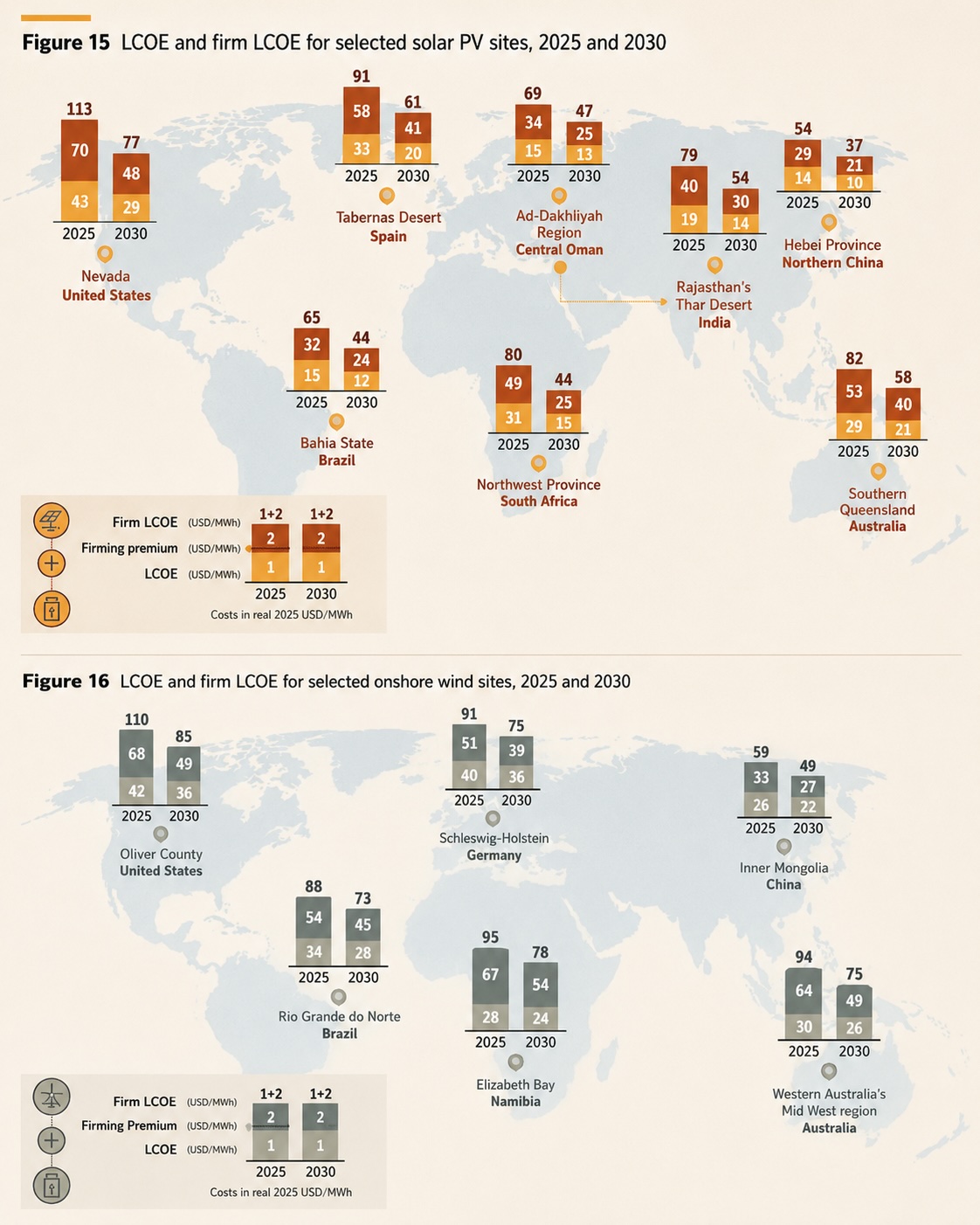
Firm levelised costs of electricity for solar-plus-storage range from $54/MWh to $82/MWh in high-irradiance regions, IRENA said in its report, 24/7 Renewables: The Economics of Firm Solar and Wind. That compares with $70/MWh to $85/MWh for new coal-fired power generation in China and more than $100/MWh for new gas-fired power globally.
The agency said rapid declines in renewable energy and battery costs have accelerated the competitiveness of dispatchable clean power. Since 2010, total installed costs have fallen 87% for solar photovoltaic projects and 55% for onshore wind, while battery storage costs have dropped 93%.
IRENA’s analysis showed firm solar-plus-storage costs declined from above $100/MWh in 2020 to between $54/MWh and $82/MWh by 2025 at high-quality resource sites. It projected further reductions of about 30% by 2030 and around 40% by 2035, potentially bringing firm renewable electricity costs below $50/MWh at the most productive locations.
“24/7 renewable power is now cost-competitive with fossil fuels,” said Francesco La Camera, director-general of IRENA. “The long-standing argument that renewables lack reliability no longer holds. Today, renewables can deliver reliable, round-the-clock power.”
Firm wind-plus-storage costs in 2025 ranged from about $59/MWh in China’s Inner Mongolia region to between $88/MWh and $94/MWh across Brazil, Germany and Australia, according to the report. IRENA added that combining wind with solar PV reduced storage requirements and lowered overall system costs.
The findings come as governments and utilities accelerate investment in grid-scale batteries and hybrid renewable energy projects to improve energy security and reduce exposure to volatile fossil fuel markets. Analysts expect global battery deployment to continue rising sharply this decade, driven by lower lithium-ion costs and expanding manufacturing capacity in China, Europe and the US.
“The economics of the entire energy system have shifted: the battery revolution has driven down costs while accelerating advances in storage,” La Camera said. “The advantage of renewables is not only economic but strategic, strengthening resilience, stability, and energy security in times of crisis.”
IRENA cited the United Arab Emirates’ Al Dhafra complex, which combines solar PV and battery storage, as an example of commercially viable firm renewable generation. The project delivers 1 GW of clean electricity at about $70/MWh, the agency said.
La Camera also pointed to geopolitical risks affecting oil and gas markets. “As oil and gas markets remain exposed to geopolitical shocks, including ongoing disruptions in the Strait of Hormuz, we must insulate our economies with resilient renewable systems,” he said.
Follow us online