
TCHAKAROV: New shade of success? Think Uzbek green!

Uzbekistan is Central Asia's rising heavyweight, and its economic story is generally being told through the now-familiar lenses of macroeconomic reform, improving policymaking and an increasingly attractive investment climate. Yet one of the country's most important structural shifts has received far less attention: a remarkable transformation of its power sector. The common perception is that Uzbekistan remains a quintessential gas economy. That is true — but increasingly incomplete.
The country's green transition is not being driven primarily by climate ambitions. It is being driven by geology. Declining gas production has become one of the strongest incentives for diversifying electricity generation, making renewables an economic necessity rather than an environmental luxury. That distinction is important because it makes the transition considerably more durable. Governments may change climate priorities; they are far less likely to ignore energy security.
Natural gas still dominates Uzbekistan's economy. Fossil fuels account for more than 95% of primary energy supply, while gas alone provides almost four-fifths of the country's energy balance and roughly 72% of electricity generation. At first glance, it may be odd to call this a green success story. Look beneath the surface, however, and a very different picture emerges.
The problem starts upstream. The country’s gas production has been decreasing for more than a decade now, from its record high of 68.3bn cubic metres (bcm) in 2008 down to 42.3 bcm in 2025. Gas consumption, on the other hand, has been surprising in its resilience, staying around 50 bcm annually despite fast economic and population growth.
That apparent paradox has a simple explanation. Uzbekistan has become steadily more energy-efficient. The economy has shifted toward services, gas-fired power stations have been modernised, tariffs have become more rational and supply constraints have encouraged conservation. These factors have allowed GDP to expand several-fold without triggering a proportional increase in gas demand. For years this balancing act worked. Since 2023 it has become increasingly difficult to sustain due to Uzbekistan’s transition into a net natural gas importer.
Importantly, Uzbekistan is not running out of gas. Proven reserves still exceed 1.8 trillion cubic metres, placing the country among the world's largest reserve holders. The challenge is instead one of mature fields, declining productivity and years of underinvestment. Even the government itself admits that a significant proportion of assets at Uzbekneftegaz has been considerably exhausted. Previous investment programmes proved to be quite unbalanced, so new money and technology are necessary.
This is precisely why hydrocarbons are still part of Uzbekistan's future despite the development of renewable energy. SOCAR’s $2bn production-sharing agreement on the Ustyurt Plateau, which attracted BP, demonstrates that international companies still find Uzbekistan attractive for upstream investments. Energy diversification does not mean giving up on gas; it means making sure that gas is no longer the sole driver of electricity generation.
This is when the renewable story starts to look really compelling. Electricity generated from renewable sources grew from a mere 7% in 2021 to close to 20% in 2025. More importantly, the whole rise in electricity generation was caused by solar and wind. Renewable electricity in Uzbekistan has been synonymous with hydropower until now. Now that is changing. For the first time ever, in 2025 solar and wind surpassed hydro (Graph 1).
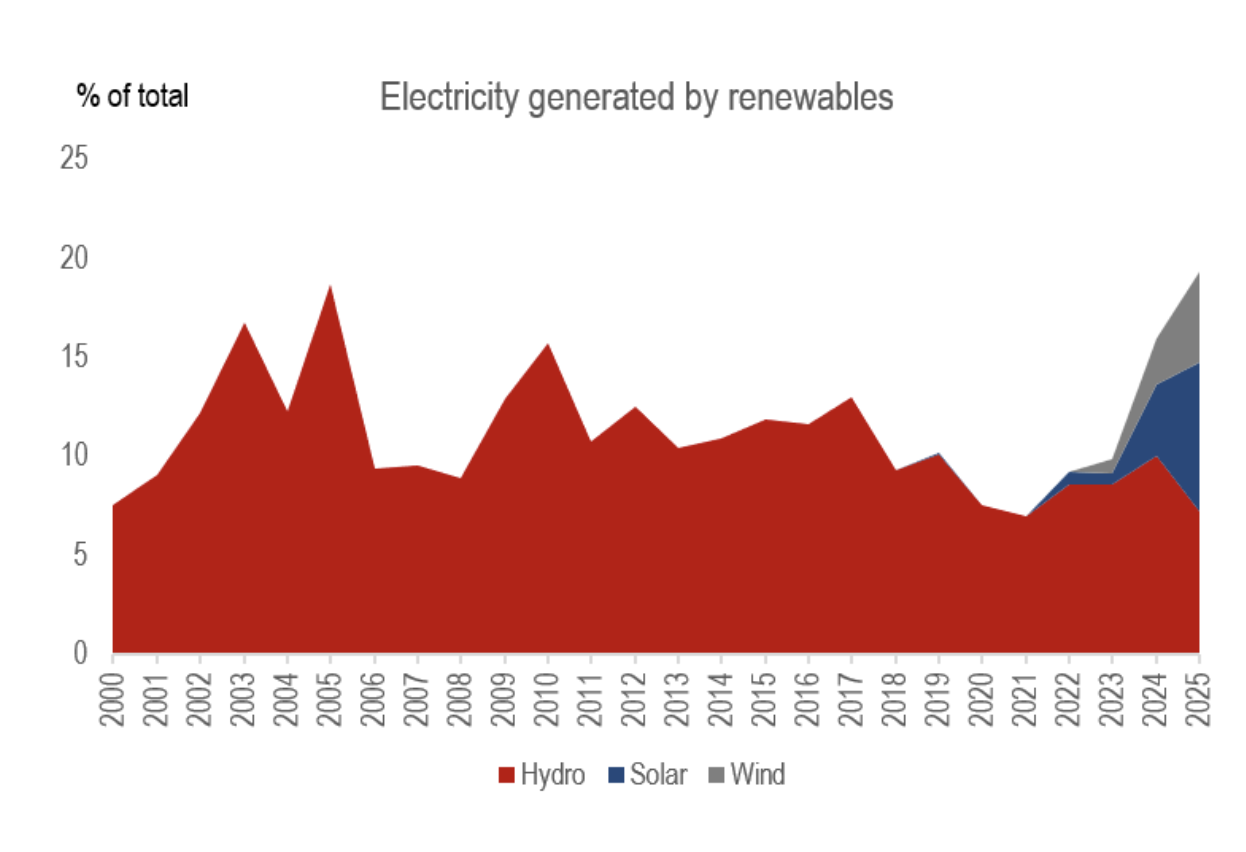
Graph 1: Solar and wind generated more electricity than hydro for the first time in 2025
Regional comparisons often understate this achievement. For instance, countries such as Kyrgyzstan, Tajikistan and Georgia will have higher shares of renewables due to having vast reserves of hydropower energy. The best way to make a comparison would be through the measure of modern renewables, which include solar and wind. Here Uzbekistan has clearly outshone other countries. In 2025, solar and wind energy provided 12% of electricity, allowing the country to overtake Kazakhstan and Armenia within just four years (Graph 2).
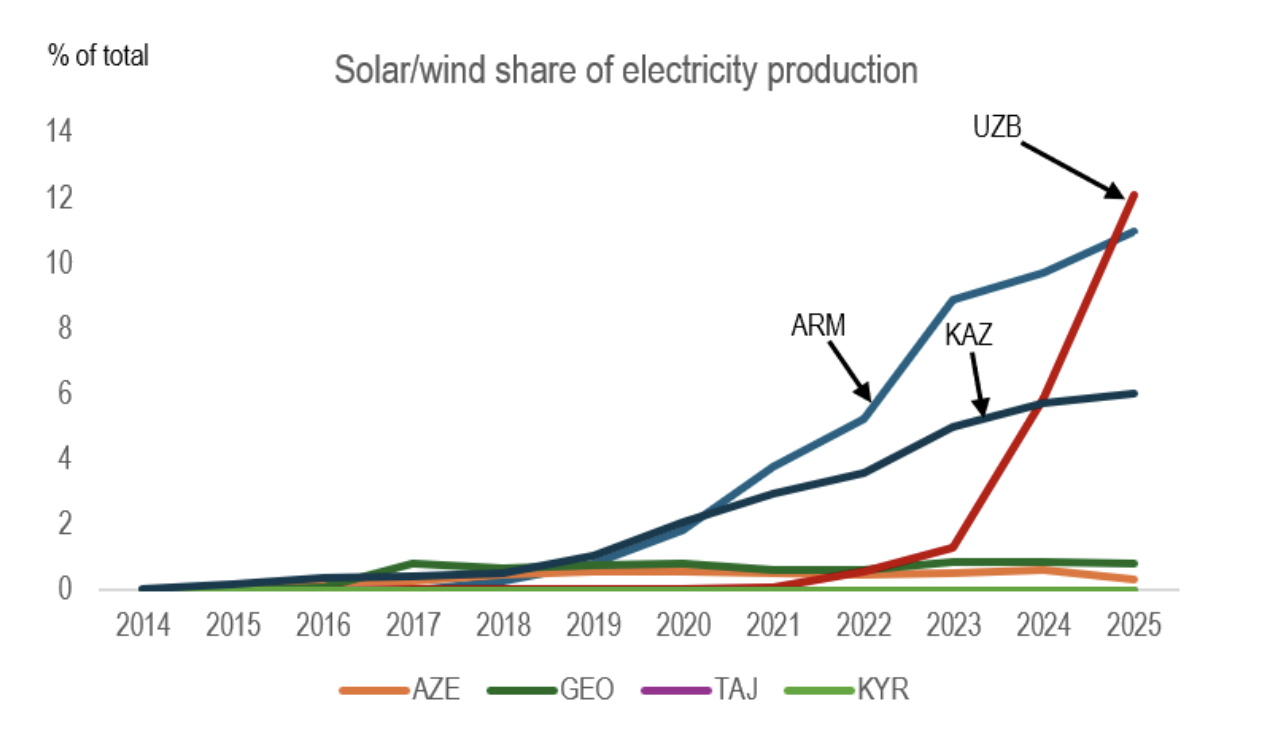
Graph 2: Uzbekistan leads the Caucasus and Central Asia in electricity generated by solar and wind
The speed of the investment cycle has been equally remarkable. Total installed generation capacity has climbed to almost 26 GW, while renewables account for roughly 30% of installed capacity. Solar and wind installations alone exceed 7.5 GW, with almost 90% commissioned during 2024-25. Few emerging markets have expanded renewable capacity at such a pace.
This transformation has not occurred by accident. It reflects a deliberate policy of attracting global developers through transparent public-private partnerships. Companies such as ACWA Power, Masdar, EDF and China Energy Engineering have emerged as key players in the expansion of Uzbekistan's power sector. Cumulative investment has reached about $35 billion — equivalent to almost one-quarter of GDP — creating one of the region's largest green investment pipelines.
One technical nuance deserves emphasis. Government statements that clean energy accounts for around 30% of the energy mix refer to installed generating capacity rather than actual electricity production. Because solar and wind operate at lower capacity factors than thermal plants, their contribution to electricity generation remains smaller. Even so, the distinction does little to diminish the broader trend. Installed capacity determines the direction of future generation, and on that measure Uzbekistan is moving rapidly.
The government's objective of lifting clean energy to more than half of installed capacity by 2030 no longer looks aspirational. Given the scale of projects already under construction, it increasingly appears realistic.
For investors, the broader message extends beyond renewables. Uzbekistan's energy transition demonstrates an increasingly pragmatic policy framework: authorities have recognised an emerging structural constraint, mobilised foreign capital, diversified technologies and created an investment model capable of delivering projects at scale. The transition is therefore as much an institutional success as an energy one.
Uzbekistan will remain a gas economy for many years. Gas will continue to underpin industrial production and provide essential balancing capacity for the electricity system. But the country's long-term growth story is no longer being written exclusively in gas fields. Increasingly, it is being written in solar parks, wind farms and transmission networks. Green energy has evolved from a supporting theme into one of the defining chapters of Uzbekistan's economic transformation.
Ivan Tchakarov is partner for the Caucasus and Central Asia at GlobalSource Partners.
Follow us online