

The big freeze

A big freeze is sweeping the globe that has seen extreme snowfall from the US to Japan, burying entire cities under metres of snow in a matter of a few hours. And it’s not going to stop. This is happening because extreme Arctic warming has weakened the polar vortex allowing polar air that is normally trapped at the top of the world to spill out over northern countries around the world, and this will happen every year from now on.
New York and 17 other states are on emergency alert. Hokkaido in Japan is under a metre of snow. Entire apartment blocks have snow up to their fifth floor in Kamchatka in Russia’s Far East. And the residents of Kyiv are lighting candles in freezing apartments as the indoor temperatures fall to below -5°C following a Russian missile barrage in recent weeks that knocked out the heat and power in more than 1mn households.
This weekend Canada officially became the coldest place on the planet, after a large body of icy cold air invaded it from the north. With temperatures falling below -55°C, Canada has the dubious honour of beating out the Russian town of Oymyakon in Yakutia, which regularly records the lowest temperatures each year. Oymyakon recorded a temperature of −67.7°C (−89.9°F) in 1933, which remains the record low for any permanently inhabited location. Similar blocks of cold air have also settled over northern America and in Central and Eastern Europe.
Kamchatka in Russia’s far east is never warm in winter, but it was one of the first to be affected by what has gone well beyond a mere “cold snap”. In the last two weeks it has suffered from some of the heaviest snowfalls on record. The city is “completely cut off,” local authorities complained and called on Moscow to send relief as record snowfall paralyses the whole region. Transport in the local capital of Petropavlovsk-Kamchatsky has been brought to a halt. Ambulances and fire trucks can’t move let alone make basic food shipment deliveries. Snowdrifts are as high as 1.7-2.5 metres reducing everything to foot traffic and conditions were, and are, much worse in many smaller settlements where residents are basically housebound. Regional Governor Vladimir Solodov acknowledged that Kamchatka lacked sufficient snow-removal equipment and described the situation on the roads as “critical.”
Similar stories are playing out around the world, according to the Ventusky Snow Cover Map. A vast part of the US has been hit by one of the most powerful winter storms in the past 100 years. Blizzards, heavy snow and freezing rain have forced the cancellation of more than 13,000 flights nationwide. The severe weather is expected to last for several days. By the evening of January 24, more than 139,000 US residents were left without electricity and the number continues to rise. The hardest-hit states are Texas and Louisiana.
“In a belt stretching from Evansville through Pittsburgh to Boston, 30 to 60 cm of snow will fall in the next 30 hours alone. Millions of people will experience significant snowfall, and transportation will remain paralysed,” Ventusky said in an online update.
Video posted on social media shows US supermarkets being emptied by locals of essentials as the population from New York to Texas stock up on flour, water, milk and Coca-Cola. Municipalities around the world have been overwhelmed by the sheer volume of snow – even in countries used to cold winters like Canada and Russia.
Ukraine humanitarian crisis
The story in Ukraine is even worse. Russia has launched a relentless drone and missile barrage that has knocked out power to over a million households and cut the heating as well in hundreds of thousands of homes as Russian President Vladimir Putin attempts to freeze Ukraine into submission.
Ukraine is nearing a "humanitarian catastrophe" after months of Russian airstrikes on energy systems and any future peace deal must include a halt to attacks on energy infrastructure, the head of Ukraine’s largest private power producer, Maxim Timchenko, CEO of DTEK, said at Davos, Reuters reports. The capital Kyiv and surrounding regions are among the most affected but Russia has been striking crucial ultra-high voltage 750kV substations across the country that supply entire cities and act as interregional connectors.
"We need an energy ceasefire. A ceasefire on the energy assets,” Timchenko said. “How can you talk about peace and (keep) attacking people, and knowing that people are freezing? How can these things go in parallel?”
A tit-for-tat ceasefire exchange is one of the items on the peace talks that just kicked off at the Abu Dhabi meeting on January 24 – the first time the US, Russia and Ukraine have all sat round the same table since US President Donald Trump took office just over a year ago. Ukraine has endured two weeks of temperatures between -15°C and -20°C Timchenko said, with Russia also striking gas transportation, storage and production facilities.
"We are close to a humanitarian catastrophe," Timchenko said. "People get power for 3-4 hours, then a 10 to 15-hour break. We have apartment blocks without heat for weeks already."
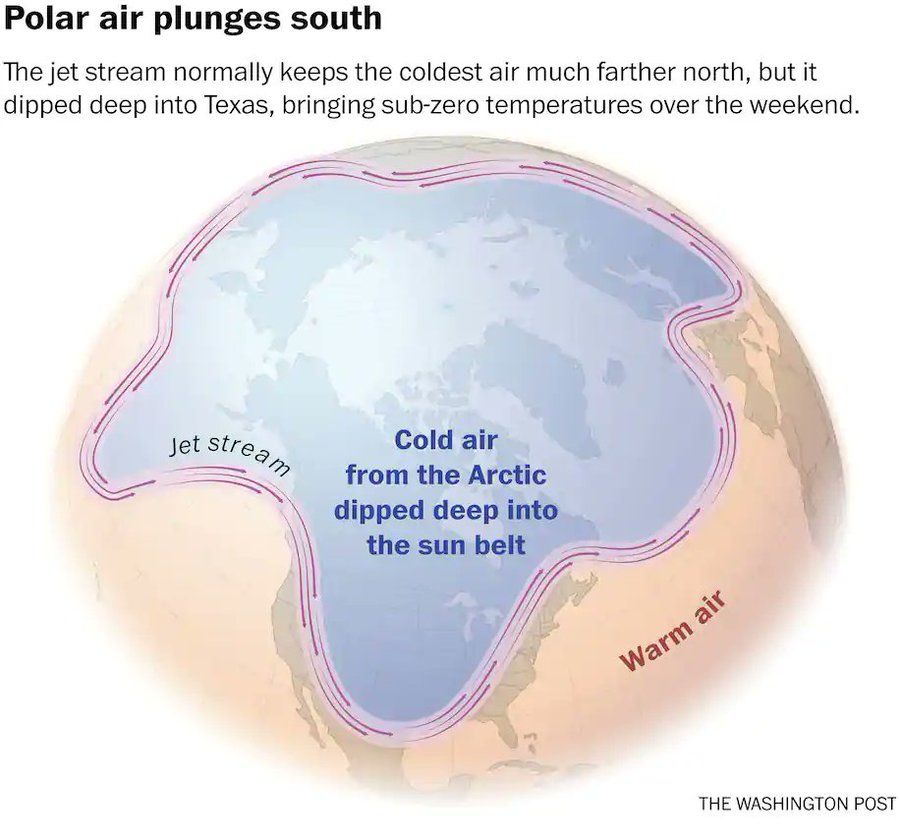
Two factors are working against each other: global warming and increasing outbreaks of icy polar air from the polar regions, sweeping down into what normally are temperate regions in winter. Normally the frozen northern air is trapped over the poles by the so-called polar vortex.
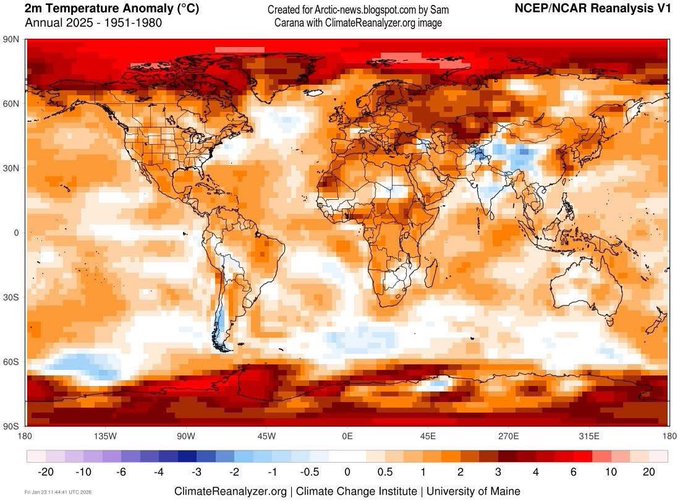
Ironically, the Arctic has been warming extremely fast in recent years, with temperature increases running as much as seven-times faster than the rest of the world. A map of temperature anomalies in 2025 shows the most extreme aberrations last year were all in the Arctic and Antarctic.
The US was already hit with a deep freeze last year as a blast of Arctic air chilled the eastern US and the polar vortex started to move southward. Sub-zero temperatures were to grip the region with parts of the Gulf Coast and Florida at risk of freezing conditions.
The polar vortex is a large area of low pressure and cold air that circulates around the Earth’s poles, strongest in the stratosphere during winter. Normally the vortex acts like a cold air containment system, keeping Arctic air trapped near the Pole, but thanks to the Climate Crisis it has slipped south as the vortex has been weakened. These winter storms are set to become a regular feature and part of the annual disaster season.
And this year’s spillover of Arctic air into Canada, Russia and the US has been a lot more significant than previous episodes.
“Weak vortex states, often associated with sudden stratospheric warmings (SSW), have been shown to increase the risk of cold-spells especially over Eurasia, but its role for North American winters is less clear,” a recent study published in Nature found.
The permafrost is already melting at the top of the world and will all be gone after temperatures rise 3°C above the pre-industrial benchmark, further undermining the stability of the polar vortex in the years to come.
Billions of dollars of damage will be done to the settlements in Russia’s interior but worse, gigatons of primordial frozen CO₂ will also be released almost overnight with extreme and unpredictable consequences. The summer Arctic sea ice which slows warming is already retreating and is due to disappear altogether in the coming decades and scientists say the process is now irreversible as various positive feedback loops are kicking in.
The big freeze hitting the world this winter is a foretaste of what is in store for Europe when the AMOC (Atlantic Meridional Overturning Circulation) collapses.
This is a sea current that transports warm water from the equator to Europe and is responsible for keeping the winters mild. However, the pace of the current is slowing and a “blob” off the east coast of the US – a precursor to the collapse of the current – is growing larger each year.
While it remains uncertain when the AMOC will stop flowing, scientists say it will happen with 95% certainty by the end of this century. The end of the AMOC conveyer belt of south-north warm water will only destabilise the Gulf Stream that is the polar vortex barrier preventing cold Arctic air spilling over into the northern countries that surround the top of the world, bringing deadly and destructive winters with it every year. Without that warm water off the west coast of the UK, the whole of Europe will be plunged into a mini-ice age.
Video round up from the rest of the world:
New York, US
The US National Weather Service issued winter storm warnings for areas in upstate and western New York, with snowfall expected to 15 to 30 centimetres in the most affected zones. Residents emptied shops as they stocked up for supplies as winter snow storms swept the country.
Eastern Scicily
Cyclone Harry and storm surges hit the eastern Scicilian coast, doing an estimated €750mn worth damage and leaving residents to pick up the pieces. Total losses — including private property and tourism — are expected to exceed €1bn.
Russia, Kamchatka
Kamchatka in Russia has already been hit by some of the heaviest snowfall in its history that has buried buildings up to several floors deep. Local residents have been digging out their cars, but younger people have turned to one of Russia’s most loved winter sports: leaping off the rooftops of their buildings into the deep snowdrifts below.
The snow lies metres deep across the region, burying the roads and building entrances. In this video a woman explains: “Here is our traffic light. And here is the button for the pedestrian cross, which had to be dug out to get to it.
Sapporo, Japan
In Japan’s northern main island of Hokkaido, Sapporo is experiencing some of the heaviest snowfall and frigid winter conditions on record. According to the metrological service, the city recorded more than 30cm of fresh snowfall in just the last 24 hours on January 25, contributing to already deep snow accumulation in the city. Snow depth in central Sapporo topped one metre by Sunday with more on the way.
Kyiv, Ukraine
Ukraine is suffering from one of its coldest winters in a decade as Russia knocks out heat and power in over 1mn households. However, the resilient Ukrainians remain defiant and gathered on the ice of a local lake near Kyiv and sang and danced to shake off the sub-zero freezing temperatures.
Follow us online