
The gas blamed for warming the planet is about to be used to store Ireland’s renewable electricity.
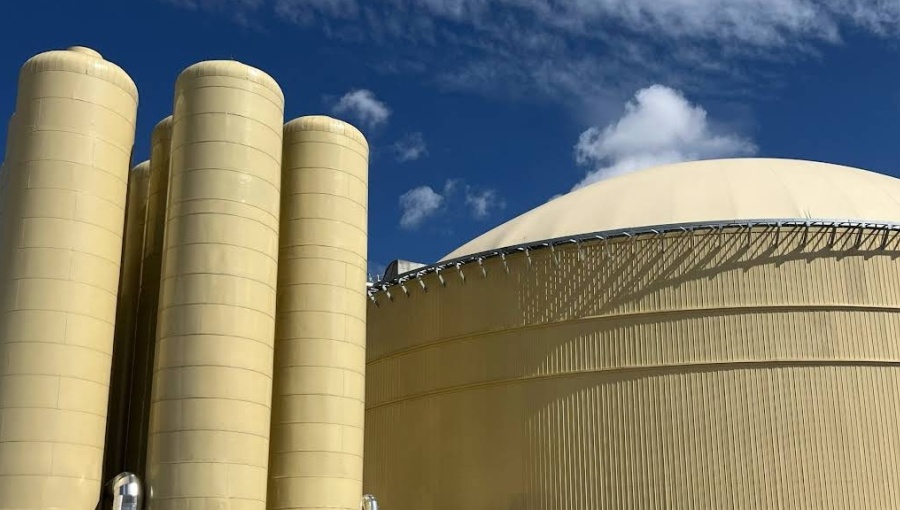
The gas blamed for warming the planet is about to be used to store Ireland’s renewable electricity.
Energy Dome, a Milan-based energy-storage developer, plans to build a battery in County Offaly that uses carbon dioxide rather than lithium to store surplus wind and solar power. The system can discharge electricity for about eight hours — long enough to cover an entire night rather than the short evening bursts handled by most conventional grid batteries.
The project brings together four elements that make it more than another experimental green technology. It uses the very gas governments are trying to keep out of the atmosphere; avoids costly and increasingly contested lithium supplies; stores power for far longer than most lithium-ion batteries; and has already moved beyond the drawing board.
Energy Dome will design, own and operate the 200 MWh plant with Irish developer Lumcloon Energy. It will be built on the site of a former peat-fired power station near Rhode in the Irish Midlands, adding another layer of symbolism to a project intended to help Ireland abandon fossil fuels.
Ireland’s state-owned transmission operator EirGrid has awarded the plant a 10-year capacity contract. Energy Dome expects it to enter service in 2028 and plans to add a second 200 MWh unit at the same site.
The agreement is the first bilateral commercial contract between Energy Dome and Lumcloon and the first time the Italian company has connected one of its CO2 batteries directly to a national transmission grid under a capacity contract, rather than operating it as a standalone demonstration project.
“This project unlocks the path to 24/7 carbon-free energy in Ireland,” said Claudio Spadacini, Energy Dome’s founder and chief executive.
The battery stores electricity through physics rather than conventional battery chemistry.
When Ireland produces more electricity than the grid needs, the plant will use the surplus power to compress carbon dioxide until it becomes a liquid. The heat created during compression is captured and stored.
When demand rises, that heat is used to turn the liquid CO2 back into a gas. As the gas expands, it drives a turbine, generating electricity that can be returned to the grid.
The carbon dioxide is neither burned nor released. It remains sealed inside the system, cycling repeatedly between liquid and gas.
That makes the technology fundamentally different from the lithium-ion batteries that have so far dominated the rapid expansion of energy storage.
Lithium batteries are highly effective at responding almost instantly to changes in electricity supply and demand. But most grid installations are designed to discharge for only one or two hours. They can smooth an evening price spike or stabilise a grid, but they struggle to cover a windless night, a cloudy day or a prolonged fall in renewable generation.
The bigger prize is an economically viable battery capable of supplying electricity for eight hours or more.
Australia has already demonstrated how shorter-duration batteries can transform electricity markets, flattening evening power-price spikes that once reached $500 per MWh. Europe, however, still has enough grid-scale storage to cover only about 15 minutes of average electricity demand.
The planned Offaly battery is intended to help close that gap. Its eight-hour discharge period would allow it to absorb excess wind and solar generation during periods of low demand and release the power later, when electricity is scarcer and more expensive.
The project also offers an alternative to the supply chains on which conventional batteries depend.
Global lithium demand is expected to continue rising rapidly as electric-vehicle production and grid storage expand. Mining is concentrated in a relatively small number of countries, while China dominates much of the processing industry. That leaves battery developers exposed to commodity-price volatility, trade disruption and geopolitical risk.
Energy Dome says its system can instead be built largely from established industrial materials, including steel, water and carbon dioxide, without relying on lithium, cobalt or rare-earth metals.
For developers and financiers, such technologies are increasingly being considered not merely as greener alternatives, but as a hedge against the cost and supply risks surrounding lithium.
The Irish project is also not simply a laboratory experiment. Energy Dome already operates a 20 MW, 200 MWh CO2 battery in Sardinia, which has been running for about a year with French utility Engie as its offtaker.
Earlier in June, Energy Dome, Google and Arizona utility Salt River Project announced a smaller 19 MW, 200 MWh project in the US.
Google is also supporting the Irish development. Vanessa Hartley, head of Google Ireland, said the deal would “help scale their promising long-duration energy storage technology”.
The Offaly site already has land rights, planning consent and a connection to the electricity network serving Dublin. It is located in an area where grid congestion can force renewable generators to reduce output, even when wind and solar power are available.
Ireland’s Electricity Storage Policy Framework identifies long-duration storage as central to the country’s target of generating 80% of its electricity from renewable sources by 2030.
There are still important questions. The Offaly plant will not begin operating at grid scale until 2028, while its long-term costs, reliability and competitiveness against falling lithium-ion battery prices remain to be demonstrated.
But the project has already passed an important dividing line. It is no longer merely an ingenious idea for turning a climate pollutant into a battery. It has a site, planning permission, a grid connection and a 10-year contract.
If it performs as intended, Ireland will be able to store a night’s worth of renewable electricity using the same gas the energy transition is designed to eliminate — without needing a single tonne of lithium.
Follow us online