
Trump agrees to two-week ceasefire with Iran after Pakistani mediation

US President Donald Trump announced on April 7 that he had agreed to suspend military operations against Iran for two weeks, pulling back from the brink of a threatened strike on the country's civilian infrastructure hours after his own deadline expired.
"Based on conversations with Prime Minister Shehbaz Sharif and Field Marshal Asim Munir, of Pakistan, and wherein they requested that I hold off the destructive force being sent tonight to Iran... I agree to suspend the bombing and attack of Iran for a period of two weeks," Trump wrote on Truth Social.
The ceasefire, which Trump described as "double sided", is conditional on Iran agreeing to the "complete, immediate, and safe opening" of the Strait of Hormuz, through which roughly 20% of global oil passes in peacetime.
Trump claimed the US had "already met and exceeded all military objectives" after 39 days of war and said both sides were "very far along with a definitive agreement concerning longterm peace with Iran, and peace in the Middle East."
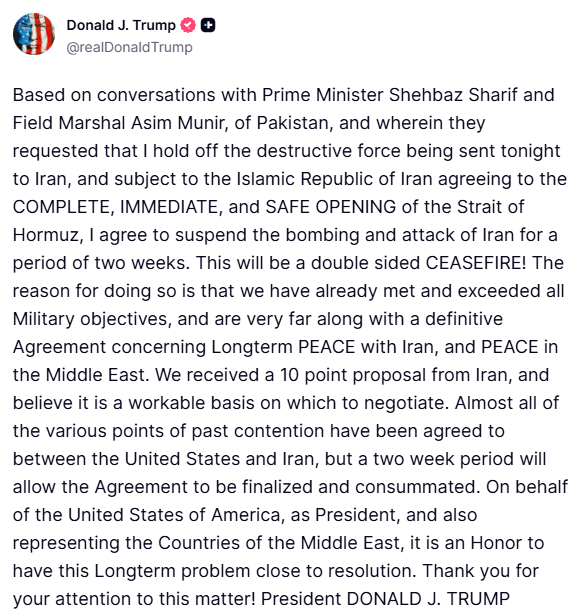
The president said the US had received a 10-point proposal from Iran and described it as "a workable basis on which to negotiate." He said "almost all of the various points of past contention have been agreed to" and that the two-week window would allow a final agreement to be completed.
The announcement came just hours after Trump had warned that "a whole civilisation will die tonight" and threatened to destroy all of Iran's power plants and bridges if Tehran did not reopen the Hormuz strait by 8pm Eastern Time.
Pakistani Prime Minister Shehbaz Sharif had earlier called on Trump to extend the deadline by two weeks, publicly requesting Iran to reopen the strait as a goodwill gesture. A senior Iranian official told local media that Tehran was "positively reviewing" the Pakistani proposal.
Pakistan's army chief, Field Marshal Asim Munir, had been in contact with US Vice President JD Vance, Special Envoy Steve Witkoff and Iranian Foreign Minister Abbas Araghchi as part of an intensive overnight mediation effort.
Iran's ambassador to Pakistan, Reza Amiri Moghadam, announced a "step forward" in negotiations with the United States on April 7, suggesting Pakistani mediation had helped avert an immediate escalation.
"As of now, a step forward from critical, sensitive stage ... In the next stage, respect and comity should replace rethorics and redundancy. Stay more tuned...," Moghadam wrote on X.
The ambassador had earlier said that "Pakistan's positive and constructive efforts in the framework of goodwill and mediation to end the war are approaching a critical and sensitive stage."
The comments came as US President Donald Trump told Fox News that "intensive negotiations" were under way, though he declined to provide details, hours before his self-imposed deadline for Iran to reopen the Strait of Hormuz or face strikes on power plants and bridges.
The war began on February 28 when the US and Israel launched strikes against Iran, killing Supreme Leader Ali Khamenei among other senior officials. Iran responded by closing the Strait of Hormuz, triggering a global energy crisis that has pushed crude oil past $115 a barrel and US petrol prices up nearly 39% since the start of hostilities.
Follow us online