
Turkey reportedly extends Iranian gas import deal to 2032 as US squeezes Tehran

Turkey has extended its gas import contract with Iran to 2032, Bloomberg reported on November 27, citing unnamed sources.
State importer Botas and the National Iranian Gas Company have reportedly agreed to prolong the contract, which expired in July. The extension has not been announced, and Bloomberg said it was unclear whether the volume of 10bn cubic metres (bcm) a year had changed. Gas has kept flowing since the contract lapsed under provisions that let Turkey take gas it had already paid for.
The deal keeps an export earner alive for Iran as Washington steps up pressure on its energy industry. The US Treasury imposed sanctions on November 20 on people and companies it accused of helping Iran sell oil and move the proceeds, nine months into the unresolved conflict that began with US and Israeli strikes on Iran on February 28.
The extension comes days after Turkey locked in Russian pipeline gas through 2029. Gazprom has renewed Botas' contracts for 21.75 bcm a year for three years on unchanged terms, Russian Deputy Prime Minister Alexander Novak said on November 27. "Gazprom and Botas have already signed the contract. It provides for a three-year extension," Novak told reporters in Istanbul, according to TASS. Energy Minister Alparslan Bayraktar had, however, complained on November 5 that Russian gas was too expensive. "We need to buy gas from Russia. But the simple answer is: It is expensive," he said.
Iran accounted for 13.5% of Turkey's gas imports in 2025, putting it in fourth place behind Russia, Azerbaijan and the US, according to an energy sector report by Turkey's investment office. Ankara has spread its supply, signing long-term LNG deals with Germany's SEFE and Italy's Eni in December 2025, and Bayraktar said in June 2025 that Turkey's existing infrastructure could replace Iranian gas if supplies were disrupted.
Iran's exports to Turkey have held up through the war even as its gas fields were hit. Iranian gas output fell 9% y/y in March-September after strikes damaged processing plants at Assaluyeh that handle gas from the South Pars field, the International Energy Agency (IEA) said in its Global Gas Security Review 2026. Pipeline deliveries to Turkey rose by more than 30% y/y in the first eight months of 2026 and hit a monthly record of 0.9 bcm in May. The agency's 2026 forecast had assumed that piped exports to Turkey would end in the second half of the year.
A line prone to outages
The 2,577 km Tabriz-Ankara pipeline, commissioned in 2001 under a deal signed in 1996, runs from northwest Iran through Erzurum to the Turkish capital, entering Turkey at Gurbulak. It can carry 14 bcm a year.
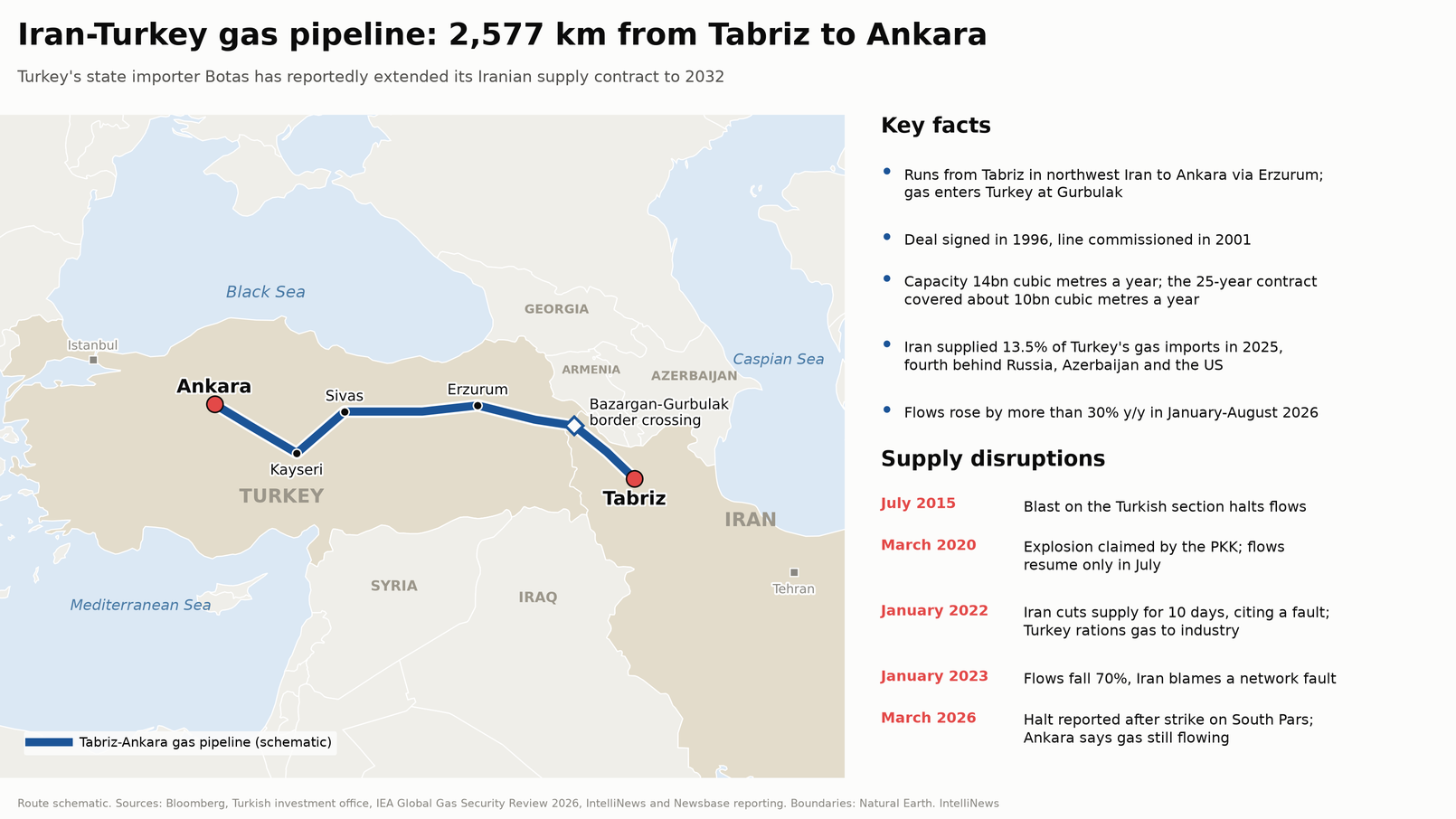
The Tabriz-Ankara gas pipeline, route schematic. Sources: Bloomberg, Turkish investment office, IEA, IntelliNews and Newsbase reporting. Boundaries: Natural Earth. IntelliNews
It has also been one of Turkey's less reliable supply routes. Flows were interrupted around a dozen times between 2001 and 2020, often by blasts blamed on the outlawed Kurdistan Workers' Party (PKK). An explosion near the border in March 2020 halted exports for three months.
In January 2022, Iran cut supply for 10 days, citing a technical fault, and Ankara imposed power cuts on industry. A Turkish delegation concluded that Tehran had diverted the gas to cover its own winter shortfall. A year later flows fell 70% as Iran again blamed a network fault.
When Bloomberg reported in March this year that Iran had frozen deliveries after an Israeli strike on South Pars, Bayraktar denied it. "Iran gas flows to Turkey continue. Our storage facilities are currently 71% full," he said on March 24.
A separate arrangement to bring Turkmen gas to Turkey through Iran's network has stopped for good over US sanctions concerns, Bayraktar said in November.
Follow us online