
US 'signals imminent Iran strike to allies' but traders don't believe war coming, claims expert
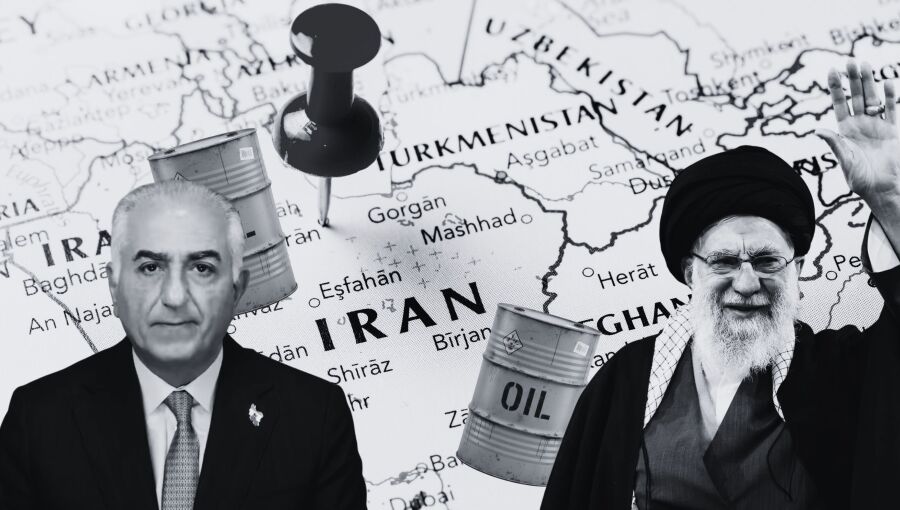
The United States has informed Iraq, Jordan, Saudi Arabia and the United Arab Emirates of an impending attack on Iran, according to Russian analyst Evgeny Ogorodnikov, though oil markets remain sanguine about the prospect of major escalation despite the risk to approximately 5% of global production.
"The Americans have notified Iraq, Jordan, Saudi Arabia, and the UAE about the imminent start of an attack on Iran," Ogorodnikov wrote on his Grafonomika channel on January 25, without providing details on the timing or scope of potential military action.
Despite what he described as "looming clouds over Iran," global oil markets do not anticipate serious escalation, the collapse of the clerical regime, or subsequent civil war in the Islamic Republic. Prices remain well below $100 per barrel despite the potential disappearance of Iran's 3.5mn barrels per day of exports, representing approximately 5% of global production, or perhaps even more according to some estimates.
"Otherwise, oil prices would be much higher - closer to the coveted price of $100 per barrel," Ogorodnikov wrote. "After all, the risk of 3.5mn barrels per day, or 5% of global production, disappearing from the market is significant. This is roughly the same share of Iran's global oil exports, perhaps even more."
The analyst noted that armed conflict in Iran would create oil production problems in neighbouring Iraq as well. Iran supplies fuel oil and gas for local power generation in Iraq. In the worst-case scenario of the closure of the Strait of Hormuz, drones could also attack oil and gas fields in Qatar, Saudi Arabia, the UAE and other Gulf states.
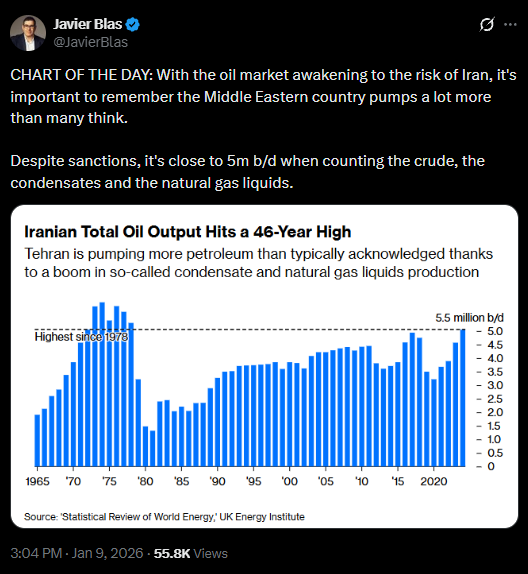
Ogorodnikov described the oil production data for Iran from the Energy Institute, also shared by Bloomberg writer Javier Blas above, which he characterised as revealing about Washington's motivations. Blas himself raised eyebrows with the January 9 X social media post, writing, "It's important to remember the Middle Eastern country pumps a lot more than many think."
The Russian analyst said of the data: "Judging by the volumes of oil produced in the country, Iran was able to bypass not only US and European sanctions, but also those of the UN Security Council, reaching a new record in 2024 in almost half a century," he wrote. Iran has, in the past decade, used a fleet of shadow tankers across the world to shift the black stuff, most recently coming into the headlines with the US seizure of the freshly reflagged Russian tanker running away from Venezuela. Those in the industry understood the tanker to actually be one of Iran's large shadow fleet.
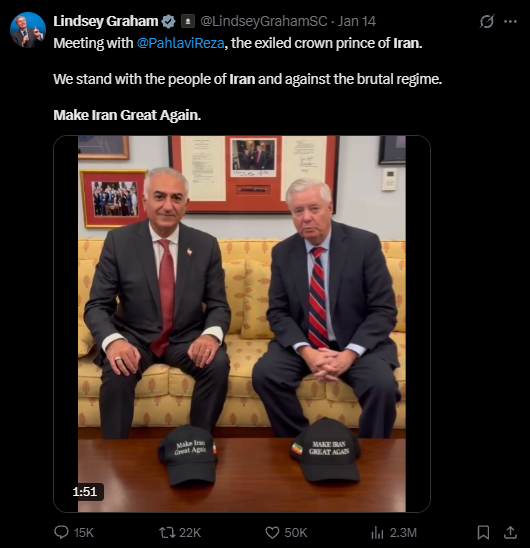
The analyst suggested this success explains "why Uncle Sam suddenly decided to 'make Iran great again'," with previous neocon warhawks like Lindsey Graham becoming recently obsessed with the former crown prince of Iran's push to topple the Islamic Republic (see tweet below). Also, note the baseball caps.
The Russian analyst appeared to sweep under the rug thousands of deaths in recent protests across Iran, with the exact figure currently unknown from two weeks of battles between security agents belonging to the state and protestors. The Pezeshkian administration said more than 3,000 souls had perished in recent clashes, while exiled organisations have placed the death toll above 20,000.
He noted that record-breaking oil production in Iran benefits multiple parties: the Islamic Revolutionary Guard Corps (IRGC), "the ayatollahs", Emirati Arabs, Malaysian oil traders, and even the Chinese. "But not American oil and gas companies," he wrote. "The latter are suffering losses on their shale, Canadian sands, and soon also on Venezuelan asphalts."
"And if you look at this situation from across the Atlantic, it seems extremely unfair. And any injustice in the world needs to be corrected," Ogorodnikov added.
The analyst highlighted a paradox in Iran's situation, noting that record oil production coincided with the country's most acute economic crisis, marked by double-digit inflation and a sharp devaluation of the rial. "And it seems that this is illogical, which means that all the money was stolen by the bloody Iranian regime of the Ayatollahs," he wrote with a strikethrough.
However, Ogorodnikov provided calculations showing structural economic constraints regardless of governance. Iran is a densely populated country of more than 90mn people. Its record production last year of 3.5mn barrels per day (bpd) equals only 22 barrels per resident annually. At an average Brent oil price of $69 per barrel, this translates to $1,500 of oil revenue per Iranian per year.
"Part of the oil is consumed in Iran, and part goes for export. From the export, we need to subtract the sanctions discounts, the services of the 'shadow fleet', the intermediary UAE and Malaysia," he wrote. "And in the end, if one Iranian gets $50 of export revenue per month, this is an excellent result."
The analyst drew comparisons to demonstrate Iran's relative position. Less oil is produced per Iranian than per Russian, at 26 barrels per Russian resident annually. "To understand the scale of the lag between Iran and Russia: in Saudi Arabia, 96 barrels of oil are produced per resident per year," Ogorodnikov wrote.
"In other words, even the record Iranian oil production does not allow locals to live off the oil rent, no matter who is in power: the Ayatollahs, Iranian Shahs, American curators, etc," he concluded.
Ogorodnikov's claims about the US notification to Persian Gulf allies could not be independently verified by bne IntelliNews. Neither the Pentagon nor Persian Gulf Arab governments have publicly confirmed receiving such notifications about imminent military action against Iran. Intelligence reports of military activity in the Gulf and across the Middle East confirm the largest military build-up since the Iraq War in 2003.
Follow us online