


World electricity output triples since 1985 as Asia supplies three-quarters of the growth - OWID

The world generated three times as much electricity in 2024 as in 1985, with three-quarters of the increase coming from Asia, Our World in Data (OWID) said.
Global generation rose from about 9,900 terawatt-hours (TWh) in 1985 to 30,930 TWh in 2024, and reached 31,772 TWh in 2025, according to OWID's compilation of Ember and Energy Institute data. Asia's output climbed from 2,009 TWh to 18,015 TWh over the same period, accounting for about 16,000 TWh of a 21,000 TWh rise.
Population growth explains only part of the shift. More Asians gained access to power and used more of it: fewer than half of South Asians had basic electricity in the early 1990s, and access is now almost universal, according to OWID researcher Hannah Ritchie. Generation per person in Asia rose almost 450% to 3,749 kilowatt-hours (kWh) a year, while outside Asia it has barely changed, so the global figure has not quite doubled, to 3,790 kWh.
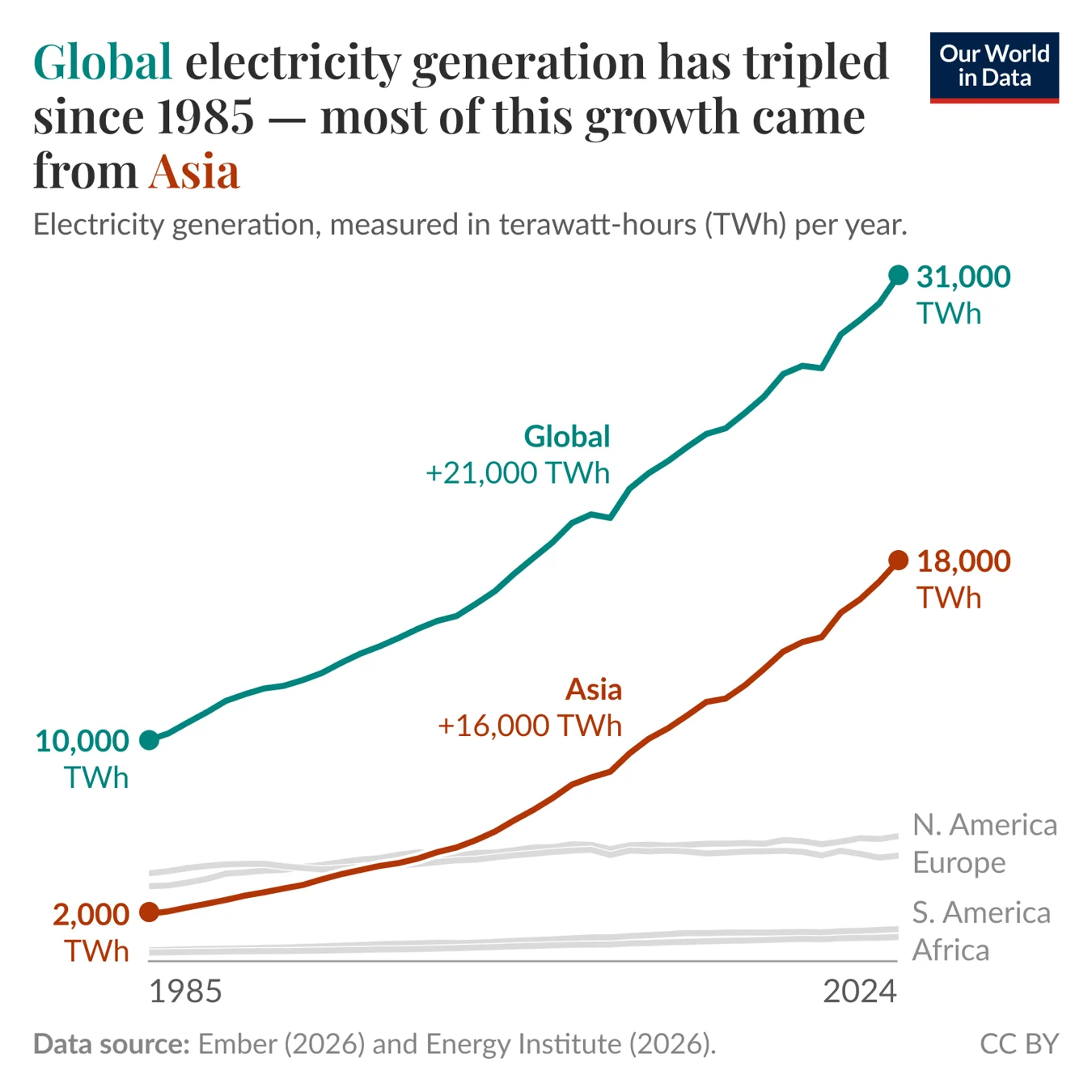
Global and regional electricity generation, TWh a year, 1985-2024. Source: Our World in Data (CC BY), Ember, Energy Institute.
China did most of the lifting. Its generation rose from 411 TWh in 1985 to 10,087 TWh in 2024, a 25-fold increase that on its own accounts for almost half of the world's extra output. Per person, China produced 7,107 kWh in 2024, more than the EU-27 average of 6,159 kWh and Germany's 5,866 kWh, the per-head data show. In 1985 a Chinese citizen had 388 kWh, less than a tenth of the EU level. The build-out of coal, solar, wind and grid capacity behind those numbers has turned China into the first electrostate.
Europe went the other way. Total European generation rose only 21% in four decades, and Germany's output per person is lower than it was in 1985, when it stood at 6,711 kWh.
Russia generated 8,350 kWh per person in 2024, above its 1985 level of 6,701 kWh after a collapse to 5,983 kWh in 2000, and above every EU country average shown here. Kazakhstan was at 5,755 kWh. Uzbekistan is one of the few countries producing less per head than in 1985, 2,241 kWh against 2,682 kWh, as its population has grown faster than its power plants.
Several emerging markets have caught up fast. Turkey's output per person rose almost six-fold to 3,901 kWh, Iran's to 4,322 kWh from 785 kWh, and Vietnam's to 3,006 kWh from just 86 kWh. South Korea went from 1,523 kWh to 12,092 kWh, close to the US level of 12,712 kWh.
India and Africa are still far behind. India's generation per person rose almost six-fold to 1,404 kWh but remains below 40% of the world average. Africa's rose to only 635 kWh from 463 kWh, and Nigeria, the continent's most populous country, generated 161 kWh per person in 2024, about one-twentieth of the global average.
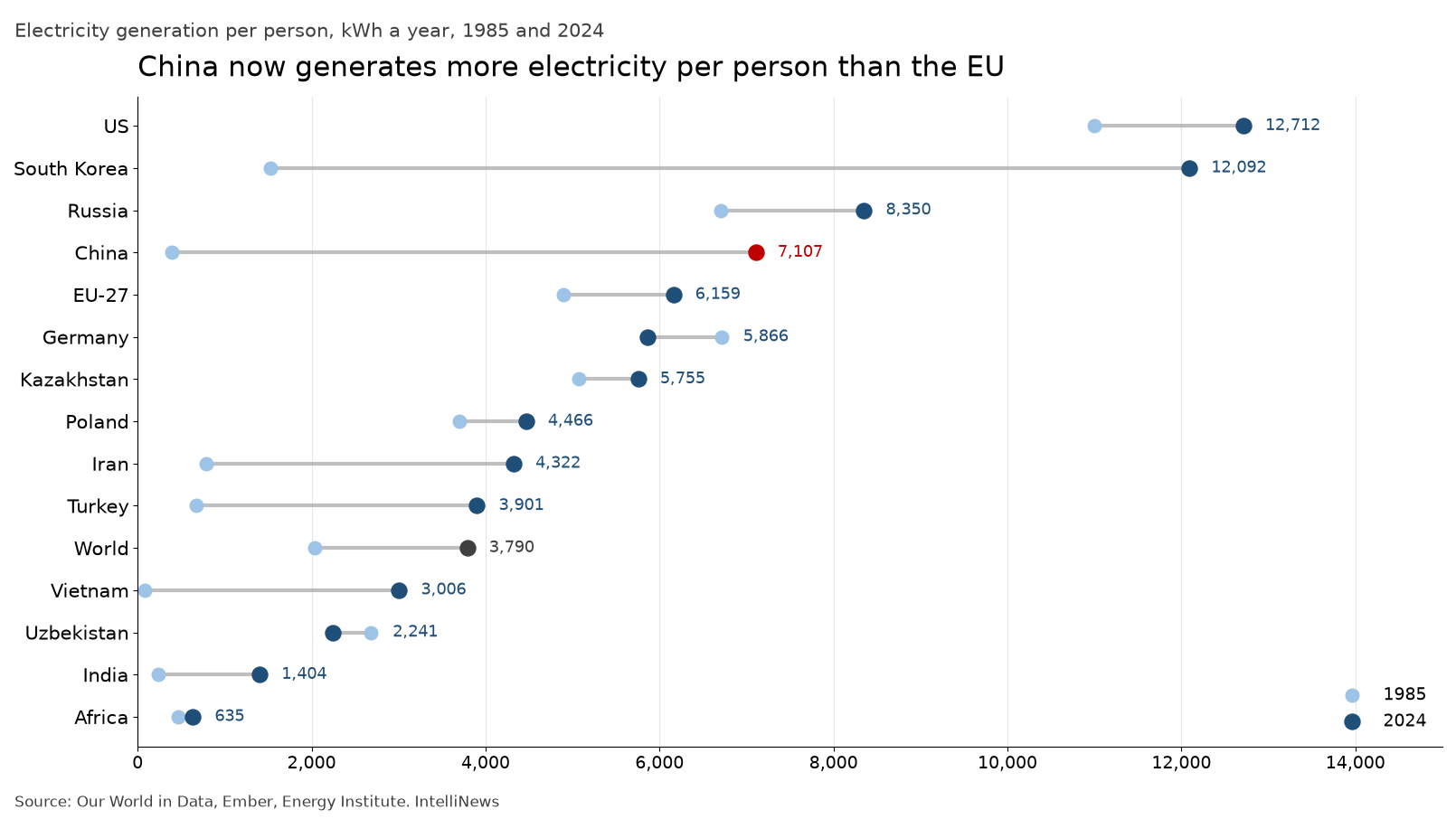
Electricity generation per person, kWh a year, 1985 and 2024, selected countries and regions. Source: Our World in Data, Ember, Energy Institute. IntelliNews
This article was produced with the help of the IntelliNews Lambda analytical tool
Follow us online